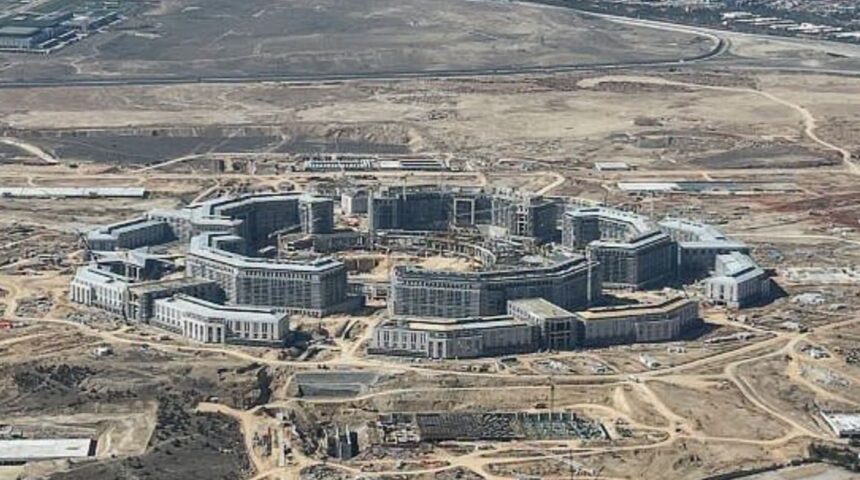
From Ankara to Cairo, a quiet but profound transformation is reshaping the military landscape of the Middle East, where the true measure of military power is no longer defined solely by the number of fighter jets, tanks, or ballistic missiles a nation possesses, but increasingly by its ability to collect intelligence in real time, process vast amounts of battlefield data, make rapid strategic decisions, and seamlessly coordinate land, naval, air, cyber, and space operations under a unified command structure. Reflecting this shift, Türkiye is developing its next-generation Joint Force Headquarters, Ay Yıldız (Moon Star), while Egypt has established The Octagon, one of the world’s largest and most sophisticated military command complexes near Cairo. Defense analysts describe these projects not merely as headquarters, but as strategic nerve centers designed for the era of network-centric warfare, integrating advanced command-and-control systems, artificial intelligence, secure communications, intelligence fusion, and multi-domain operational planning into a single command architecture. As modern conflicts become increasingly dependent on information superiority and decision-making speed, these facilities are intended to provide commanders with a decisive operational advantage by enabling synchronized responses across every military domain. Experts argue that the regional military competition is rapidly evolving beyond conventional arms acquisitions toward technological superiority, digital command infrastructure, cyber resilience, intelligence integration, and joint-force interoperability. This emerging trend has the potential to redefine the balance of power across the Middle East, where strategic influence may increasingly depend not only on military hardware but also on the sophistication of command networks and the ability to execute complex operations with precision and speed. Nevertheless, defense specialists caution that advanced infrastructure alone cannot guarantee military effectiveness; its true value will ultimately depend on highly trained personnel, reliable intelligence, resilient communication systems, continuous technological innovation, realistic operational training, and coherent political and military leadership. The parallel development of Türkiye’s Ay Yıldız and Egypt’s The Octagon therefore represents far more than ambitious construction projects—it signals the emergence of a new strategic era in which command technology, information dominance, and integrated decision-making are becoming the defining pillars of military power in the twenty-first century.
Turkey’s ‘Ay Yildiz’ and Egypt’s ‘Octagon’: The future of war is changing