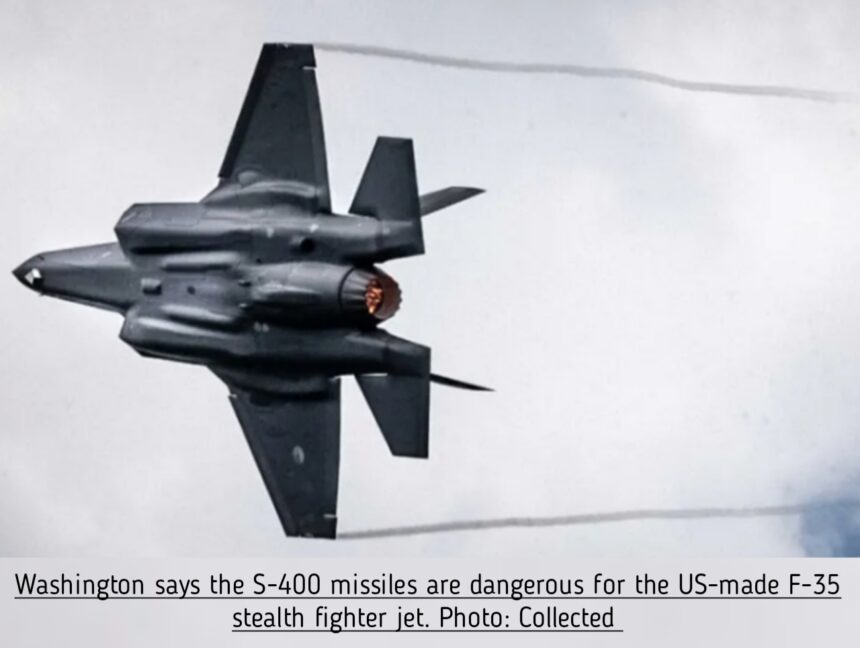
Türkiye is once again exploring ways to rejoin the U.S.-led F-35 Lightning II fighter jet program, signaling a potentially significant shift in its defense policy after years of strained relations with Washington. According to recent reports, Ankara is examining options to remove or otherwise resolve the issue surrounding its Russian-made S-400 Triumf air defense system and has reportedly sought Moscow’s consent regarding possible arrangements. The move reflects Türkiye’s broader effort to rebuild strategic defense cooperation with the United States while maintaining a delicate balance in its relations with Russia.
The dispute dates back to 2019, when Türkiye received the S-400 missile defense system from Russia despite repeated warnings from the United States and other NATO allies. Washington argued that operating the advanced Russian system alongside the F-35 could expose sensitive stealth technology and intelligence capabilities, posing an unacceptable security risk to the alliance. As a result, the United States removed Türkiye from the multinational F-35 program, halted deliveries of aircraft intended for the Turkish Air Force, and later imposed sanctions under the Countering America’s Adversaries Through Sanctions Act (CAATSA).
For Türkiye, returning to the F-35 program would significantly strengthen its long-term air combat capabilities and enhance interoperability with NATO forces. The fifth-generation stealth fighter remains one of the world’s most advanced combat aircraft, offering superior stealth, sensor fusion, and network-centric warfare capabilities. Rejoining the program would also provide economic benefits for Türkiye’s defense industry, which previously participated in manufacturing numerous F-35 components before its removal from the project.
However, resolving the S-400 issue is expected to be extremely challenging. Any proposal involving the storage, transfer, or deactivation of the Russian-made system would likely require Moscow’s approval, given contractual and strategic considerations. At the same time, strong opposition remains within the U.S. Congress, where many lawmakers continue to view Türkiye’s acquisition of the S-400 as incompatible with NATO’s collective security interests. Congressional approval would likely be necessary before any meaningful progress could be made toward restoring Türkiye’s participation in the F-35 program.
The evolving situation highlights the complex geopolitical position Türkiye occupies between East and West. As a key NATO member with growing regional influence and ongoing strategic ties with Russia, Ankara continues to pursue a foreign policy aimed at balancing multiple security interests. Whether this renewed effort ultimately leads to Türkiye’s return to the F-35 program will depend on difficult negotiations involving Washington, Moscow, NATO allies, and domestic political considerations on all sides.
If the S-400 dispute can be resolved through a mutually acceptable arrangement, it could mark a major turning point in U.S.-Türkiye defense relations and reshape the security landscape of the Eastern Mediterranean and the wider NATO alliance. For now, however, significant diplomatic, legal, and political obstacles remain before any agreement can become a reality.
Türkiye wants to return to the F-35 program after overcoming the S-400 deadlock, is Ankara-Washington defense relations at a new turning point?