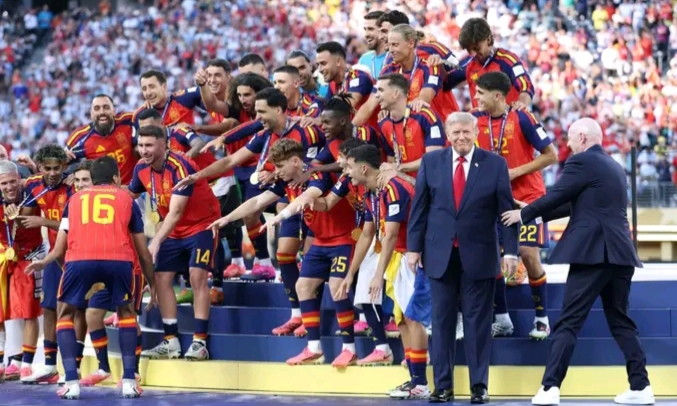
The celebrations following the FIFA World Cup final were expected to belong entirely to the newly crowned champions, with players, coaches and supporters marking one of football’s greatest achievements. Instead, part of the global conversation shifted toward U.S. President Donald Trump, whose prominent presence during the trophy presentation and post-match celebrations reignited a familiar debate over the intersection of politics, leadership and sport. Images and videos of Trump remaining alongside the victorious players circulated rapidly across social media and international news platforms, prompting contrasting reactions from supporters and critics alike and once again placing the American president at the center of a sporting occasion.
For many observers, the episode was not unprecedented. Throughout Trump’s political career, championship celebrations and major sporting events have repeatedly become stages for broader political discussions. During his first presidential term, several championship teams declined White House invitations over political disagreements, while Trump’s criticism of athlete protests during the U.S. national anthem fueled a wider national debate over patriotism, free expression and the role of athletes in political discourse. Those controversies established a pattern in which sporting occasions involving Trump often attracted attention well beyond the games themselves.
The World Cup trophy ceremony has now become the latest example. While FIFA’s post-match celebrations traditionally focus on players lifting the trophy with teammates and coaching staff, Trump’s continued presence on the podium drew significant public attention. Supporters argued that, as president of the tournament’s host nation, his participation reflected the country’s role in staging one of the world’s largest sporting events. Critics, however, questioned whether the spotlight should have remained exclusively on the athletes whose performances defined the tournament.
Political analysts note that global sporting events increasingly serve not only as athletic competitions but also as platforms for diplomacy, national branding and international influence. Every appearance by a head of state during events such as the FIFA World Cup is carefully scrutinized, with gestures, body language and public interactions often carrying symbolic significance far beyond the ceremony itself. In Trump’s case, whose presidency has consistently generated deeply polarized public opinion, even routine appearances tend to become politically charged moments.
The reaction following the final reflected those divisions. Online discussions ranged from praise for Trump’s visibility as a representative of the host nation to criticism that his presence distracted from the players’ historic achievement. Commentators also pointed out that modern sporting ceremonies are broadcast instantly to billions of viewers worldwide, meaning even brief moments involving political leaders can quickly become defining images of an event.
The episode highlights the increasingly blurred boundaries between politics and global sport. International tournaments have long been used to project national prestige and diplomatic influence, but they also provide opportunities for political figures to command worldwide attention. As a result, celebrations intended solely for athletes can evolve into broader conversations about leadership, symbolism and public perception.
Whether viewed as an appropriate presidential appearance or an unnecessary intrusion into a team’s moment of triumph, Trump’s role during the World Cup celebrations has once again demonstrated how major sporting events can become arenas for political debate. The final will be remembered not only for crowning a new world champion, but also for reviving longstanding questions about the place of political leaders in moments designed to celebrate athletic excellence.
Trump did not leave the stage after presenting the trophy, social media is full of criticism