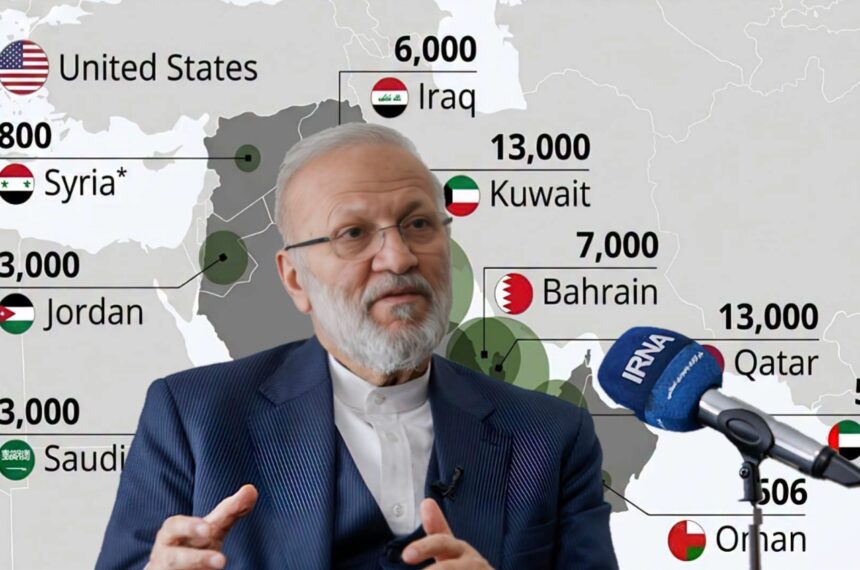
A senior Iranian politician has issued one of the strongest public statements yet against Jordan and six Persian Gulf countries, accusing them of facilitating military operations against Iran by allowing their land, airspace and territorial waters to be used by what he described as “aggressor” forces. The remarks, made by Manouchehr Mottaki, a member of Iran’s Parliament representing Tehran, Rey, Shemiranat, Islamshahr and Pardis and a former Iranian foreign minister, come amid heightened regional tensions following the latest escalation involving Iran, the United States and Israel.
In a statement circulated by Iranian media and on social media platforms, Mottaki alleged that Jordan and the Gulf states had provided logistical support to military operations that resulted in the deaths of Iran’s leader and a large number of Iranian citizens. Citing United Nations General Assembly Resolution 3314, adopted in 1974, he argued that a state which permits its territory, airspace or territorial waters to be used by another country for an act of aggression may itself be regarded as participating in that aggression.
Based on that interpretation, Mottaki called on the Islamic Republic to officially designate Jordan and the six Gulf states as “enemy states,” claiming they had become parties to the aggression against Iran. He further asserted that, should such a declaration be made, not only US military bases located within those countries but also their territories, officials and centres of power could be considered “legitimate targets.” He also warned that the leaders of the Gulf states should not assume there would be any safe refuge from potential retaliation.
The comments have drawn attention across the region because they significantly expand the scope of potential confrontation beyond Iran’s traditional adversaries. Analysts say the remarks reflect growing frustration among some hardline political figures in Tehran over the perceived role of neighbouring states in supporting US and allied military operations. However, Mottaki’s comments do not, by themselves, constitute official Iranian government policy.
Regional observers note that the statement comes at a particularly sensitive moment, with military exchanges between Iran and the United States continuing to intensify and concerns mounting over the possibility of a broader regional conflict. Several Gulf countries host American military facilities under longstanding bilateral defence agreements, making them strategically important to US operations in the Middle East.
At the time of writing, neither Jordan nor the Gulf states mentioned in Mottaki’s remarks had publicly responded to his allegations. Likewise, Iranian authorities had not announced any official policy adopting his proposal to designate those countries as hostile states.
International law experts caution that while UN General Assembly Resolution 3314 provides a widely recognised definition of aggression, determining whether a state has committed aggression is a complex legal and political matter that depends on the specific facts and international legal processes. They also note that statements by individual politicians do not automatically reflect a state’s official legal position or military policy.
The latest comments are nevertheless expected to add further strain to an already volatile regional environment, where diplomatic relations remain fragile and military tensions continue to rise. With the Persian Gulf remaining one of the world’s most strategically important energy corridors, any further deterioration in relations between Iran and its Arab neighbours could have significant implications for regional security, global energy markets and international diplomatic efforts to prevent a wider conflict.
Gulf countries were involved in aggression – explosive allegation by former Iranian foreign minister