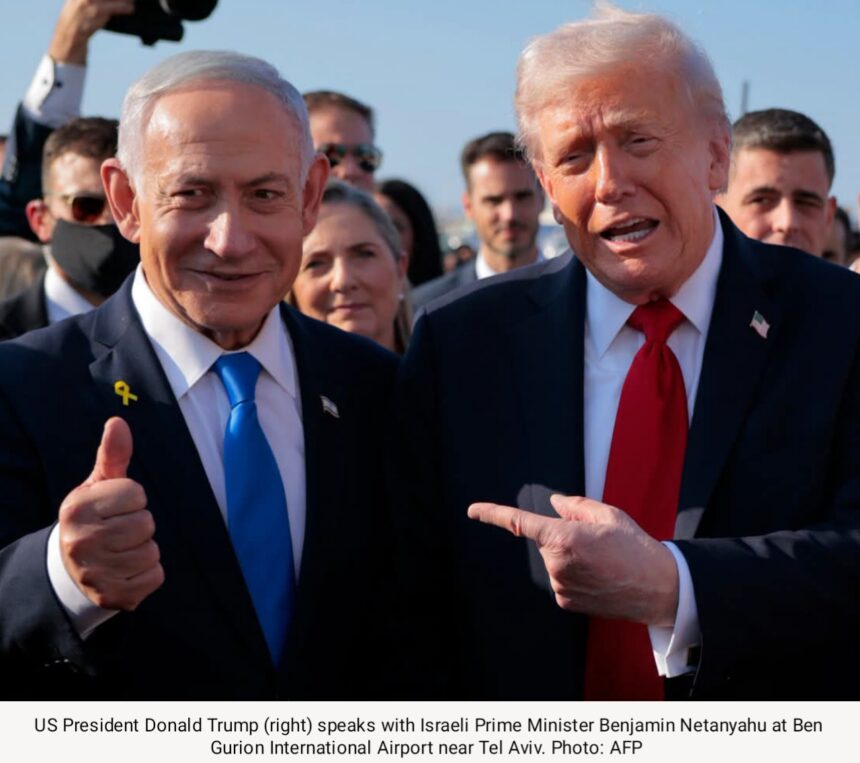
Israeli Prime Minister Benjamin Netanyahu has rejected a 15-point US-backed roadmap for ending the war in Gaza, insisting that Israeli forces will not withdraw from the territory until Hamas has been “genuinely disarmed”, a position that threatens to derail Washington’s latest effort to establish a lasting ceasefire and a framework for post-war governance. Speaking at a cabinet meeting, Netanyahu said Israel would not accept what he described as a merely symbolic or incomplete disarmament of Hamas, making clear that the surrender of the group’s weapons must precede any significant Israeli military withdrawal. “Israel rejects the 15-point document,” Netanyahu said, while acknowledging that discussions with Washington were continuing and that some elements of the proposal were acceptable to Israel while others were not. His remarks have exposed a major disagreement between the Israeli government and the administration of US President Donald Trump over the sequencing of the proposed ceasefire framework, particularly over whether Israeli forces should begin withdrawing as Hamas disarms or remain in Gaza until the group has completely surrendered its military capabilities. The US-backed plan, proposed on July 30 by the Board of Peace, sets out a phased roadmap for Gaza involving Hamas disarmament, an Israeli military withdrawal, the establishment of a Palestinian governing body and the deployment of an international security force. Under the framework, Hamas and other armed groups would surrender their weapons while Israel would withdraw its forces in stages as the disarmament process advances. Governance of Gaza would eventually be transferred to an independent Palestinian National Committee, with international support for security and reconstruction. The proposal is intended to provide a structured pathway from war to political transition and reconstruction in the devastated coastal enclave, but its implementation depends heavily on mutual commitments by Israel and Hamas. Hamas has previously indicated that its implementation of any agreement would depend on Israel fulfilling its own obligations, including ending military operations and withdrawing its forces. Israel, however, has increasingly emphasized that the complete elimination of Hamas’s military capabilities must come first. Netanyahu’s latest declaration therefore threatens to create a deadlock at the heart of the US initiative. If Israel refuses to withdraw until Hamas is fully disarmed, while Hamas refuses to surrender its weapons without firm guarantees of an Israeli withdrawal and an end to hostilities, the proposed sequence could become impossible to implement. The dispute comes at a politically sensitive moment for Netanyahu, who is expected to face a difficult national election later this year. With his right-wing political base demanding a hard line against Hamas, Netanyahu has faced growing domestic pressure over any proposal that could be interpreted as allowing the group to retain military capabilities or granting Palestinians political concessions. Israeli analysts have therefore linked his rejection of the plan to both security concerns and the country’s increasingly contentious domestic political environment. Former Israeli diplomat Alon Pinkas argued that Netanyahu’s decision should be viewed largely through the lens of the upcoming election, suggesting that maintaining a prolonged confrontation could carry fewer political risks for the prime minister than accepting a deal that could anger his coalition partners and supporters. Other Israeli analysts have taken a more critical view of the rejection, arguing that an agreement leading to Hamas disarmament and an end to the humanitarian crisis should be considered an opportunity rather than a threat. Dan Perry, a former Associated Press chief in Europe, Africa and the Middle East, said Israeli security requirements and the humanitarian needs of Palestinians should not necessarily be treated as mutually exclusive objectives. The disagreement also reflects a much broader dispute over what Gaza should look like after the war. For Israel, the central issue remains preventing Hamas from retaining the ability to launch attacks against Israeli territory. For Palestinians, the priority is an end to Israeli military operations, the withdrawal of Israeli forces, the restoration of basic services and the establishment of a political system capable of representing Palestinian interests. The proposed international security force and Palestinian National Committee were designed to bridge some of those competing demands, but the Israeli rejection has raised doubts over whether the proposed transition can begin at all. Palestinians in Gaza have expressed deep concern that the failure of the latest initiative could prolong an already devastating conflict. Years of fighting have destroyed large parts of the enclave’s housing, health, water and civilian infrastructure, while repeated military operations have created widespread displacement and a severe humanitarian crisis. Any collapse of the diplomatic process could therefore have consequences far beyond the political dispute between Washington and Jerusalem. Palestinian political analyst and former adviser to the Palestinian negotiating team Xavier Abu Eid has argued that the broader US-backed framework has placed greater emphasis on Israeli security interests than on Palestinian self-determination and political rights. His criticism reflects a wider Palestinian concern that discussions about Gaza’s future have focused heavily on disarmament and security while leaving questions of sovereignty, accountability and Palestinian political representation unresolved. The United States now faces a difficult diplomatic challenge. Trump’s administration must attempt to reconcile Israel’s demand for complete Hamas disarmament with the Palestinian demand for a credible Israeli withdrawal and a permanent end to military operations. Washington must also determine whether it is prepared to exert meaningful political pressure on Netanyahu if Israel continues to reject key elements of the framework. The issue is particularly sensitive because the United States remains Israel’s principal international ally, while Trump has presented his Gaza initiative as a major diplomatic breakthrough. A failure of the plan could therefore represent not only a setback for the Gaza ceasefire process but also a significant test of the Trump administration’s ability to influence Israeli decision-making. The Board of Peace has previously argued that an Israeli withdrawal from Gaza would only take place after Hamas’s disarmament is completed, reinforcing the centrality of the issue. But without a mutually agreed timetable and verification mechanism, the disarmament process could become open-ended, leaving Israeli troops in Gaza indefinitely and undermining Palestinian confidence in the proposed transition. Hamas, meanwhile, faces its own strategic dilemma. Agreeing to surrender its weapons could weaken its military and political leverage, while refusing to disarm could provide Israel with a justification to maintain its military presence. The group therefore faces pressure to balance its demand for an Israeli withdrawal and an end to the war against the possibility of losing its armed capabilities. The coming weeks are likely to determine whether Washington can bridge these differences or whether the latest ceasefire initiative will join previous attempts that failed to produce a lasting settlement. At stake is not simply the implementation of a 15-point document, but the broader question of whether the Gaza war can finally move from military confrontation to a credible political transition. Netanyahu’s rejection has made clear that Israel is not prepared to accept an Israeli withdrawal without what it considers genuine and verifiable Hamas disarmament. Unless the United States, Israel, Hamas and Palestinian representatives can agree on a sequence that addresses the core security and political concerns of all sides, the proposed roadmap risks becoming another diplomatic framework trapped between incompatible demands. For Gaza’s civilians, the consequences of such a failure could be severe, prolonging uncertainty, displacement and humanitarian suffering while leaving the territory’s political future unresolved. The immediate focus will now turn to Washington and whether Trump chooses to revise the proposal, pressure Netanyahu to reconsider, or seek a new formula capable of breaking the deadlock. The outcome could determine whether the latest US-led initiative becomes a pathway toward a lasting ceasefire and reconstruction—or another missed opportunity to end the conflict.
Netanyahu’s tough stance puts uncertainty in Gaza peace initiative, pressure on Washington grows