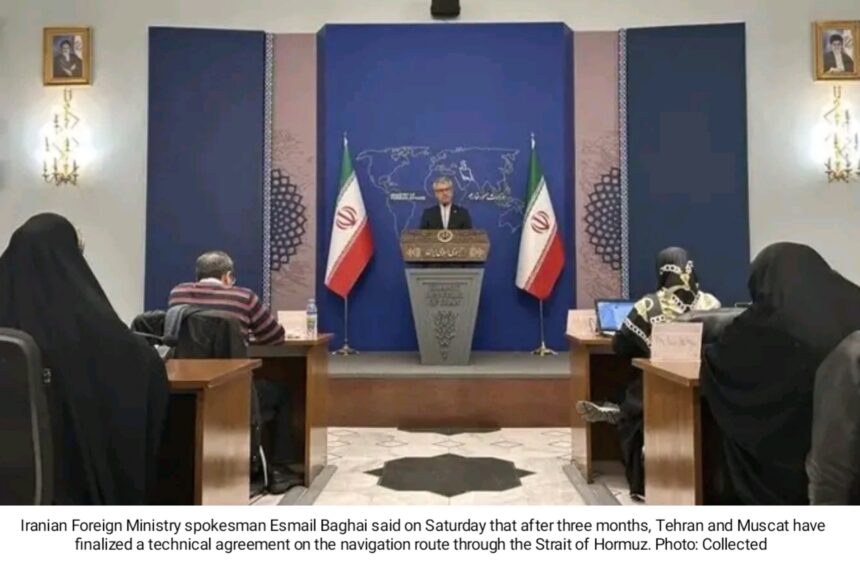
TEHRAN/MUSCAT — Iran and Oman have reached a technical understanding on a navigation route map aimed at making commercial shipping through the strategically vital Strait of Hormuz safer and more orderly, Iranian Foreign Ministry spokesman Esmail Baghaei said. The agreement follows weeks of intensive technical discussions between the two coastal states.
According to Tehran, the arrangement is an independent bilateral initiative designed to establish a clearer and safer navigation corridor for commercial vessels passing through the strait. Baghaei said the agreement was reached following extensive coordination among Iran’s foreign, defense and security agencies.
The move signals Tehran’s continued position that maritime traffic management in the Strait of Hormuz should be addressed through direct consultations among the countries bordering the strategic waterway. Commercial shipping through the strait has declined significantly in recent weeks amid heightened military tensions and a series of security incidents involving vessels.
The proposed navigation map is therefore more than a technical maritime arrangement. It represents a test of whether Iran and Oman can establish a practical framework for commercial shipping while the broader confrontation between Tehran and Washington remains unresolved. Iranian officials have indicated that the bilateral understanding alone cannot guarantee comprehensive maritime security and that conditions in the strait remain closely linked to wider military and political developments.
The Strait of Hormuz is a critical gateway between the Persian Gulf and the Gulf of Oman and one of the world’s most important routes for energy shipments. A prolonged disruption to maritime traffic could have consequences far beyond the Middle East, affecting energy prices, tanker insurance premiums, transportation costs and global supply chains. The recent decline in commercial shipping caused by attacks and threats against vessels has increased pressure on regional governments and international markets.
Iran’s announcement also highlights Oman’s delicate diplomatic position. Muscat has long maintained communication channels with Tehran and played a role in regional mediation efforts. By engaging directly with Iran over navigation routes in the Strait of Hormuz, Oman has placed itself at the center of efforts to prevent the maritime crisis from escalating further.
At the same time, Tehran appears keen to demonstrate that regional arrangements over the strategic waterway can be developed without direct U.S. involvement. However, major obstacles remain. Washington and Tehran continue to disagree over the future of the waterway, the conditions required to restore normal commercial shipping and the broader military confrontation.
Recent incidents involving commercial vessels have also intensified international concerns over freedom of navigation and the safety of ships operating in and around the strait.
For global energy markets, the real significance of the Iran-Oman understanding will depend not on the announcement itself but on whether commercial vessels can actually use the designated route safely and consistently. If implemented effectively, the arrangement could provide a limited framework for reducing maritime risks and rebuilding confidence among shipping operators.
But if military tensions continue to escalate, there is a risk that the new navigation map will remain largely theoretical rather than becoming an effective mechanism for restoring normal maritime traffic.
The latest development therefore leaves the region facing a crucial question: Will the Iran-Oman bilateral navigation understanding become the first practical step toward reopening one of the world’s most strategically important waterways, or will the continuing confrontation between Iran and the United States keep the Strait of Hormuz at the center of a wider geopolitical and global energy crisis?
Sources: Iranian Foreign Ministry; Reuters; Associated Press; Anadolu Agency.
Iran-Oman agreement on navigation in Strait of Hormuz on the way