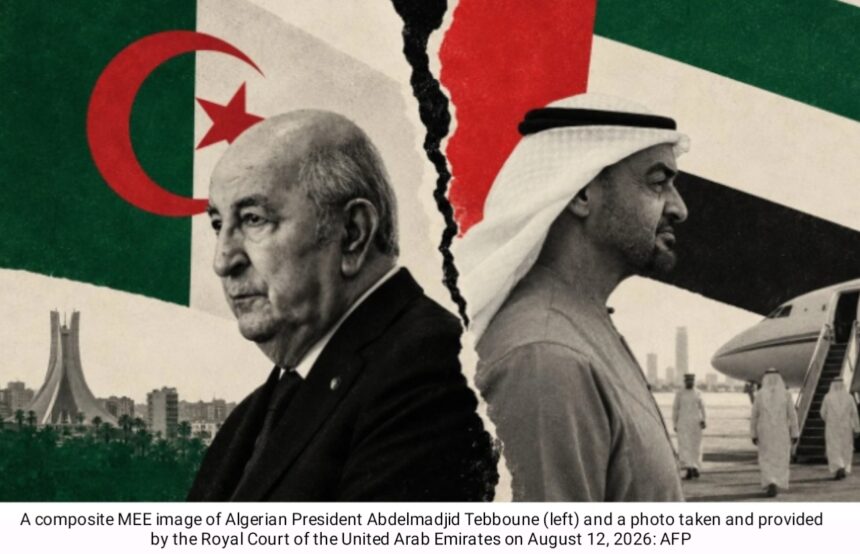
Relations between Algeria and the United Arab Emirates have entered a period of growing tension, with analysts describing the deterioration as the result of months of accumulating disagreements over Abu Dhabi’s regional policies and Algeria’s security concerns. Andreas Krieg, an associate professor of security studies at King’s College London, told Middle East Eye that the significance of the latest rupture lies less in the immediate diplomatic break than in what it reveals about how Algiers now views the UAE’s role across the region. According to Krieg, Algerian authorities have increasingly concluded that the UAE’s regional strategy, which he described as building an “axis of secessionists” through its relationships with actors including Libya’s Khalifa Haftar, Sudan’s Rapid Support Forces and forces linked to the southern movement in Yemen, could eventually have implications for Algeria itself. Tensions had already been building for much of the year. On February 7, Algeria began cancelling its bilateral air-services agreement with the UAE, a move that was widely interpreted by analysts as reflecting broader disagreements over Emirati activities in Algeria’s regional neighbourhood. One of Algiers’ most sensitive concerns has reportedly been the possibility of Emirati contacts with the Movement for the Autonomy of Kabylie, or MAK, which Algeria considers a terrorist organisation and regards as a direct challenge to national unity. The dispute has also been shaped by wider regional issues, including the UAE’s military and political involvement in Libya and the Sahel and its position toward Morocco over the Western Sahara dispute, a particularly sensitive issue for Algeria. Earlier this year, after the UAE announced its withdrawal from OPEC, Algerian President Abdelmadjid Tebboune publicly played down the significance of the move and said that Saudi Arabia remained the main pillar of OPEC, while declaring that, regarding the UAE, “the book is closed.” Krieg said the wording used by Algeria’s foreign ministry was significant because it referred to the decision being taken after all efforts to preserve the relationship had been exhausted, without identifying a single triggering incident. In his assessment, the language reflected a broader accumulation of disputes rather than one isolated confrontation. The growing rift between Algiers and Abu Dhabi therefore extends beyond a bilateral diplomatic disagreement and is closely linked to competing approaches to security and political influence across North Africa, the Sahel and the wider Arab region. The deterioration also highlights how regional rivalries surrounding Libya, Sudan, Yemen and Western Sahara are increasingly affecting relations between Arab and North African states, with Algeria becoming more openly resistant to what it sees as external interference in matters connected to its national security and regional interests.
Algeria-UAE relations tough, tensions rise over regional politics