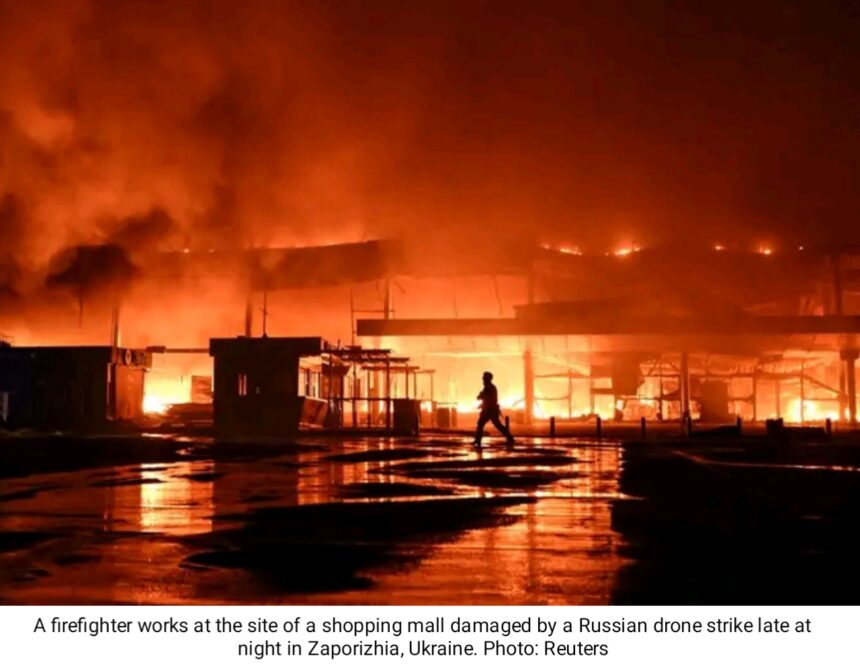
Russia launched a major wave of drone, missile and artillery attacks across Ukraine on Saturday, September 19, killing at least eight people and injuring dozens more, according to Ukrainian regional authorities, while Moscow said its forces had also struck two commercial vessels in the Black Sea. The latest escalation came as fighting continued across several sectors of the front and as both sides maintained intensive long-range attacks against military and infrastructure targets. Ukraine’s Air Force said Russia and forces operating from the annexed Crimean Peninsula launched a total of 174 drones during the overnight assault, alongside two Zircon anti-ship missiles fired from Russia’s Kursk region. Ukrainian authorities said the scale of the aerial attack placed significant pressure on the country’s air-defence network, which was required to respond to incoming threats across multiple locations. According to the Ukrainian Air Force, 141 incoming targets were intercepted or electronically suppressed. The Air Force said successful interceptions were recorded in 15 locations, while falling debris was reported in another nine areas. It also said the two Zircon missiles did not reach their intended targets. The Ukrainian military did not provide evidence in the information available to independently verify every detail of the interception claims, while Russia has continued to maintain that its strikes are directed primarily at military-related targets and infrastructure connected to Ukraine’s war effort. The latest Russian assault nevertheless caused significant civilian casualties and damage in several Ukrainian regions, according to local officials. Kharkiv region was among the areas most severely affected. Governor Oleh Syniehubov said Russian attacks struck 14 settlements, killing five people and injuring 15 others. Heavy destruction was reported in communities including Balakliya and Lypkuvativka. The attacks added to the continuing pressure on Kharkiv region, which has remained one of the major areas exposed to Russian missile, drone and artillery strikes because of its geographical proximity to Russia and its importance to Ukraine’s defensive position in the northeast. Local authorities have repeatedly reported damage to residential areas and civilian infrastructure during the war, while Russian forces have continued to use a combination of drones, missiles and artillery in attacks across the region. In neighbouring Kherson region, the situation was also serious. Governor Oleksandr Prokudin said Russian shelling struck 25 communities and killed three people, while five others were injured. Residential and public infrastructure was damaged, including high-rise apartment buildings, private homes, a communications tower and a gas pipeline. The damage to the gas network and communications infrastructure raised additional concerns for local communities already living under the continuing threat of shelling. Kherson has remained one of the most frequently targeted areas of southern Ukraine, particularly communities located close to the front line and along the Dnipro River. Ukrainian officials have repeatedly reported attacks against both urban and rural settlements in the region, with drones, artillery and other weapons used against areas under Ukrainian control. Dnipropetrovsk region also came under repeated attack during the latest wave. Oleksandr Ganzha, head of the regional administration, said four areas were targeted more than 10 times using drones, artillery and aerial bombs. Two people were reported injured. The strikes damaged a number of civilian and commercial facilities, including warehouses in Dnipro, an outpatient clinic in Pavlohrad and a shopping centre in Nikopol. Homes were also damaged in Kryvyi Rih and Synelnyky. The pattern of attacks demonstrated the broad geographic reach of the latest Russian operation, with Ukrainian authorities reporting strikes in several regions rather than a single concentrated area. The use of large numbers of drones has become a central feature of the war, with both Russia and Ukraine increasingly relying on unmanned systems for long-range attacks, battlefield surveillance and attempts to overwhelm opposing air-defence networks. Ukraine has developed and expanded its own drone capabilities, while Russia has continued to launch large numbers of attack drones against Ukrainian cities and infrastructure. The scale of Saturday’s assault once again highlighted the importance of air-defence systems to Ukraine’s ability to protect population centres and critical infrastructure. Alongside the attacks on Ukrainian territory, Russia’s Defence Ministry said its forces had targeted two commercial vessels in the Black Sea. Moscow claimed that Geran-4 seeker drones were used to strike a Ukrainian dry cargo ship travelling towards Odesa and a tanker that was docked at the port of Odesa. The Russian ministry alleged that both vessels were carrying military supplies. Those claims were not independently verified in the information available, and details about the condition of the vessels and possible casualties were not immediately established. The reported maritime strikes are significant because the Black Sea has become an increasingly important arena in the wider conflict. Commercial shipping, port facilities and maritime infrastructure have repeatedly been affected by the war, creating additional security risks for vessels operating near Ukrainian ports and major sea routes. Odesa remains one of Ukraine’s most important maritime centres and a key gateway for the movement of goods. Any increase in attacks around commercial shipping routes could create additional pressure on Ukraine’s maritime trade and raise concerns among international shipping operators about the risks of operating in the region. The latest developments also prompted a temporary increase in Poland’s military readiness. As Russian forces carried out their large-scale aerial attack against Ukraine, Poland scrambled fighter aircraft and placed its air-defence systems on a heightened state of readiness. Poland’s Operational Command said military aviation operations were launched inside Polish airspace because of the intensity of Russian drone activity in neighbouring Ukraine. The command said it had activated the necessary forces and resources and raised the readiness of ground-based air-defence and radar reconnaissance systems to their highest level. The operation was later concluded, with Polish aircraft and ground-based units returning to normal duties after authorities determined that there had been no violation of Polish airspace. Polish forces nevertheless remained prepared to respond to any further developments and continued monitoring the situation along the border. Poland’s decision reflects the wider security concerns created by the proximity of the Russia-Ukraine war to NATO territory. Since Russia launched its full-scale invasion of Ukraine in February 2022, neighbouring NATO countries have repeatedly monitored their airspace closely during major Russian attacks, particularly when drones or missiles operate near their borders. Although Poland said no violation of its airspace occurred during the latest incident, the deployment of military aircraft demonstrated the precautions being taken to protect national territory during periods of intense fighting close to the alliance’s eastern flank. Meanwhile, Russia’s Defence Ministry said its ground forces were continuing offensive operations at several points along the front line. The ministry claimed that Russian troops had taken more than 5,300 square kilometres of territory during 2026, including approximately 670 square kilometres in September alone. Russia also said its forces were making progress in the direction of Zaporizhzhia and described the approaches to the Kramatorsk-Slovyansk agglomeration as one of the areas experiencing the heaviest fighting. These battlefield claims have not been independently verified from the information available, and territorial assessments in the Russia-Ukraine war are often disputed by the opposing sides. Ukraine has continued to contest Russian claims of battlefield advances and has maintained that its forces are defending positions against Russian attacks across several sectors. The Kramatorsk-Slovyansk area remains strategically significant because of its location in eastern Ukraine and its connection to important Ukrainian defensive positions and transportation routes. Zaporizhzhia is also an important area in the wider war because of its strategic location in southeastern Ukraine and its proximity to territories occupied by Russia. Fighting in these areas has involved artillery, drones, aerial bombs and ground assaults, with both sides attempting to gain tactical advantages while maintaining pressure on opposing positions. The latest Russian attacks therefore unfolded on two interconnected levels: a large-scale campaign of long-range strikes against Ukrainian territory and continued ground operations along the front. The combination places pressure on Ukraine’s air-defence systems, civilian infrastructure, military positions and logistics networks. For civilians, the consequences remain severe. The deaths reported in Kharkiv and Kherson regions brought renewed attention to the continuing risks faced by communities located both near and away from active front-line areas. Even when incoming missiles or drones are intercepted, falling debris can cause damage to buildings, vehicles and infrastructure. Successful air-defence interceptions can therefore reduce the impact of an attack without eliminating the danger entirely. Ukraine’s reliance on air-defence systems has become particularly important as Russia has expanded its use of drones and other long-range weapons. Large drone formations can force defenders to spread their resources across wide areas, while the use of different types of missiles and unmanned systems can complicate efforts to identify and intercept every incoming threat. The reported use of Zircon missiles in the latest attack also drew attention because of the characteristics attributed to the weapon and its role in Russia’s broader missile arsenal. Ukraine’s Air Force said the two missiles did not reach their targets, but the attack demonstrated that Kyiv continues to face a range of aerial threats requiring different defensive responses. The Black Sea dimension of the conflict has also become increasingly important as Russia and Ukraine have expanded their use of drones and other weapons beyond traditional battlefield positions. Commercial vessels operating in the region face risks not only from direct attacks but also from the wider military environment, including mines, missiles, drones and restrictions on maritime movement. Odesa and other Ukrainian ports have remained important to the country’s economy, making the security of shipping routes a major issue during the war. Russia’s claim that the two vessels targeted during the latest incident were carrying military supplies reflects Moscow’s repeated argument that attacks on infrastructure or transport linked to Ukraine’s war effort are legitimate military operations. Ukraine and other parties have frequently disputed Russian descriptions of targets and the circumstances surrounding attacks. Independent verification of individual battlefield and maritime claims remains difficult because of restricted access to conflict zones and the continuing nature of military operations. The latest escalation also comes at a time when the Russia-Ukraine war remains unresolved despite continued international diplomatic efforts and repeated discussions about possible negotiations. The conflict has entered another period in which long-range drone warfare, missile attacks and ground offensives are being conducted simultaneously. Both Moscow and Kyiv continue to seek battlefield advantages while maintaining military pressure on the other side. The intensity of Russia’s latest aerial assault, combined with reported fighting around strategically important areas in eastern and southern Ukraine, indicates that the military dimension of the conflict remains active across a broad front. At the same time, the temporary activation of Poland’s air-defence forces illustrates how developments inside Ukraine can quickly create security concerns for neighbouring NATO members. Although Poland reported no violation of its airspace during Saturday’s operation, the deployment of fighter aircraft and the elevation of radar and air-defence readiness showed the level of caution maintained by countries bordering the war zone. The situation also highlights the continuing risk that an incident involving a missile or drone near NATO territory could generate wider regional tensions, even when no direct violation occurs. For Ukraine, however, the immediate challenge remains the protection of civilians and critical infrastructure while maintaining its military positions against Russian offensive operations. The deaths and injuries reported in Kharkiv and Kherson, together with damage across Dnipropetrovsk region, show the continuing human and material costs of the war. The reported attacks on commercial vessels in the Black Sea add another layer of risk to an already complicated security environment. As Russia continues to claim territorial advances and Ukraine works to defend its positions and cities, the conflict remains marked by rapid technological adaptation, extensive drone use, long-range missile strikes and persistent ground fighting. The latest wave of attacks demonstrates that the war continues to extend beyond the immediate front lines, affecting civilian communities, regional infrastructure, maritime shipping and the security calculations of neighbouring countries. With no comprehensive end to the conflict yet in sight, further attacks involving drones, missiles, artillery and ground forces are likely to remain a central feature of the war as both sides continue military operations across Ukraine and the wider Black Sea region.
Major Russian attacks across Ukraine, 8 killed; claims of attacks on commercial ships in the Black Sea