
Saudi Arabia’s air defence forces intercepted and destroyed a ballistic missile launched by Yemen’s Houthi movement towards the capital, Riyadh, on Saturday, September 19, according to the Saudi-led coalition fighting the group. The incident marked a significant escalation in the renewed confrontation between the Houthis and Saudi Arabia and triggered emergency alerts across parts of the kingdom.
The Saudi-led coalition said the missile was intercepted before it could reach its intended target. Coalition spokesman Major General Turki al-Maliki said Houthi forces had also attempted to target civilians and civilian infrastructure in several other Saudi locations, including Bisha, Taif, Farasan and Yanbu. Saudi air defence systems were reported to have thwarted those attacks as well.
The attack came as fighting between the Houthis and forces aligned with the internationally recognised Yemeni government has intensified after a prolonged period of relative calm. The latest escalation has raised concerns that the conflict could once again spread beyond Yemen’s borders, threatening Saudi cities, energy infrastructure and strategically important shipping routes in the Red Sea and around the Bab el-Mandeb Strait.
Riyadh comes under renewed missile threat
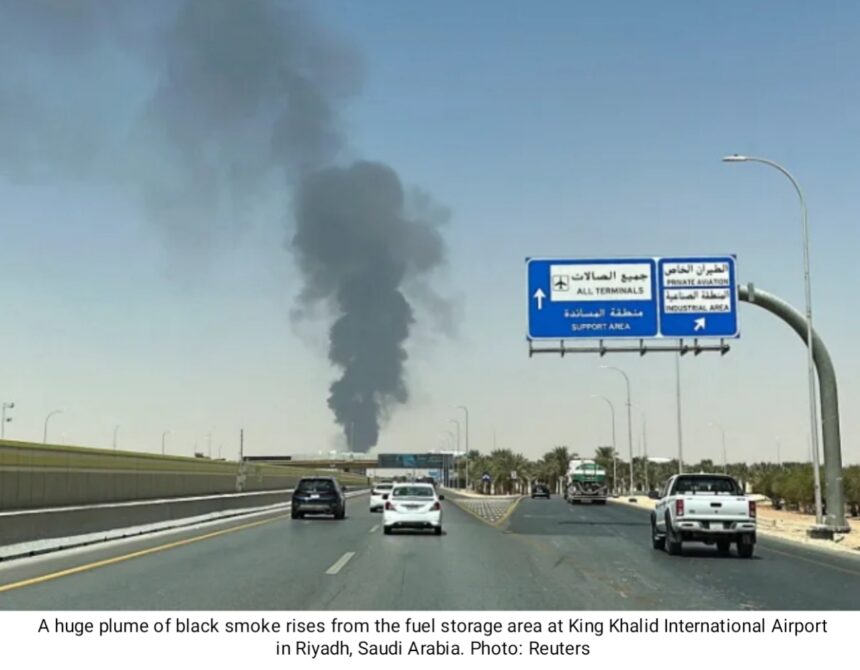
Saudi authorities issued warnings of a “hostile aerial threat” overnight on Friday as the missile and drone attacks unfolded. Residents in Riyadh reported hearing an explosion on Saturday morning, while images and videos circulated showing a large plume of black smoke near the area of King Khalid International Airport.
Saudi authorities said there were no casualties or significant damage in Riyadh from the intercepted missile. Reuters also reported that flames and smoke were visible near the airport following the attacks, although the exact cause and extent of any damage remained subject to official assessment.
The incident was particularly significant because it represented the first air-raid alert in Riyadh since the latest escalation in fighting with the Houthis began in July, according to Al Jazeera. The Saudi capital had previously faced repeated missile and drone threats during the Yemen war, but the renewed attacks come in a substantially changed regional security environment.
The Houthi movement later claimed responsibility for attacks against what it described as “sensitive” sites in Riyadh. Houthi military spokesman Yahya Saree said the group had used ballistic and cruise missiles as well as drones. The Houthis also claimed that an Aramco facility in the western Saudi city of Yanbu was among their targets.
The Saudi side, however, said its air defence systems had successfully prevented the attacks from achieving their intended objectives.
Multiple Saudi locations targeted
The attack on Riyadh was part of a wider series of reported Houthi operations against Saudi territory.
According to the Saudi-led coalition, attempts were also made to strike Bisha, Taif, Farasan and Yanbu. The coalition said the attacks were directed towards civilians and civilian infrastructure but were intercepted or otherwise thwarted by Saudi air defences.
Yanbu is particularly important because of its position on Saudi Arabia’s Red Sea coast and its role in the kingdom’s energy infrastructure. The city contains major oil-processing and export facilities and provides Saudi Arabia with an alternative route for transporting crude and petroleum products to international markets without relying entirely on the Strait of Hormuz.
Any sustained threat to Yanbu or other Saudi energy facilities could therefore have consequences beyond the immediate military confrontation.
Bisha and Taif also occupy important positions within Saudi Arabia. Taif lies relatively close to Mecca and is home to significant military and civilian infrastructure. Farasan, an island group in the Red Sea off Saudi Arabia’s southwestern coast, is located near important maritime routes.
The geographical spread of the reported attacks has increased concern in Riyadh that the renewed conflict may develop into a broader campaign against Saudi territory.
Houthis say attacks are retaliation
The Houthis have presented their attacks as part of a response to Saudi and allied military operations in Yemen.
The movement has accused Saudi Arabia and its partners of conducting attacks against Houthi-controlled areas, including Sanaa. The latest escalation has followed an increase in fighting on the ground inside Yemen, where Houthi forces and Saudi-backed Yemeni government forces have clashed in several provinces.
The Houthis said their latest missile and drone operations were directed at strategic and sensitive targets in Saudi Arabia. Saudi officials have rejected the justification for the attacks and accused the group of deliberately targeting civilians and civilian infrastructure.
These competing claims highlight the broader problem surrounding the Yemen conflict: both sides continue to describe their military operations as defensive or retaliatory, while civilians and critical infrastructure remain exposed to the consequences of the fighting.
Fighting intensifies inside Yemen
The missile attack on Riyadh occurred against the backdrop of renewed fighting inside Yemen.
According to Al Jazeera, clashes have intensified in Marib, Taiz, Lahj, al-Jawf and al-Bayda as part of a military escalation that began in early July. The latest fighting is described as the most serious period of hostilities since the relative calm that followed an April 2022 truce.
Saudi-backed forces said they had also thwarted a Houthi infiltration attempt in southern Marib. The forces claimed that 12 Houthi fighters were killed and others wounded. Separately, the Yemeni army said 13 of its soldiers had been killed during two days of fighting in Taiz and Lahj.
Those battlefield claims have not been independently verified in full.
The renewed ground fighting is important because developments inside Yemen directly affect the security of Saudi Arabia. The Houthis control significant territory in northern and western Yemen, including the capital Sanaa, and possess missile and drone capabilities that allow them to threaten targets far beyond the immediate battlefield.
A difficult military challenge for Saudi Arabia
The renewed attacks present Saudi Arabia with a complex military problem.
Saudi forces possess sophisticated air-defence systems and have repeatedly intercepted missiles and drones launched from Yemen. But defending a large country against repeated attacks requires substantial quantities of interceptor missiles, radar coverage and other defensive resources.
Saudi Arabia is also facing security pressures elsewhere in the region. The wider Middle East has experienced a series of military confrontations and attacks involving Iran, Israel, the United States and armed groups operating across several countries.
This broader environment has increased the importance of Saudi Arabia’s defensive capabilities and raised questions about how Riyadh can protect its cities and critical infrastructure while responding to threats from several directions.
The renewed Houthi campaign also comes at a time when Saudi Arabia is seeking stronger security cooperation with regional partners. Turkey has recently indicated that it could help meet Saudi military requirements under a defence arrangement involving Saudi Arabia, Pakistan and Turkey.
The development reflects Riyadh’s broader effort to strengthen its security partnerships as regional threats become more interconnected.
The Red Sea dimension
The latest escalation also has implications for maritime security.
The Houthis have previously attacked commercial shipping in the Red Sea and surrounding waters, saying their operations were linked to the broader regional conflict. The group’s recent advances along parts of Yemen’s Red Sea coast have increased concerns about the security of the Bab el-Mandeb Strait, one of the world’s key maritime chokepoints.
The Bab el-Mandeb connects the Red Sea with the Gulf of Aden and provides an important route between Europe and Asia through the Suez Canal. Disruption in this area can increase shipping costs, extend travel routes and place additional pressure on global energy markets.
The renewed fighting therefore has consequences that extend beyond Saudi Arabia and Yemen.
If missile, drone or maritime attacks continue, commercial shipping companies may face greater security risks and higher insurance and transportation costs. Energy markets could also react to concerns about possible disruption involving Saudi oil infrastructure or shipping routes.
Saudi Arabia has spent years developing alternative export routes through the Red Sea, including infrastructure connected to Yanbu. Protecting these facilities has become increasingly important as tensions around the Strait of Hormuz and the wider Gulf region remain high.
International concern over civilian infrastructure
The latest attacks have also renewed international concern about the protection of civilians and civilian infrastructure.
The Saudi-led coalition has accused the Houthis of deliberately targeting civilian areas and said it reserves the right to take appropriate measures to deter further attacks in accordance with international humanitarian law.
The United Nations Security Council has also condemned continuing Houthi attacks against Saudi Arabia and expressed concern over attacks affecting civilian and energy infrastructure. The council has reiterated the importance of protecting civilians and maintaining regional security.
At the same time, the humanitarian consequences of the Yemen conflict remain severe. Years of war have weakened Yemen’s economy, damaged infrastructure and displaced large numbers of people.
A renewed cycle of missile strikes, air attacks and ground fighting could place additional pressure on an already vulnerable civilian population.
Why the latest escalation matters
The missile attack on Riyadh is significant because it demonstrates that the renewed fighting in Yemen is not confined to the battlefield.
The Houthis have the ability to project military force into Saudi territory, while Saudi Arabia has the capacity to conduct air operations against targets inside Yemen. This creates a cycle in which attacks from one side can trigger retaliation from the other.
The challenge for Riyadh is that a large-scale military response could further intensify the conflict without necessarily removing the Houthi movement’s ability to launch missiles and drones.
Yasmeen al-Eryani, executive director for knowledge production at the Sana’a Center for Strategic Studies, told Al Jazeera that the Houthis appeared to have considerable influence over the timing and level of the current escalation. She also argued that military options against the group are constrained by Yemen’s difficult mountainous terrain.
The geography of western Yemen has historically made military campaigns difficult. Mountainous areas provide defensive advantages and complicate efforts to seize and permanently hold territory.
For Saudi Arabia and its Yemeni allies, this means that simply increasing air strikes may not produce a decisive outcome on the ground.
A return to a wider regional conflict?
The renewed confrontation also comes at a time when the Middle East is experiencing several overlapping security crises.
The conflict involving the Houthis is closely connected to the broader regional rivalry involving Iran and its opponents. The Houthis maintain political and military relations with Iran, although the exact nature and extent of Iranian support remains a subject of international debate.
Saudi Arabia has historically viewed the Houthi movement as a major security threat along its southern border. Riyadh intervened militarily in Yemen in 2015 after the Houthis seized large parts of the country and advanced towards the southern city of Aden.
Years of war followed, causing extensive destruction and a major humanitarian crisis.
The conflict later entered a period of relative calm, particularly after the 2022 truce. Although the war was not formally resolved, large-scale cross-border attacks declined significantly.
The latest missile launch towards Riyadh shows how fragile that calm was.
What happens next
The immediate priority for Saudi Arabia is likely to remain the protection of its population and critical infrastructure.
For the Houthis, the ability to threaten Saudi territory provides an important military and political tool. Continued missile and drone attacks could increase pressure on Riyadh, but they also risk provoking a stronger Saudi military response.
For the internationally recognised Yemeni government and its allies, the battlefield situation is equally important. If fighting continues to intensify in Marib, Taiz, Lahj and other provinces, the possibility of a wider ground offensive could increase.
Diplomatic efforts will therefore remain important.
A lasting reduction in violence would require more than the interception of individual missiles. It would require an agreement addressing the political future of Yemen, security arrangements along the Saudi-Yemeni border, control of strategic territory, economic issues and the interests of the different Yemeni factions.
Until such an agreement emerges, the region remains vulnerable to another cycle of escalation.
The intercepted missile over Riyadh may not have caused casualties or major physical damage, but it has demonstrated that the threat posed by the Yemen conflict remains capable of reaching the heart of Saudi Arabia.
With fighting intensifying inside Yemen, attacks spreading to multiple Saudi locations and maritime security concerns growing around the Red Sea, the latest incident represents another warning that the Yemen conflict remains deeply connected to the wider security and economic stability of the Middle East.
For Saudi Arabia, the immediate success of its air-defence systems prevented the missile from reaching Riyadh. The larger question, however, is whether military interception can prevent the conflict itself from escalating further.