
LONDON — The distinctive black bearskin caps worn by Britain’s ceremonial guards outside Buckingham Palace, one of the most recognizable symbols of the British monarchy and the United Kingdom’s military tradition, are facing renewed scrutiny over the continued use of real bear fur.
A cross-party group of British lawmakers has called on the government to end the use of real bearskins in the ceremonial headpieces worn by the King’s Guard. The MPs and a member of the House of Lords have urged the Ministry of Defence to stop ordering new caps made from bear pelts and accelerate the development of a synthetic alternative.
The debate has brought together questions of military tradition, animal welfare, cost, performance and the practical requirements of ceremonial military uniforms. While the bearskin caps have a history stretching back more than two centuries, critics argue that modern synthetic materials could eventually replace real fur without ending the ceremonial tradition associated with the guards.
In a letter sent this week to Defence Minister Luke Pollard, 18 MPs and one member of the House of Lords argued that continued use of real bearskins no longer meets contemporary ethical standards. They called on the Ministry of Defence and its suppliers to work with manufacturers to develop a suitable faux-fur material and to halt new orders while alternatives are assessed.
The lawmakers said the issue was particularly urgent because new bearskin caps continue to require bear pelts. They referred to the killing of bears in Canada and argued that animals continue to be killed for material used in the ceremonial headgear.
Animal rights organization People for the Ethical Treatment of Animals, known as PETA UK, has campaigned for years against the use of real bearskin in British military ceremonial uniforms. The organization has renewed its call for the British government to replace the traditional material with synthetic fur.
According to figures obtained through Freedom of Information requests and cited by PETA UK, the Ministry of Defence ordered 22 bearskin caps in 2024 and 96 in 2025. PETA UK has also said that each cap requires the skin of at least one bear, although the exact amount of material required can depend on the manufacturing process and the design of the individual cap.
The organization previously said that hundreds of bearskin caps purchased by the Ministry of Defence represented at least as many bears killed. PETA has used those figures to argue that Britain is continuing to support the killing of wildlife overseas for ceremonial purposes.
The Ministry of Defence, however, has indicated that it is open to replacing real bearskin with synthetic material if an alternative can meet the demanding requirements of the ceremonial uniform.
A Ministry of Defence spokesperson told CNN that the department supports replacing bearskin caps with a faux-fur alternative and has established five tests that any replacement material must pass.
Those requirements include water absorption, water penetration, appearance, drying rate and compression. The material would also need to be assessed by serving guards to determine whether it retains the required shape during ceremonial duties and whether it is safe and comfortable to wear.
Other considerations include sustainability, affordability and whether a synthetic material would remain suitable over many years of use.
The technical requirements are significant because the bearskin cap is not simply a decorative hat. It is a highly distinctive piece of ceremonial military equipment that must retain its shape and appearance during long periods of public duty.
The caps are built around a wicker frame and stand approximately 45 centimetres, or 18 inches, high. Their height was historically intended to make soldiers appear taller and more imposing on the battlefield.
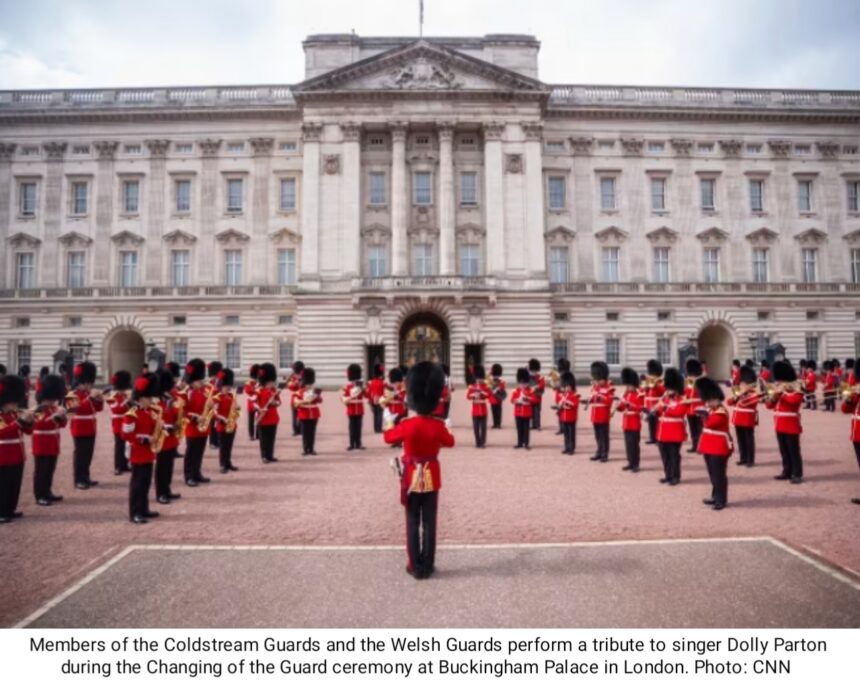
Today, however, the bearskin is primarily associated with ceremony rather than combat. Guards wearing the caps can be seen outside Buckingham Palace and other royal residences, as well as at major state occasions.
The King’s Guard is drawn from five British Army Foot Guards regiments: the Grenadier Guards, Coldstream Guards, Scots Guards, Irish Guards and Welsh Guards. Their ceremonial duties include guarding royal residences and participating in major national occasions.
The bearskin caps are particularly visible during the Changing of the Guard at Buckingham Palace, an event watched by large numbers of visitors and tourists each year.
They also form part of the uniforms used during the King’s Birthday Parade, commonly known as Trooping the Colour, and the State Opening of Parliament.
For many people, the caps have become inseparable from the visual image of Britain’s royal ceremonies. Their appearance, therefore, raises a broader question about how traditional military symbols can be maintained while adapting the materials used to produce them.
The debate is not new.
Animal welfare organizations have repeatedly challenged the use of real bear fur by the British military. Their campaigns have focused particularly on the claim that bears continue to be killed for pelts used in new ceremonial caps.
PETA UK has argued that Britain should move toward a synthetic alternative rather than continuing to obtain bear pelts from legal culls in Canada.
The Ministry of Defence has previously explored possible alternatives, but replacing the traditional material has proved more complicated than simply finding a synthetic fabric that looks similar.
The material must satisfy military requirements relating to durability, weather resistance and appearance. It must also preserve the distinctive shape of the cap during ceremonial use.
According to the Ministry of Defence, a replacement would have to undergo testing before it could be adopted. Serving guards would also need to assess the material.
This approach reflects the practical difficulty of replacing a material that has been used for generations.
The Ministry of Defence has said it would be willing to resume work with PETA on an alternative if the organization wished to re-engage.
The issue also involves the cost of the ceremonial headgear.
The British government said in April that a bearskin cap costs approximately £2,460 to procure, equivalent to roughly $3,300 at the exchange rate cited in the report.
PETA UK, using Freedom of Information data, estimated that the Ministry of Defence spent more than £1 million on bearskin caps between 2017 and 2024.
The relatively high price reflects the specialized nature of the caps, which are produced for a specific military purpose and are expected to remain in service for a long period.
The Welsh Guards have said that the caps are carefully maintained. They may be brushed, steamed and shampooed to keep the fur clean and preserve its shape.
With proper care, a bearskin cap can remain in service for decades. Some caps currently being used are reportedly more than 40 years old.
That longevity is one of the factors that complicates comparisons between the cost of an individual cap and the frequency with which it needs to be replaced.
Supporters of retaining the traditional material have historically pointed to the long service life and established appearance of the bearskin as part of the argument for maintaining the existing system. Critics, meanwhile, argue that durability should not prevent the development of alternatives that could provide the same ceremonial appearance without the use of animal fur.
The debate also highlights a changing relationship between military traditions and animal welfare standards.
Britain continues to maintain a number of highly visible ceremonial military traditions connected to the monarchy and the armed forces. These traditions attract international attention and form part of the country’s public image.
At the same time, standards concerning animal welfare have changed considerably over the decades. Materials and manufacturing technology have also developed, creating the possibility of alternatives that were not available when the current system was established.
The central question for the government is therefore whether a synthetic material can reproduce the necessary characteristics of real bearskin while meeting military requirements and remaining affordable.
For the lawmakers campaigning for change, the answer should be pursued urgently.
Their letter calls for the Ministry of Defence to stop placing new orders for real bearskin while alternative materials are developed and assessed.
The lawmakers argue that the continued procurement of real bear fur is difficult to justify when synthetic options are being developed in other areas of clothing and manufacturing.
PETA UK has made a similar argument, saying that the Ministry of Defence should devote resources to finding a suitable faux-fur material and ending Britain’s reliance on wildlife products obtained overseas.
The Ministry of Defence has not announced an immediate end to the use of real bearskin. Instead, its position indicates that replacement will depend on whether a suitable alternative can meet the required technical and operational standards.
That distinction is important. The current debate is not simply about whether Britain should preserve the appearance of the bearskin cap. It is about whether the material itself can be replaced without compromising the requirements of the ceremonial uniform.
The future of the bearskin cap may therefore depend less on its historical symbolism than on the development of a material capable of matching its physical characteristics.
If such an alternative is approved, the change could allow the British military to preserve the familiar appearance of the King’s Guard while ending the procurement of new real bear pelts.
Until then, the traditional bearskin remains part of the ceremonial uniforms worn by Britain’s Foot Guards.
For visitors standing outside Buckingham Palace, the sight of soldiers in red tunics and tall black caps remains one of London’s most familiar scenes.
But behind that familiar image is an increasingly contested question about how much of a centuries-old tradition needs to remain unchanged.
The British government now faces pressure from lawmakers and animal welfare campaigners to move toward synthetic fur, while the Ministry of Defence is assessing whether modern materials can meet the demanding standards required for ceremonial use.
The outcome will determine whether the bearskin cap continues to be made from real bear fur or becomes an example of a longstanding military tradition adapted to changing expectations about animal welfare.
For now, the bearskin cap remains a visible symbol of Britain’s ceremonial military heritage. But with political pressure increasing and the Ministry of Defence acknowledging support for a suitable faux-fur replacement, its traditional material may eventually become a relic of the past.