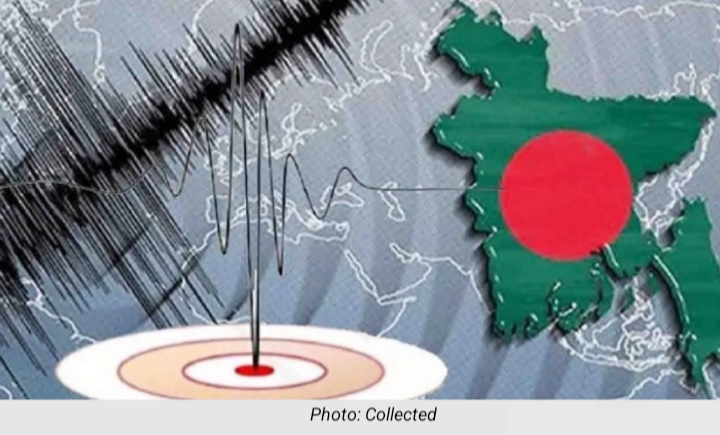
Recent seismic activities around Dhaka have raised concerns among experts and residents alike, as several earthquakes over the past months have originated alarmingly close to Bangladesh’s capital. The latest tremor was felt on June 22 at 8:28 PM, registering a magnitude of 4.4 on the Richter scale. According to the United States Geological Survey (USGS), the earthquake originated approximately 10 kilometers southwest of Narsingdi at a depth of 10 kilometers, while India’s National Center for Seismology reported a magnitude of 4.0 and a depth of 16 kilometers. Bangladesh Meteorological Department (BMD) identified the epicenter in Rupganj, Narayanganj, about 16 kilometers east of Dhaka. Although slight variations exist among different agencies regarding the exact location, experts agree that the affected area lies within the greater Narsingdi-Rupganj seismic zone.
Data from the Bangladesh Meteorological Department indicate that several earthquakes recorded between early 2025 and June 2026 originated near Dhaka. On February 1, a magnitude 3.2 earthquake struck Kaliakair in Gazipur, approximately 42 kilometers from the capital. Earlier, on November 21, 2025, a powerful magnitude 5.7 earthquake shook Dhaka and large parts of Bangladesh. According to official records, its epicenter was located near Madhabdi in Narsingdi, only 13 kilometers from Dhaka and at a depth of 10 kilometers beneath the surface.
That earthquake was among the strongest inland seismic events recorded in Bangladesh in recent decades. The disaster resulted in fatalities and injuries across multiple districts, causing widespread panic and highlighting the vulnerability of densely populated urban areas. Remarkably, within hours of the main shock, three additional earthquakes were recorded, with epicenters concentrated in different parts of Narsingdi and Dhaka’s Badda area. In the following days, several more tremors ranging between magnitude 3.3 and 4.3 were detected in Palash, Badda, Ghorashal, and Shibpur, suggesting heightened seismic activity in the region.
Geologists believe these earthquakes may be linked to tectonic movements or previously inactive fault systems becoming active again. Professor Dr. Md. Badruddoza Mia, Chairman of the Department of Geology at the University of Dhaka, explained that earthquakes can occur due to newly formed faults or the reactivation of ancient fault lines that have remained dormant for long periods. Bangladesh lies within the influence zone of three major tectonic plates—the Eurasian Plate, the Indian Plate, and the Burmese Plate—making the country naturally susceptible to seismic activity.
Despite the recent increase in earthquakes near Dhaka, experts caution against interpreting these smaller tremors as definitive precursors to a major earthquake. Professor Mehedi Ahmed Ansary, a leading earthquake researcher at Bangladesh University of Engineering and Technology (BUET), stated that the recent low-to-moderate magnitude earthquakes around Dhaka are unlikely to trigger widespread building collapses or catastrophic casualties. However, he emphasized that these events should serve as a warning and an opportunity to improve public awareness and disaster preparedness.
According to Professor Ansary, Bangladesh’s greatest seismic concern remains the major fault systems that have historically generated earthquakes exceeding magnitude 7.0. Areas such as Srimangal and Sherpur, located within approximately 150 to 200 kilometers of Dhaka, have previously experienced devastating earthquakes. Historical records show that Srimangal was struck by a magnitude 7.6 earthquake in 1918, while Sherpur experienced a magnitude 7.1 earthquake in 1885. These events demonstrate that powerful earthquakes are possible within a distance capable of significantly affecting the capital.
Experts note that earthquakes follow long recurrence cycles, and the absence of recent major events does not eliminate future risk. While it is impossible to predict exactly when a large earthquake may occur, seismologists agree that a magnitude 7 or greater event remains a realistic possibility for Bangladesh in the future. Although the recent cluster of earthquakes in Narsingdi has attracted scientific attention, there is no historical evidence suggesting that the area itself has produced major earthquakes of similar magnitude in the past.
When assessing earthquake safety in Dhaka, specialists emphasize that geological conditions alone do not determine risk. Structural quality and urban planning play equally important roles. Geologist Syed Humayun Akhter notes that parts of northern Dhaka are situated on the relatively stable Madhupur Clay formation, making areas such as Ramna, Maghbazar, New Market, Lalmatia, Khilgaon, Motijheel, Dhanmondi, Lalbagh, Mirpur, Gulshan, and Tejgaon comparatively more stable from a geological perspective. Nevertheless, experts stress that no area can be considered truly safe without evaluating the structural integrity of its buildings. In Old Dhaka, for example, narrow roads and dense urban congestion may pose greater risks during emergencies than the buildings themselves.
A growing concern among researchers is the presence of “blind faults” — hidden fault systems that do not reach the Earth’s surface and therefore remain difficult to detect through conventional geological mapping. Although no major known fault line passes directly beneath Dhaka, Bangladesh is influenced by several active tectonic structures, including the Myanmar-Noakhali plate boundary, the Narsingdi tectonic zone, the Sylhet fault region, the Dauki Fault, and the Madhupur Fault. Historically, earthquakes ranging from magnitude 7.0 to 8.5 have occurred along these systems. Scientists warn that large earthquakes can recur on these faults after centuries of accumulated tectonic stress.
To date, two blind faults have been identified in Bangladesh, located in the Mymensingh and Rangpur regions. Because such faults are difficult to identify and monitor, providing advance warning before a major earthquake becomes extremely challenging. As a result, blind faults are increasingly becoming a key focus of seismic risk assessments throughout the country.
Overall, while the recent concentration of earthquakes around Dhaka has drawn significant scientific attention, experts do not consider them definitive evidence of an imminent major earthquake. Nevertheless, Bangladesh’s tectonic setting, history of powerful seismic events, active fault systems, and the potential presence of hidden faults continue to place Dhaka and much of the country at long-term earthquake risk. Strengthening building standards, improving urban resilience, enhancing public awareness, and expanding disaster preparedness measures remain the most effective strategies for reducing future losses and protecting lives.
Earthquakes originating near Dhaka: Is the risk of major earthquakes increasing?