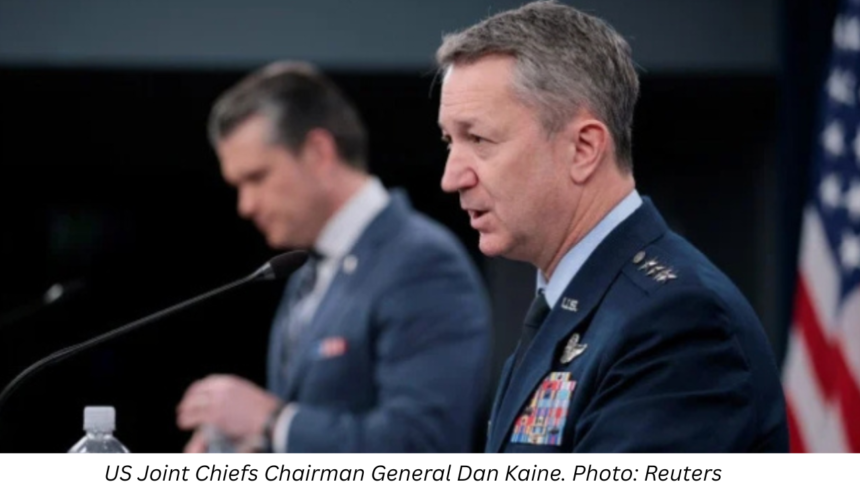
The United States is increasingly confronting a difficult strategic question over how to end its prolonged conflict with Iran, as senior military and national security officials reportedly grow concerned that Washington’s remaining military options may be limited, increasingly risky and incapable of delivering the political outcome President Donald Trump wants. According to multiple sources familiar with recent discussions cited by CNN, Gen. Dan Caine, chairman of the U.S. Joint Chiefs of Staff, has privately been making the case to senior members of the Trump administration that the United States needs to find a way to achieve a “dignified exit” from the conflict rather than risk becoming trapped in an open-ended escalation. Caine’s concern, according to the sources, is not simply the possibility of additional casualties or military costs, but the broader strategic danger that further escalation could produce consequences that Washington would struggle to control. One source described his position bluntly: “He’s looking for a way out.” Caine has reportedly raised his concerns in separate conversations with other senior officials, including CIA Director John Ratcliffe, Secretary of State Marco Rubio and Vice President JD Vance. The discussions are said to have focused on the limits of available military options, particularly scenarios in which the United States seeks to intensify the conflict without committing large numbers of American ground forces. The private consultations also appear to reflect an effort to coordinate the administration’s position before major meetings with Trump, ensuring that senior officials are prepared to explain both the potential effectiveness and the risks of further military action. One source familiar with the discussions suggested that Caine’s approach may partly be an effort to protect the U.S. military from being drawn into an increasingly difficult strategic and political situation. Trump has repeatedly expressed reluctance to deploy American ground troops into Iran and has instead indicated that sustained airpower could be sufficient to force Tehran into accepting Washington’s demands. But according to people familiar with the administration’s internal discussions, Caine and several other senior officials privately believe that relying solely on airstrikes to achieve Trump’s stated objectives has a low probability of success. Iran’s military infrastructure is dispersed, hardened and capable of adaptation, making it difficult for an air campaign alone to permanently eliminate the country’s ability to retaliate or continue resisting. The problem facing Washington, therefore, is not whether the United States can inflict additional damage on Iran. American forces possess the ability to destroy significant military infrastructure, strike missile and drone facilities and impose substantial costs on Tehran. The more difficult question is whether those attacks can produce a decisive political outcome. That distinction has become increasingly important as the conflict approaches the six-month mark. At the beginning of the campaign, U.S. officials repeatedly claimed that Iran’s military capabilities had been severely degraded. Yet the continuation of the conflict has demonstrated the difficulty of translating battlefield destruction into a lasting political settlement. Trump has framed the war primarily around preventing Iran from acquiring a nuclear weapon, but the longer the conflict continues, the more difficult it becomes to identify a clear military path toward a definitive end state. Caine’s public comments have also suggested that the Pentagon recognizes the limitations of airpower. During a congressional hearing late last month, he acknowledged that airstrikes have limits, a remark that has taken on greater significance amid the administration’s internal debate over whether to intensify the campaign. According to sources familiar with the discussions, Caine and other senior officials were particularly cautious about proposals considered in late July for a more aggressive phase of military operations. Some officials reportedly feared that a major escalation could trigger a much broader Iranian response, potentially targeting U.S. military facilities and critical infrastructure across the Gulf. Regional allies have also reportedly expressed serious concern about the consequences of further escalation, particularly the possibility that Iran could retaliate against oil facilities, ports, power infrastructure and other strategic assets. Such attacks could disrupt energy markets, threaten global shipping and create economic consequences far beyond the immediate battlefield. Trump has repeatedly threatened attacks against Iran’s energy infrastructure, but officials familiar with the internal debate have reportedly questioned whether such strikes would actually force Tehran to surrender. Instead, they could produce the opposite political effect by strengthening Iranian nationalism and intensifying anti-American sentiment. Damage to electricity networks, fuel facilities, bridges and other critical infrastructure could also impose enormous costs on civilians without necessarily weakening the Iranian government’s ability to continue fighting. The same dilemma applies to Iran’s missile and drone capabilities. Repeated attacks on known military sites can destroy individual facilities, but Iran can potentially relocate, conceal or rebuild elements of its military infrastructure. The result, according to one source, risks becoming a continuous cycle in which the United States destroys one target while Iran adapts and restores another capability elsewhere. The strategic value of such attacks becomes increasingly questionable if they fail to change Tehran’s political calculations. Another major concern reportedly influencing the administration’s thinking is the condition of America’s weapons stockpiles. Multiple sources have said that U.S. military officials are increasingly worried about shortages of precision-guided munitions, air-defense interceptors and other critical weapons. The concern is particularly significant because the United States must simultaneously maintain its commitments to allies and partners, including Israel and Ukraine. A prolonged conflict with Iran could therefore place additional pressure on an already strained American defense-industrial base and reduce Washington’s flexibility in responding to other global crises. Officials in the Gulf have reportedly warned the Trump administration that an escalation could expose regional allies to Iranian retaliation at a time when the availability of advanced U.S. air-defense systems is already under pressure. The prospect of Iranian attacks on Gulf energy infrastructure is particularly sensitive because the region remains central to global oil and gas supplies. Any sustained disruption could have consequences for international markets, shipping routes and the wider global economy. These concerns reportedly contributed to Trump’s decision to step back from at least one proposal for a major escalation, although officials have indicated that the option has not necessarily been permanently removed from consideration. The president’s decision was reportedly influenced by consultations with Middle Eastern allies, who warned that they were deeply concerned about Iran’s potential response. But the internal debate illustrates the increasingly narrow space available to Washington. The United States can intensify the bombing campaign, but doing so may trigger a larger regional conflict. It can launch attacks against energy and civilian infrastructure, but such strikes may generate political backlash without producing decisive military gains. It can continue targeting missile and drone facilities, but Iran may adapt and rebuild. And the most decisive military option—a large-scale ground invasion—would carry enormous risks, including potentially thousands of American casualties and a long-term occupation or military presence that Trump has repeatedly sought to avoid. For Caine, the challenge is therefore one of maintaining a delicate balance between military readiness and strategic restraint. According to sources familiar with his interactions with Trump, the chairman has been careful not to appear to be questioning the president’s authority or undermining the credibility of American military power. Instead, he has reportedly emphasized that the U.S. military retains the capability to inflict devastating damage on Iran if Trump orders a major operation, while simultaneously warning that military capability does not automatically translate into political success. During at least two recent meetings with Trump, Caine reportedly raised concerns about dwindling weapons supplies and the consequences of prolonged escalation. At the same time, he reiterated that American forces could impose severe damage on Iran if ordered to do so. The dual message reflects the difficult position occupied by the nation’s highest-ranking military adviser: he must demonstrate that the military can execute the president’s orders while also making clear that some military options carry costs that cannot be solved by additional firepower alone. Caine’s relationship with Trump has therefore become a crucial element of the administration’s internal debate. Sources familiar with his approach say he has worked carefully to maintain the president’s confidence while communicating the risks associated with escalation. His effort has reportedly included attempts to maintain close access to the White House so that he can provide frequent briefings and operate in a secure environment near the president. The broader concern over weapons shortages predates the current phase of the war. Before the conflict began, Caine and other senior military leaders reportedly warned that a prolonged campaign could place significant strain on American weapons inventories and potentially affect Washington’s ability to support Israel and Ukraine simultaneously. Those warnings have become more consequential as the conflict has continued. One source previously described U.S. ammunition stocks as having fallen to “dangerously low” levels, highlighting the tension between the demands of a major war and America’s commitments across multiple theaters. The reported disclosure of those shortages has also reportedly frustrated Trump, who has been concerned that public discussion of American weapons limitations could weaken Washington’s leverage in negotiations with Tehran. The Pentagon and U.S. Central Command have consequently been reassessing elements of their military strategy. In an unusual development, a senior CENTCOM official reportedly sought new and unconventional ideas from personnel on how to pressure or punish Iran. While seeking new ideas is not inherently unusual during a war, the timing of such a request—months into the conflict—has been interpreted by some officials and analysts as evidence that existing strategies have failed to produce a clear path toward a decisive outcome. The debate is ultimately centered on the gap between military capability and political objectives. The Pentagon may have the ability to destroy additional Iranian targets, but destroying targets is not the same as forcing a government to accept political demands. Iran’s geography, military structure, missile capabilities and ability to retaliate across the region mean that even a highly successful American air campaign may not deliver a clean victory. The only option that could potentially produce a more decisive military outcome would be a massive ground operation, but that would carry costs that neither the Trump administration nor the U.S. military appears willing to accept at this stage. Such a campaign could result in large numbers of American casualties, require a sustained regional deployment and potentially transform the conflict into a long-term occupation. For that reason, officials inside and outside the administration are reportedly converging around a difficult but increasingly attractive alternative: finding a way to end the conflict while allowing Trump to claim a political victory. The concept of a “dignified exit” would seek to prevent the United States from appearing to have simply withdrawn under pressure while simultaneously creating an opening for diplomacy. A potential settlement could involve restrictions on Iran’s nuclear activities, guarantees concerning regional security, arrangements for freedom of navigation and shipping, or an agreement to restore stability around the Strait of Hormuz. Such an outcome could allow Trump to present the end of the conflict as the result of American military pressure rather than a retreat, while giving Tehran a pathway to reduce tensions without appearing to surrender unconditionally. The central question now facing Washington is whether military force can still deliver the political outcome Trump wants or whether the limits of military power will ultimately push the administration back toward diplomacy. The discussions involving Caine and other senior officials suggest that the latter possibility is gaining increasing attention. After months of fighting, the fundamental strategic problem remains unchanged: American airpower can destroy targets, degrade infrastructure and impose significant costs on Iran, but it cannot by itself guarantee that Tehran will accept Washington’s political demands. As the risks of escalation increase and the availability of additional military options narrows, the search for an exit strategy may therefore become as important as the military campaign itself. For Trump, the challenge will be to find an ending that can be presented domestically as a victory. For Caine and the Pentagon, the challenge will be to prevent a conflict that began as a limited campaign from evolving into a wider regional war. And for the broader Middle East, the stakes are even higher: whether Washington chooses further escalation or a negotiated off-ramp could determine whether the current conflict ends with a controlled settlement—or becomes the beginning of a much larger and potentially far more destructive confrontation.
US general says airstrikes alone in Iran cannot achieve war goals