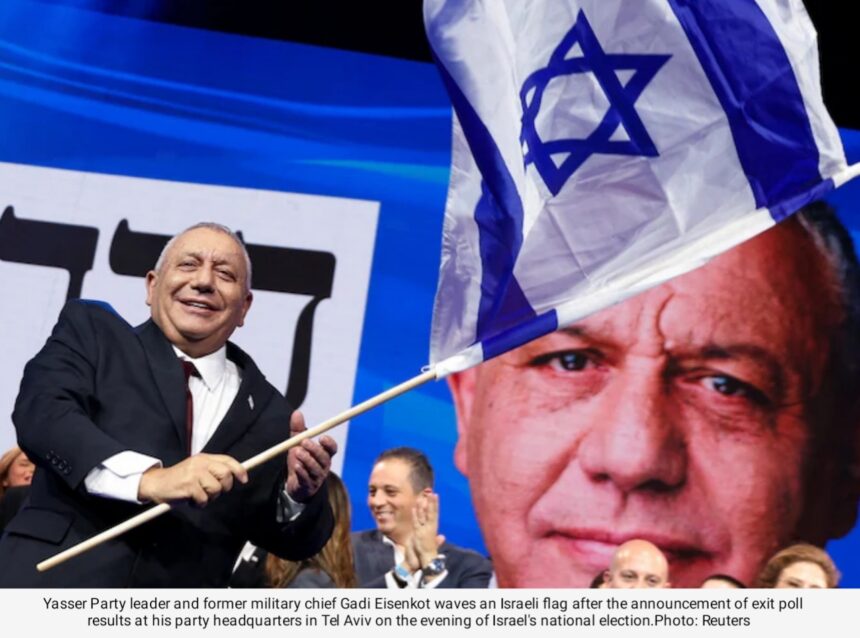
JERUSALEM, November 8, 2026: Israel has entered a significant new phase of political uncertainty after President Isaac Herzog announced on Saturday night that opposition leader Gadi Eisenkot would receive the first opportunity to form a new governing coalition following the country’s October 27 parliamentary elections, potentially opening the way for a major political transition and bringing an end to Benjamin Netanyahu’s long tenure as prime minister. The presidential announcement represents an important development in Israel’s post-election political process, as Netanyahu and his political allies have lost their parliamentary majority, while the opposition bloc led by Eisenkot has also fallen short of securing enough seats to govern independently. Eisenkot, a former chief of the Israeli military who emerged as Netanyahu’s principal challenger during the election campaign, now faces the difficult task of assembling a parliamentary majority in a deeply divided political environment shaped by years of conflict, security concerns and disagreements over the country’s domestic and regional policies. Following Herzog’s announcement, Eisenkot declared that Israel needed a national emergency government and pledged to make every possible effort to demonstrate that his political camp was worthy of the responsibility. In a statement published on his X account shortly after the announcement, he called for the establishment of a broad national government, signalling his intention to pursue negotiations beyond his immediate political alliance. Under the country’s political arrangements, Eisenkot has up to six weeks to negotiate with other parties and secure the parliamentary support required to form a government. However, the negotiations are expected to be complicated by sharp ideological differences among the parties, competing political interests and the difficult compromises required to establish a stable coalition. Representatives of most of Israel’s major political parties recommended Eisenkot to the president during consultations earlier in the week, giving him an important political advantage in the initial stage of the government formation process. Nevertheless, receiving the presidential mandate does not guarantee that he will succeed in forming a government, particularly because his parliamentary bloc does not hold an independent majority. One of the most significant factors in the negotiations is the increased political influence of Arab-led parties, which made historic gains in the October elections and have emerged as potential kingmakers in the new parliamentary balance. Their support could become essential if Eisenkot intends to secure the numbers necessary to replace Netanyahu, although cooperation with Arab political groups remains a highly controversial issue within Israeli politics. An Arab party has previously participated in an Israeli governing coalition only once, making any renewed arrangement politically sensitive, particularly after more than three years of war in Gaza and continued regional tensions. The possibility of an alliance between Eisenkot’s bloc and Arab-led parties has become a central issue in Netanyahu’s political campaign against the opposition leader. Netanyahu and his allies have repeatedly warned against including Arab parties in a future government, portraying such cooperation as a threat to Israel’s national security. Shortly before Herzog announced his decision, Netanyahu issued a video statement calling for a national unity government and warning against what he described as the danger of hastily establishing a government supported by parties sympathetic to terrorism. His remarks reflected his continued efforts to prevent a political arrangement between Eisenkot and Arab-led parties. Netanyahu has also made allegations that Arab parties stole the election, although such claims have not been substantiated. The confrontation over Arab political participation has exposed one of the deepest divisions within Israel’s political system, raising questions about the definition of national unity, the representation of Arab citizens and the role of minority parties in determining the country’s government. Eisenkot has indicated that he may be willing to cooperate with Arab-led parties under certain conditions, while maintaining a hard-line position against Hamas, which he has described as a terrorist organisation that must be destroyed. This position could form part of his attempt to balance the political demands of potential coalition partners with the security expectations of voters who remain deeply affected by the Hamas-led attacks of October 7, 2023, and the subsequent wars in Gaza and other parts of the region. The political consequences of those conflicts continue to influence public debate, party negotiations and disagreements over Israel’s future security strategy. For Netanyahu, who has served as Israel’s longest-serving prime minister, the election results represent a serious setback after years of political dominance. Losing his parliamentary majority has weakened his ability to remain in office, although the opposition’s failure to secure an outright majority means that his political future is not yet definitively settled. The coming weeks will therefore be decisive for both political camps as they attempt to attract additional parliamentary support and negotiate the compromises necessary to establish a functioning government. If Eisenkot succeeds, Israel could witness a major change in political leadership and a new approach to coalition politics. If he fails, the country could face further negotiations and renewed political uncertainty. The role of Arab-led parties will remain particularly important throughout this process, as their parliamentary strength could determine whether the opposition can overcome its numerical disadvantage. Beyond the immediate question of who will become prime minister, the government formation negotiations are likely to expose broader disagreements over the future direction of Israeli politics, relations with Arab citizens, the consequences of the Gaza war and the country’s national security priorities. President Herzog’s decision has therefore opened a critical political chapter in Israel, but the final outcome will depend on Eisenkot’s ability to build a coalition across a fragmented parliament and convince parties with sharply different positions that cooperation is preferable to continued political deadlock.
Source: AP