
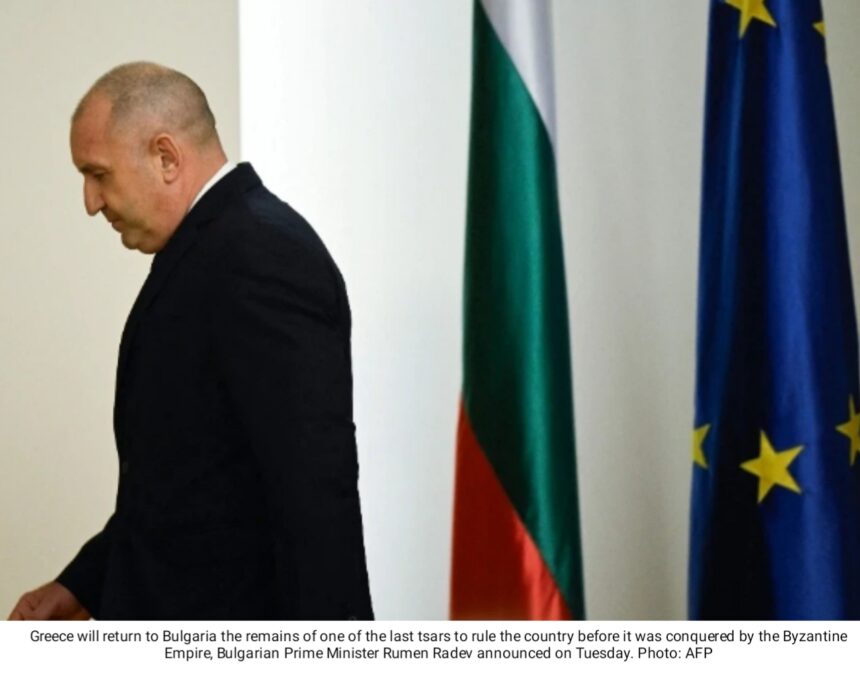
The remains attributed to Tsar Samuel, one of the last major rulers of the medieval Bulgarian Empire before its conquest by the Byzantine Empire, are set to return to Bulgaria after decades in Greece, in a move that the two countries say reflects their shared historical and cultural heritage.
The transfer follows a long-running effort by Bulgarian authorities to bring Samuel’s remains back to his homeland. The remains were discovered during archaeological excavations in 1965 at a basilica on the island of Saint Achilleios in Lake Prespa, a historic region shared by Greece and Albania. They have since been preserved in Greece.
Bulgarian Prime Minister Rumen Radev announced that the official handover will take place on Saturday morning at the Museum of Byzantine Culture in Thessaloniki, where the ceremony will be hosted by Greek Prime Minister Kyriakos Mitsotakis.
Radev described the agreement as an important moment in the historical relationship between the two neighbouring countries and said the memory of Samuel could now serve as a point of connection between Greece and Bulgaria.
“The memory of Tsar Samuel today unites the two countries instead of dividing them,” Radev said, while thanking Mitsotakis for what he described as political courage and for the friendship between the two nations.
The planned return of Samuel’s remains comes more than six decades after archaeologists uncovered the burial site believed to be connected to the medieval Bulgarian ruler. The discovery has remained a subject of historical and archaeological interest because of Samuel’s central role in the final decades of the First Bulgarian Empire and his prolonged struggle against the Byzantine Empire.
Samuel ruled Bulgaria from 997 until his death in 1014. His reign was dominated by military confrontation with Byzantium, then one of the most powerful states in southeastern Europe.
During Samuel’s rule, Bulgarian forces fought repeatedly against the armies of Byzantine Emperor Basil II. The conflict eventually became one of the defining struggles of the final period of the First Bulgarian Empire.
One of the most dramatic episodes associated with Samuel occurred after the Battle of Kleidion in 1014. Byzantine forces defeated the Bulgarian army and captured thousands of soldiers.
According to medieval accounts, Byzantine Emperor Basil II ordered large numbers of Bulgarian prisoners to be blinded. The traditional accounts say that one soldier in every group was left with one eye so that he could lead the others back to Samuel.
When the blinded soldiers were brought before the Bulgarian ruler, the sight is said to have deeply shocked him. Historical accounts state that Samuel suffered a severe physical reaction and died shortly afterwards.
The episode later became one of the most powerful stories associated with the conflict between Samuel and Basil II. Although medieval sources and later historical interpretations have been examined and debated by scholars, the story has remained deeply embedded in Bulgarian historical memory.
Samuel’s death did not immediately end the Bulgarian-Byzantine conflict. Fighting continued under his successors, but the Bulgarian state eventually succumbed to Byzantine military pressure.
By 1018, the First Bulgarian Empire had been conquered by Byzantium, bringing an end to an independent Bulgarian state in that period.
Samuel is therefore remembered in Bulgaria as one of the major rulers of the final stage of the First Bulgarian Empire and as a monarch whose reign was closely connected with the struggle against Byzantine expansion.
The archaeological discovery of his remains added a physical dimension to that historical memory.
In 1965, Bulgarian and Greek historical interest in Samuel was given new momentum when archaeologists working on the island of Saint Achilleios uncovered a sarcophagus containing human remains.
The excavation was led by Greek archaeologist Nikolaos Moutsopoulos. The basilica on the island was identified with the religious and political centre associated with Samuel and his period.
The archaeological site is located on an island in the Prespa lake region, an area whose history predates the modern borders separating Greece, Albania and North Macedonia.
The basilica of Saint Achilleios is particularly significant because of its association with Samuel. Historical sources indicate that Samuel established the area as an important centre during his reign.
The remains discovered there were subsequently attributed to Samuel. Their identification has made the site one of the most important archaeological locations connected with the medieval Bulgarian ruler.
For Bulgaria, the issue of the remains has therefore involved more than archaeology. It has also been connected with national historical memory and the question of where the remains of one of the country’s most important medieval rulers should ultimately rest.
The decision to return the remains is part of a broader agreement between Greece and Bulgaria covering historical, religious and cultural objects.
Under the arrangement, Greece will return the remains attributed to Samuel as well as remains from two other sarcophagi. Bulgarian authorities associate one of them with Gavril Radomir, Samuel’s son and successor, while the other remains are believed to belong to members of the Bulgarian royal family.
The agreement therefore concerns several individuals connected with the ruling dynasty rather than Samuel alone.
At the same time, Greece is set to receive 48 historical and religious objects that are currently held in Bulgaria.
According to the Greek Culture Ministry, the objects were taken from the Diocese of Serres and Nigrita during the First World War and are currently held at Bulgaria’s National Historical Museum.
Their return forms the reciprocal part of the agreement, allowing both countries to recover cultural and religious objects connected with their respective histories.
The arrangement reflects a wider issue faced by European countries over cultural property removed from one country during periods of war, occupation or political upheaval.
In this case, the two governments have chosen a reciprocal framework under which the return of Samuel’s remains is linked to the transfer of Greek historical and religious objects held in Bulgaria.
The official ceremony in Thessaloniki is expected to mark the beginning of Samuel’s final journey to Bulgaria.
Following the handover, his remains will be transported to Sofia by military aircraft.
A public ceremony is planned in the Bulgarian capital, after which the remains will be taken in procession to the Church of Saint Sofia.
The Bulgarian government has invited members of the public to take part in the procession and accompany Samuel on what officials describe as his final journey.
The decision to place the remains at the Church of Saint Sofia carries its own historical significance.
The church is one of the most important historic religious buildings in Sofia and has a long association with Bulgaria’s medieval Christian heritage.
For Bulgarian authorities, the planned burial is intended to provide a permanent resting place for the ruler whose reign came during one of the most important periods in the country’s medieval history.
The return also has significance for the relationship between Greece and Bulgaria.
The two countries have a complicated shared history shaped by the Byzantine Empire, the medieval Bulgarian states, the Ottoman period and the emergence of modern national borders in the Balkans.
Samuel’s reign itself is part of that shared history.
The wars between Bulgaria and Byzantium were fought across territories that today belong to several modern states. Historical figures from that period are consequently viewed through different national and historical traditions.
Samuel’s memory has particular importance in Bulgaria, while the archaeological locations associated with his reign are located in present-day Greece.
The return of the remains represents an attempt to deal with that history through cooperation rather than dispute.
Radev has emphasised this point, saying that Samuel’s memory should bring Greece and Bulgaria closer rather than create division between them.
The agreement also demonstrates the continuing importance of archaeological discoveries made decades ago.
The excavation at Saint Achilleios took place in the 1960s, when European archaeology was entering a period of major development. More than 60 years later, the discovery has resulted in a new diplomatic agreement between two neighbouring European states.
For historians, archaeologists and cultural authorities, the return raises questions about the treatment of human remains and archaeological material discovered outside the country with which they are historically associated.
For Bulgaria, the physical return of Samuel’s remains has a strong symbolic meaning. It allows the country to establish a permanent burial place for a ruler who played a central role in its medieval history.
For Greece, the reciprocal return of 48 historical and religious objects represents the recovery of cultural material associated with Greek religious institutions.
The agreement therefore creates a balance between two different historical claims.
One concerns the remains of a medieval Bulgarian ruler discovered on Greek territory. The other concerns Greek religious and historical objects that were transferred to Bulgaria during the First World War.
The two sides have chosen to resolve both matters through a formal cultural agreement.
The story of Samuel himself remains one of the most dramatic chapters in the history of medieval southeastern Europe.
His reign came at a time when Bulgaria and Byzantium were competing for political control and influence across the Balkans.
Samuel managed to maintain Bulgarian resistance for many years, but the prolonged war placed enormous pressure on the Bulgarian state.
The defeat at Kleidion in 1014 was a major turning point. Four years later, Byzantine forces completed the conquest of Bulgaria.
The empire that Samuel had fought to preserve disappeared as an independent political power, but his name survived in Bulgarian historical tradition.
More than a millennium after his death, the discovery of his remains gave modern generations a tangible connection to that period.
Now, after decades in Greece, the remains are scheduled to return to Bulgaria.
The planned ceremony in Thessaloniki will mark the formal end of a long chapter in the history of the remains. Their arrival in Sofia will then begin another chapter, as Bulgaria prepares to give Samuel a permanent resting place.
The transfer is also expected to draw public attention in Bulgaria, where the government has invited citizens to participate in the official ceremonies.
For Greece and Bulgaria, the agreement is being presented as an example of cultural cooperation based on their shared and sometimes contested history.
The two countries are not changing the history of their medieval conflicts. Instead, they are using the present-day institutions of archaeology, diplomacy and cultural cooperation to determine how the physical remains and objects connected with that history should be treated today.
More than a thousand years after Samuel’s death, his remains are therefore becoming part of a new story, one centred less on medieval warfare and more on historical memory, cultural heritage and cooperation between neighbouring states.
The return of Tsar Samuel’s remains is expected to be completed with the transfer to Sofia and the subsequent burial at the Church of Saint Sofia.
For Bulgaria, it will bring home the remains of one of its most significant medieval rulers.
For Greece, the reciprocal transfer of religious and historical objects will return part of its own cultural heritage.
And for both countries, the agreement marks a rare moment in which a shared and sometimes difficult past is being addressed through cultural cooperation rather than conflict.