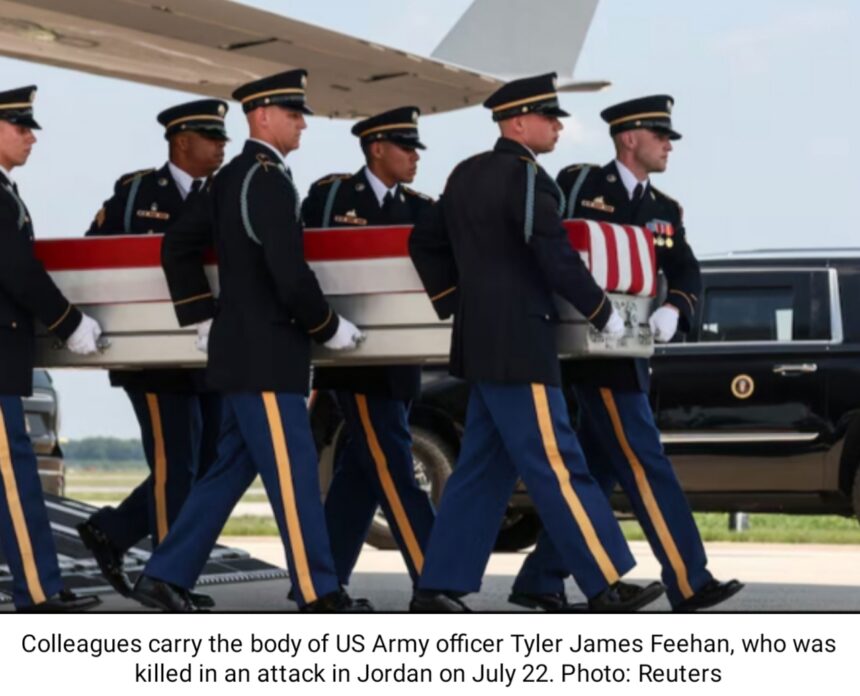
The United States military has confirmed that at least 624 American service members have been wounded since President Donald Trump ordered military strikes against Iran in February, according to updated casualty figures released by the Pentagon on July 25. The revised data has also sparked fresh questions over transparency after the Defence Department quietly altered its official casualty records without providing an immediate public explanation. According to the latest figures, 417 personnel were wounded during Operation Epic Fury, while another 207 were listed under a newly established category labelled Overseas Operations. The updated statistics come despite a ceasefire agreement reached between Washington and Tehran in April and a memorandum of understanding signed in June, both of which were intended to reduce hostilities. Sporadic attacks, however, have continued, underscoring the fragile nature of the truce. The Pentagon’s handling of casualty figures has become the focus of growing criticism after it revised its battlefield losses last week. Until Tuesday, official records showed 18 US troops killed and 482 wounded under Operation Epic Fury. By Thursday, however, the death toll for that operation had been reduced to 14, with the names of four fallen service members removed from the list and transferred to the newly created Overseas Operations category, which tracks casualties from operations conducted since July 7, 2026. The unexplained adjustment has prompted concerns among military analysts and lawmakers about the accuracy and transparency of the Pentagon’s reporting. Retired Lieutenant General Ben Hodges, the former commander of US Army Europe, said the administration appeared to be struggling to present a clear account of both the casualties and the broader conflict, arguing that the changes had further complicated public understanding of the war. Republican Congressman Thomas Massie also criticised the decision, describing the separation of casualties into different operational categories as “a ridiculous manoeuvre” that risked obscuring the true human cost of the conflict. Responding to the controversy, Pentagon spokesman Sean Parnell said in a post on X that the discrepancy was caused by a “temporary technical issue” and that officials were working to correct the records. The explanation has done little to ease concerns among critics, who continue to question why the revisions were made without a detailed public clarification. President Donald Trump had stated on July 21 that 18 American service members had died in the Iran conflict. However, according to an Associated Press report, the Pentagon subsequently introduced the Overseas Operations section on its website, listing four recently killed personnel and 207 wounded troops. It remains unclear whether all 207 injuries are directly linked to the Iran conflict, adding further uncertainty to the official figures. Analysts believe the restructuring of casualty records was intended to separate the deaths of four soldiers killed after the collapse of the Trump-brokered ceasefire. Three of those troops were killed in an Iranian missile strike in Jordan on July 17, while another died in Iraq. The renewed escalation followed the effective breakdown of the ceasefire, with both sides exchanging missile and drone attacks for 13 consecutive nights before the violence subsided last Friday. Although the intensity of fighting has eased for now, the revisions to the Pentagon’s casualty data have fuelled a broader debate over government transparency, military accountability, and the true cost of a conflict that continues to cast a shadow over US-Iran relations.
US losses in Iran war revised, criticism grows over administration’s transparency