

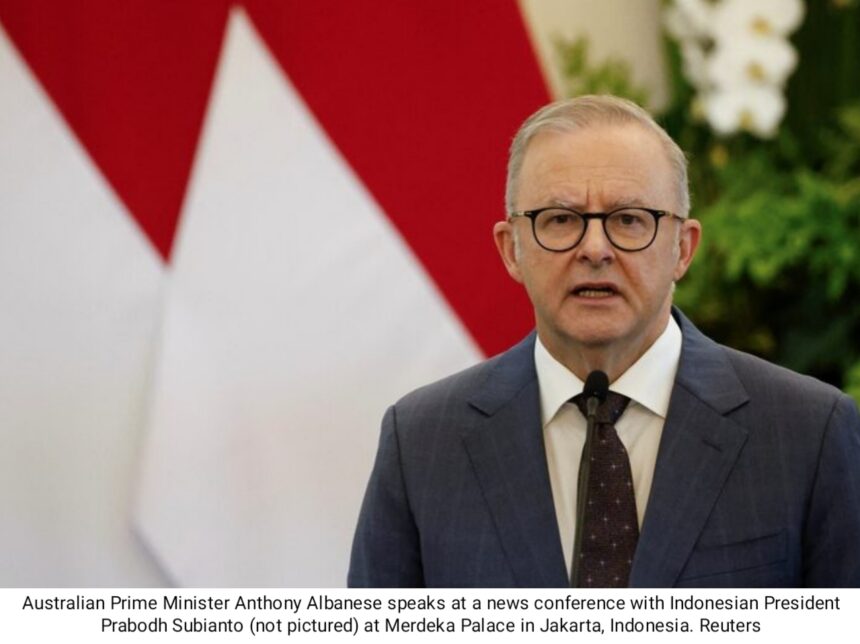
Australia is stepping up efforts to strengthen online safety protections and establish new rules for artificial intelligence, with Prime Minister Anthony Albanese seeking greater cooperation from some of the world’s largest technology companies.
Albanese’s government is working on a broader regulatory framework aimed at protecting Australians from online harms while ensuring that rapidly developing technologies such as artificial intelligence are used in ways that are consistent with public safety and the interests of users. During a visit to the United States for the United Nations General Assembly, Albanese met Apple Chief Executive Officer Tim Cook at the company’s headquarters in Cupertino, California, where online safety and child protection were among the issues discussed.
The Australian prime minister said the country could not address the risks associated with the digital environment on its own. He argued that technology companies have an important role to play alongside governments in protecting children and other users from harmful online experiences.
“We spoke about what we’re doing to protect children from online harm and the work ahead,” Albanese said in a social media post following his meeting with Cook. He added that Australia was introducing stronger rules to improve online safety and that major technology companies such as Apple were also taking steps in response.
The meeting comes as Australia continues to develop some of the more extensive online safety measures introduced by a national government. Canberra has already imposed restrictions on social media access for children under 16, while lawmakers are now considering additional obligations for companies that operate major digital platforms.
The government’s approach reflects growing international concern over the effects of social media platforms, recommendation systems and artificial intelligence on children and younger users. Governments in several countries are examining whether existing laws are sufficient to deal with technologies that can influence what people see online, collect large amounts of personal information and generate content at unprecedented speed.
Australia’s Expanding Online Safety Framework
Australia introduced legislation preventing children under the age of 16 from accessing social media platforms in 2025. The measure was presented as a major effort to address risks including online bullying, harmful content and algorithm-driven experiences that can expose young users to material unsuitable for their age.
The policy placed Australia at the forefront of a growing debate over whether governments should establish age-based restrictions on social media. Supporters of stronger restrictions have argued that children require greater protection from online risks and that technology companies should bear more responsibility for the design and operation of their platforms.
However, implementation has proved difficult.
Data reported in August 2026 indicated that Australians under 16 were still using platforms such as Instagram and TikTok despite the restrictions. The findings raised questions about how effectively age restrictions can be enforced in an online environment where users may have multiple accounts, access services through different devices and attempt to circumvent verification systems.
The experience has also highlighted a broader challenge facing governments: legislation can establish legal responsibilities, but enforcing those responsibilities requires cooperation from technology companies and effective technical systems.
The Australian government is therefore continuing to consult with social media companies, industry groups and civil society organisations as it develops further legislation.
Proposed Duty of Care for Technology Platforms
One of the most significant elements of Australia’s latest regulatory plans is a proposed “duty of care” requirement for companies operating major online platforms.
Under draft legislation unveiled in September, companies behind widely used services including Facebook, TikTok and Instagram would face additional obligations relating to the risks created by their platforms.
The proposed framework would also give users greater control over recommendation algorithms. Users would be able to turn off algorithmic systems that determine or personalise the content presented to them.
Algorithmic recommendation has become a central issue in debates about online safety. Social media platforms commonly use automated systems to determine which posts, videos and other material appear in users’ feeds. These systems are designed to respond to user behaviour and engagement, but governments and researchers have increasingly examined whether such systems can contribute to harmful or excessive use, particularly among younger users.
Australia’s proposed rules would shift part of the responsibility toward the companies that design and operate these systems.
Rather than focusing solely on individual users, the proposed legislation seeks to place greater responsibility on technology businesses to identify and reduce risks associated with the design of their products.
The draft laws are expected to be introduced to parliament later this year following consultation with technology companies, industry organisations and civil society groups.
Political Disagreement Over the Proposed Rules
The proposed legislation has also generated political disagreement inside Australia.
The opposition Liberal-National Coalition has said it does not support the bill in its current form. In a statement published on September 10, the opposition raised concerns about what it described as inadequate safeguards for free speech and journalism.
The Coalition also objected to the amount of authority that could be given to the Communications Minister under the proposed framework.
These concerns reflect a wider policy debate over how governments can regulate online platforms without creating excessive restrictions on legitimate speech, journalism or public discussion.
Australia therefore faces the challenge of balancing two competing regulatory objectives. One is to reduce online harm and increase protections for children and other vulnerable users. The other is to preserve lawful expression, access to information and independent journalism.
The final legislation could change as the consultation process continues and parliament considers the government’s proposals.
Albanese Pushes for AI Regulation
Australia’s online safety debate is taking place alongside another major regulatory effort involving artificial intelligence.
AI systems are developing rapidly and are increasingly being incorporated into consumer products, workplaces, education, government services and online platforms. Their growing use has created new questions about privacy, misinformation, safety, intellectual property and accountability.
During his US visit, Albanese called for stronger regulation of AI and said Australia would introduce new standards for artificial intelligence by the end of 2026.
The government has presented the initiative as part of an effort to ensure that technological development serves the interests of Australians.
In a video posted to X, Albanese said his Labor government was working to ensure that technology works for Australians rather than Australians having to adapt to technology without adequate protections.
The government’s proposed AI standards are expected to form part of a wider regulatory approach. The details of the standards will be important because AI covers a wide range of technologies, from automated decision-making systems to generative AI tools capable of producing text, images, audio and computer code.
The challenge for policymakers is to create rules that address genuine risks while allowing businesses, researchers and the public to continue developing and using new technologies.
Apple’s Role in Child Online Safety
Albanese’s meeting with Tim Cook also reflects the growing role of technology companies in Australia’s online safety policy.
Cook said after the meeting that he had shared information with the Australian prime minister about new controls designed to help keep children safer online.
Apple has increasingly incorporated parental controls, age-related settings and other safety features into its devices and operating systems. Such tools can give parents greater control over children’s use of digital services, although their effectiveness depends on how they are configured and how different services interact with one another.
The Australian government’s decision to engage directly with Apple and other major technology companies indicates that Canberra views cooperation with industry as an important part of implementing online safety policies.
Governments can establish legal requirements, but technology companies control many of the systems through which those requirements must operate.
This includes account creation, age verification, content moderation, recommendation systems, parental controls and reporting mechanisms.
Why Technology Companies Matter
The scale of Australia’s technology regulation means that government policy increasingly depends on cooperation from private companies.
Platforms such as Facebook, Instagram and TikTok operate across national borders and serve millions of users. Their infrastructure, algorithms and content moderation systems are largely controlled by companies headquartered outside Australia.
This creates a regulatory problem for national governments.
Australia can pass laws applying to companies that provide services to Australians, but enforcing those laws may require technical changes by companies operating globally. Governments therefore need mechanisms that make compliance practical and enforceable.
The Australian approach combines legislation with engagement between government and technology companies.
The government is consulting industry representatives and civil society organisations before introducing its proposed platform rules. This process is intended to allow policymakers to examine how the proposed requirements would work in practice and what technical or legal problems could arise.
The Challenge of Enforcing an Under-16 Social Media Ban
Australia’s existing under-16 social media restrictions provide an important example of the difficulty of regulating digital services.
The legislation established a clear legal principle: children below the specified age should not have access to covered social media platforms.
However, preventing access is considerably more complicated than establishing the legal rule.
Age verification systems must determine whether a user meets the required age threshold while dealing with privacy concerns. Platforms must also identify accounts that may have been created using false information or through other methods of bypassing restrictions.
The continued use of social media by some under-16 Australians has demonstrated that legislation alone cannot completely eliminate access.
This does not necessarily mean the law has no effect. Rather, it highlights the difference between establishing a restriction and achieving complete compliance in a global digital environment.
The issue is likely to remain part of Australia’s wider discussion about technology regulation.
Algorithms at the Centre of the Debate
The proposed ability for users to turn off recommendation algorithms represents another important element of Australia’s regulatory plans.
Algorithms play a central role in modern digital platforms. They determine which videos, posts, advertisements and other material users are likely to see.
For companies, recommendation systems can help users discover relevant material and keep them engaged with a service. For policymakers, however, the same systems raise questions about transparency, user autonomy and potential exposure to harmful content.
Allowing users to switch off personalised recommendations would give individuals a different way to interact with platforms.
The proposal also reflects a broader international discussion about whether users should have more control over automated systems that shape their online experiences.
The practical effect of such a measure would depend on how companies implement it and what alternative systems are offered to users.
Free Speech and Journalism Concerns
Any major change to online regulation also raises questions about freedom of expression.
Australia’s opposition has argued that the proposed legislation does not contain sufficient safeguards for free speech and journalism. It has also expressed concern over ministerial powers under the proposed framework.
These objections are part of a broader debate over the appropriate limits of government authority in regulating online platforms.
Supporters of stronger regulation argue that governments have a responsibility to protect children and reduce foreseeable online harms. Critics can argue that broad regulatory powers may create risks for lawful speech or give governments excessive influence over digital communications.
The final balance will depend on the wording of the legislation, parliamentary amendments, regulatory guidelines and the way the rules are enforced.
Australia’s Broader Technology Strategy
Australia’s current regulatory agenda is occurring at a time when governments worldwide are reconsidering their relationship with large technology companies.
For years, many digital services developed faster than national regulatory frameworks could adapt. Governments are now attempting to establish clearer responsibilities for companies that provide online platforms, collect personal data or deploy artificial intelligence.
Australia has chosen to pursue several areas simultaneously, including child safety, social media regulation, algorithmic transparency and AI standards.
The government argues that these measures are necessary to ensure that technological development remains compatible with public safety.
At the same time, the debate over the proposed legislation shows that regulation itself carries difficult policy questions.
The Australian government must determine how far companies should be responsible for risks created by their platforms, how users should be protected, how privacy should be maintained and how free expression should be preserved.
What Comes Next
The next stage will be consultation and parliamentary consideration.
The government plans to continue discussions with social media companies, industry organisations and civil society groups before introducing the proposed laws to parliament later in 2026.
The AI standards announced by Albanese are also expected before the end of the year.
The outcome will determine how Australia regulates some of the world’s most influential technologies at a time when social media and artificial intelligence are becoming increasingly integrated into everyday life.
The government’s discussions with Apple and other technology companies indicate that Canberra sees cooperation between the public and private sectors as an important part of this process.
For Australia, the central question is how to establish enforceable rules that protect children and other users while maintaining space for innovation, privacy, journalism and lawful public debate.
As the government moves toward new AI standards and prepares legislation on online platforms, the country’s experience is likely to remain part of the wider international discussion over who should be responsible for safety in the digital age: governments, technology companies, users, or some combination of all three.
Australia’s latest measures show that the country’s technology policy is moving beyond voluntary commitments and toward a system in which major digital companies could face clearer legal responsibilities. How those responsibilities are ultimately defined, enforced and balanced against other rights will depend on the legislation that reaches parliament and the regulatory framework that follows.