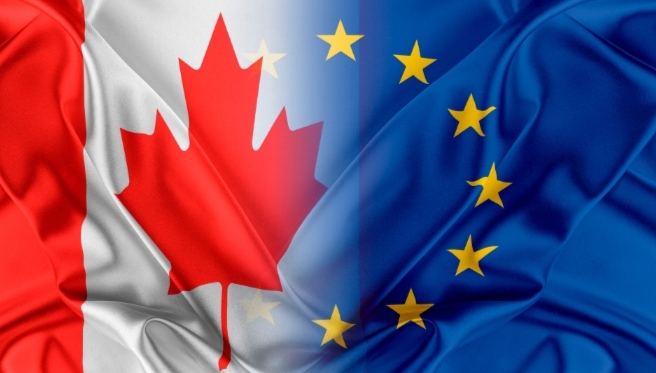
Canadians are showing growing interest in a closer relationship with the European Union as Ottawa explores a new form of partnership with Europe amid an increasingly difficult trade relationship with the United States, although Canada is not seeking to become a full member of the EU and the proposed idea of “associate membership” remains undefined. The debate gained momentum in September 2026 after European Commission President Ursula von der Leyen publicly opened the possibility of Canada becoming the European Union’s first associate member, a proposal welcomed by Canadian Prime Minister Mark Carney during his visit to Strasbourg. The discussion has quickly moved beyond traditional questions of trade and diplomacy, touching on defence, critical minerals, energy, artificial intelligence, research, financial services, travel, education and opportunities for young people to live and work on either side of the Atlantic. The proposal comes at a sensitive moment in Canada-US relations, with the two neighbours engaged in a widening trade dispute and facing disagreement over tariffs and market access. According to Al Jazeera, the United States has threatened significant economic measures against Europe if the EU proceeds with an arrangement that Washington considers hostile, adding a geopolitical dimension to what began as a discussion about closer economic cooperation between Canada and Europe.
The idea of a special Canada-EU relationship has generated considerable public attention in Canada, with social media users responding to the proposal with humour while political and economic observers have begun examining what an associate relationship could actually mean. Some Canadians have joked about suddenly becoming “European”, while others have focused on the practical possibilities of easier travel, employment and education. The enthusiasm has been fuelled by a broader shift in public attitudes toward Canada’s relationship with Europe and the United States. An Abacus Data survey conducted among 1,479 Canadian adults from September 4 to 9 found that 81 percent supported closer integration with the EU while Canada remained outside the bloc. The survey described closer integration in terms of easier trade, travel, work and study and greater cooperation on security. Eighty percent also supported deeper strategic cooperation with the EU on foreign policy, defence and economic priorities.
The figures indicate that the Canadian debate is currently focused more strongly on partnership than on full EU membership. The same Abacus survey found that 49 percent of Canadians supported the idea of Canada eventually becoming an EU member state, while 30 percent opposed full membership and 21 percent remained unsure. The distinction is significant because Canada’s current discussion with Brussels is about developing a new relationship while remaining outside the European Union. The concept therefore raises questions about how far economic and political integration could go without requiring Canada to adopt the EU’s institutional structures or become subject to the obligations associated with full membership. The exact legal and political framework for associate membership has yet to be defined, meaning that many of the most important details remain subject to negotiations between Ottawa and Brussels.
Prime Minister Mark Carney has presented the proposed relationship as part of a broader effort to strengthen Canada’s international partnerships and reduce excessive dependence on any single country. During his address to the European Parliament on September 17, Carney argued for a deeper and more integrated Canada-EU relationship, pointing to areas where the two sides could combine their respective strengths. The Canadian government has highlighted Europe’s large market, research capacity and manufacturing base, while presenting Canada as a major source of energy, critical minerals and expertise in areas including artificial intelligence, quantum technology and space. Ottawa has also pointed to Canada’s financial system and geographic position, including its access to both Atlantic and Pacific markets and its Arctic location.
Carney’s argument is based on diversification rather than economic isolation. In his European Parliament address, he said the objective should not be complete self-sufficiency but greater collective resilience through diversified partnerships. Canada already has a major trade relationship with Europe through the Comprehensive Economic and Trade Agreement, known as CETA, but the Canadian government now argues that the changing geopolitical environment requires a broader framework. Ottawa has also referred to the Canada-EU Strategic Partnership Agreement and Canada’s participation in the European defence initiative SAFE as existing foundations for deeper cooperation. The government says these arrangements can be developed further to cover strategic industries and security-related capabilities.
Critical minerals are expected to be one of the most important areas of potential cooperation. Canada possesses significant natural resources that are increasingly important to advanced manufacturing, clean-energy technologies and defence industries, while European countries are seeking to diversify their supply chains. A stronger Canada-EU relationship could therefore provide opportunities for Canadian producers to gain access to European markets while giving European industries another source of strategically important raw materials. Energy is another major area of interest. Canada has extensive energy resources, and European countries have been seeking reliable and diversified energy partnerships as they attempt to reduce vulnerabilities created by geopolitical tensions and disruptions in global supply chains.
Defence cooperation is also becoming more prominent in the relationship. Canada and European governments share concerns about security in the North Atlantic, Arctic and wider international environment, while European countries are increasing investment in defence capabilities. Ottawa has suggested that closer cooperation could include defence industries, advanced technologies and strategic capabilities. The European Parliament has also described defence, trade, energy, education and research as areas where Canada and Europe could deepen cooperation.
Artificial intelligence, advanced computing, quantum technology and research are another important part of Canada’s proposed partnership with Europe. Both sides have significant interests in developing technologies that are increasingly connected to economic competitiveness and national security. Canada has positioned itself as a country with strong capabilities in artificial intelligence and quantum technology, while Europe has a large research community, substantial industrial capacity and a significant regulatory role in global technology markets. Greater cooperation could involve research partnerships, investment, technology development and the movement of highly skilled workers and students.
For younger Canadians, however, one of the most attractive aspects of a closer relationship could be opportunities to study, work and live in Europe. Carney has called for stronger people-to-people links that would make it easier for Canadians and Europeans to move across the Atlantic for education and employment. The Abacus survey found that 38 percent of Canadians aged 18 to 29 identified study, training and research among their priorities for a closer relationship with the EU. This suggests that the younger generation may view the proposed partnership partly through the lens of mobility and access to international education and professional opportunities.
Public attitudes toward Europe have also changed alongside the debate over Canada’s relationship with Washington. Abacus Data reported that 71 percent of Canadians had a positive impression of the European Union, while only 21 percent expressed a positive impression of the United States. The same survey found that 56 percent of Canadians said their country had more in common with EU countries in terms of values, way of life and outlook, compared with 16 percent who chose the United States. These figures provide important context for understanding why the idea of closer European ties has attracted significant public interest.
At the same time, the polling shows that Canadians are not necessarily seeking to replace the United States with Europe. The survey found that 61 percent believed a closer Canada-EU relationship could increase Canada’s economic independence by improving access to markets and essential supplies without relying too heavily on any one country. Only 9 percent believed it would reduce Canada’s economic independence. Forty percent of respondents were more concerned about Canada continuing to rely too heavily on the United States than about closer EU ties weakening the Canada-US relationship, while 16 percent expressed the opposite concern. Another 26 percent were concerned about both issues.
The Canadian government has described this approach as diversification. Ottawa says stronger relations with Europe are part of a wider effort to build multiple international partnerships rather than depending excessively on one major economic and strategic partner. The government has also emphasised common democratic values, the rule of law and pluralism as foundations for closer relations with European countries. During his European visit, Carney met with European Commission President Ursula von der Leyen and European Parliament President Roberta Metsola to discuss critical minerals, energy, defence, research, advanced technologies, financial services and closer people-to-people ties.
The proposal has also generated concerns about sovereignty and the possible obligations attached to any future arrangement. Conservative opposition leader Pierre Poilievre has warned that Canada should remain independent and sovereign and has raised questions about the possibility of EU taxes, laws or immigration arrangements affecting Canadians. However, the measures he mentioned have not been proposed as part of the current discussion. The issue illustrates one of the central challenges facing any future negotiations: defining precisely what associate membership would involve and what it would not involve.
For some Canadians, the question is also financial. A closer institutional relationship could raise questions about contributions, market access, regulatory alignment and the responsibilities of both sides. These issues cannot be answered simply by referring to full EU membership because the proposed associate arrangement is intended to be a different form of partnership. The details would have to be negotiated and agreed upon by Canada and the European Union. The Canadian government has so far focused on practical cooperation rather than presenting a finalized institutional model.
The political debate is complicated further by the reaction from Washington. US President Donald Trump has warned that the United States could impose serious tariffs or restrict trade with Europe if the EU moves forward with a Canadian associate membership arrangement that Washington regards as a hostile act. Trump has also dismissed the idea publicly. His comments demonstrate that Canada’s attempt to expand its European relationships is taking place within a wider dispute over trade, economic dependence and strategic alignment.
The Canada-US trade dispute has provided much of the immediate background to the European initiative. Negotiations between Ottawa and Washington have faced repeated tensions over tariffs and market access. According to Al Jazeera, the dispute has involved threatened US tariffs on billions of dollars of Canadian goods and retaliatory measures from Canada. The conflict has encouraged Canadian policymakers to examine alternative markets and partnerships. At the same time, the United States remains a major economic partner for Canada, meaning that any long-term strategy involving Europe would have to take into account the continuing importance of the North American relationship.
This is why the concept of diversification has become central to Ottawa’s argument. A more diversified network of trade and strategic relationships could give Canada greater flexibility in dealing with economic shocks, supply-chain disruptions and geopolitical pressure. The government has described the approach as strengthening Canada’s strategic autonomy while maintaining relationships with existing partners. The proposed European partnership is therefore being presented as an additional pillar rather than a formal replacement for Canada’s relationship with the United States.
The European Union also has its own reasons for considering a special relationship with Canada. Canada is a major resource-producing country with substantial energy and critical mineral potential, advanced research capabilities, a developed financial system and a strategically important Arctic position. Europe, meanwhile, offers a large consumer market, advanced industrial capacity, extensive research networks and regulatory influence. The two sides could therefore complement each other in several sectors. European officials have increasingly discussed the value of partnerships with countries that can contribute to economic and security resilience, particularly as global competition and geopolitical tensions intensify.
However, the proposal remains at an early stage. There is no established framework that automatically defines what “associate member” status would mean for Canada. The two sides are expected to continue discussions and determine which areas of cooperation could be included in a future arrangement. A Canada-EU summit planned for Montreal in October is expected to provide another opportunity to discuss the issue and potentially clarify the direction of negotiations.
The debate also reflects a broader question about Canada’s role in the international system. For decades, Canada’s economy and security relationships have been strongly connected to the United States, while the country has maintained close historical and political ties with Europe. The current debate is bringing those relationships into sharper focus. Rather than choosing a simple Europe-versus-America framework, Canadian policymakers are discussing whether Canada can expand its international options while maintaining existing partnerships.
For Canadians, the immediate question is therefore less about joining the European Union and more about what a new form of cooperation could deliver. Easier access to European markets, greater mobility for students and workers, cooperation on critical minerals and energy, stronger defence ties, joint research and technology partnerships, and broader financial cooperation are among the possibilities being discussed. The final outcome will depend on negotiations and on the willingness of both Canada and the EU to define a framework that balances economic integration with Canadian sovereignty.
The public debate suggests that Canadians are increasingly interested in having more international options. The September Abacus survey provides evidence of substantial support for closer Canada-EU cooperation, while also showing that full EU membership remains a more divisive proposition. The distinction matters because the current proposal does not mean Canada is becoming part of the European Union. Instead, it opens a discussion about whether a country outside Europe can develop a much deeper institutional relationship with the bloc.
The coming months are likely to determine whether the idea develops into a concrete agreement or remains primarily a political and diplomatic proposal. Canada and the EU already have a significant economic and strategic relationship, but the proposed associate membership concept could move that relationship into new areas, including defence, technology, energy, critical minerals, finance, education and mobility. For Ottawa, the initiative forms part of a broader strategy of diversifying partnerships at a time of uncertainty in relations with Washington. For Brussels, Canada represents a major democratic partner with resources, technology and strategic geography that could complement European capabilities.
What happens next will depend on negotiations over the substance of the proposed partnership. The name “associate membership” may attract attention, but the practical details will matter far more: what market access would be provided, how people could move between Canada and Europe, what commitments would be required, how defence and technology cooperation would operate, and how the arrangement would interact with existing Canada-EU agreements. Until those questions are answered, Canada is not joining the European Union. It is exploring whether a new and deeper relationship with Europe can give Canadians additional economic, diplomatic and strategic choices while the country continues to maintain its long-standing ties with the United States and other international partners.