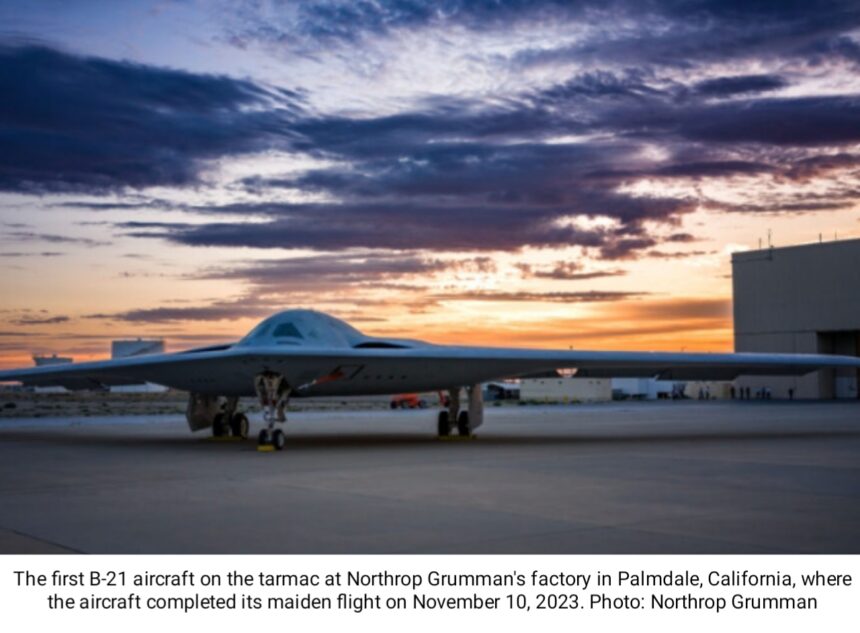
The United States’ B-21 Raider represents a major step forward in long-range strategic airpower and is widely regarded as one of the most advanced military aircraft ever developed. Built from the ground up as a next-generation stealth bomber, the aircraft has been designed to operate in highly contested environments where conventional combat aircraft would face significant risks. According to defense analysts, the B-21’s primary mission is to penetrate sophisticated integrated air defense networks, conduct precision strikes against high-value targets, and return safely while remaining difficult to detect throughout the mission.
At the heart of the B-21 Raider’s design is an exceptionally low radar cross-section, achieved through a combination of advanced shaping, radar-absorbing materials, carefully integrated engine placement, and minimized thermal and electromagnetic signatures. These features are intended to reduce the aircraft’s visibility to enemy surveillance systems, making detection and tracking considerably more challenging. While no aircraft is completely invisible to radar under all conditions, military experts believe the Raider significantly raises the difficulty for modern air defense systems attempting to locate and engage it.
The bomber is expected to play a central role in the United States’ future long-range strike capability. It has been designed to carry both conventional and nuclear weapons within internal weapon bays, preserving its stealth characteristics while providing flexibility across a wide range of military missions. This dual-role capability ensures that the aircraft can support conventional operations while also contributing to the country’s strategic nuclear deterrent.
Another defining feature of the B-21 Raider is its future-oriented architecture. The aircraft has been engineered with an open systems design that allows new technologies, sensors, communications equipment, and mission systems to be integrated more efficiently as operational requirements evolve. Defense officials have emphasized that this approach is intended to keep the bomber technologically relevant for decades without requiring extensive redesigns.
The B-21 is also being developed with the potential for optionally manned operations, reflecting the growing influence of automation and artificial intelligence in modern warfare. Although current operational concepts continue to involve human crews, the aircraft’s design points toward a future in which certain missions may be conducted with reduced or potentially no onboard personnel, depending on technological and operational developments. Such capabilities could reduce risks during particularly dangerous missions while expanding operational flexibility.
Strategically, the Raider is viewed as a key element of the United States’ effort to maintain credible long-range strike capabilities in an increasingly complex global security environment. As nations continue investing in advanced radar systems, long-range surface-to-air missiles, electronic warfare capabilities, and layered defensive networks, penetrating these defenses has become progressively more difficult. The B-21 has been specifically designed to address these emerging challenges and ensure that the United States retains the ability to project power over long distances.
The aircraft’s introduction is also expected to influence global military modernization efforts. Countries such as China and Russia continue developing advanced air defense technologies, while also pursuing their own next-generation bomber programs. The arrival of the B-21 Raider is therefore likely to contribute to continued competition in stealth technology, long-range precision strike capabilities, electronic warfare, and advanced sensing systems.
Despite widespread attention surrounding the aircraft, many technical details remain classified. The United States Department of Defense has released only limited information regarding the bomber’s full capabilities, ensuring that much of its operational performance remains confidential. Consequently, many public assessments rely on official statements, open-source analysis, and expert evaluations rather than complete technical disclosures.
Although many aspects of the B-21 Raider remain undisclosed, defense analysts broadly agree that it represents far more than simply another strategic bomber. It reflects the continuing evolution of air warfare toward greater survivability, networked operations, advanced automation, and long-range precision strike capabilities. As geopolitical competition intensifies across multiple regions, the Raider is expected to become one of the defining military platforms shaping strategic deterrence and global airpower throughout the coming decades.
B-21 is the new hope of the US in the defense challenge of China and Russia