
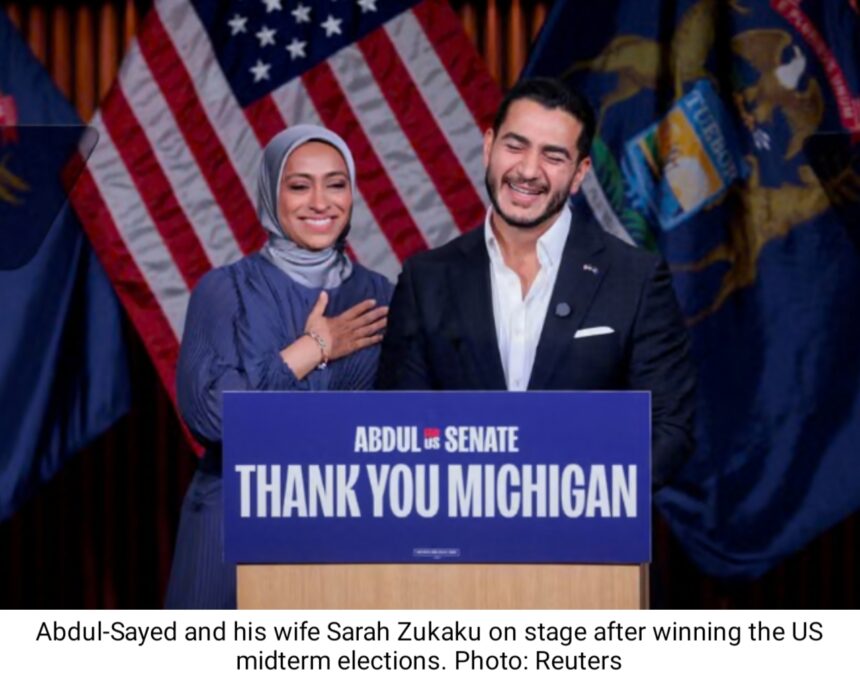
Abdul El-Sayed, a physician, public health advocate and progressive Democratic politician, has made history by winning Michigan’s closely watched US Senate election, defeating Republican candidate Mike Rogers to become the first Muslim elected to the United States Senate, marking a significant moment in American political history and a major breakthrough for Muslim representation in the country’s highest legislative chamber. El-Sayed declared victory early Wednesday at the Michigan Democratic Party headquarters in Detroit, where he addressed supporters and thanked voters for placing their confidence in a candidate who had initially been regarded as an unconventional challenger in a highly competitive political race. His victory also contributed to a broader Democratic resurgence in the 2026 midterm elections, as the party secured control of the Senate through a series of unexpected victories in several states, including Texas, Kansas and South Carolina, according to the election account provided.
Speaking to an enthusiastic crowd following his victory, El-Sayed reflected on the challenges of his campaign and the support he received from communities across Michigan. “You took a chance on the unlikeliest of candidates,” he said, thanking voters who welcomed him into their homes, churches and synagogues. He credited the success to a grassroots political movement built through approximately 18 months of campaigning across major urban centres, smaller communities and towns throughout the state. According to El-Sayed, ordinary voters played a central role in transforming his campaign into a winning movement, particularly during moments when the electoral contest appeared increasingly difficult.
The election attracted national attention because of El-Sayed’s political positions, Muslim identity and outspoken criticism of several aspects of US foreign policy. During the campaign, President Donald Trump and Vice-President JD Vance publicly attacked him, while Republican allies attempted to portray him as too radical for Michigan voters. Some of the attacks focused directly on his name and religious background. Trump reportedly described El-Sayed as a “jihadist” and made remarks suggesting that his religion would make him unsuitable for the Senate. These statements became part of a wider controversy over religious discrimination, political rhetoric and the treatment of Muslim candidates in American public life.
Responding to the attacks, El-Sayed argued that his opponents had chosen to create division rather than address the economic challenges facing American households, including the rising cost of fuel, groceries and essential services. He maintained that voters were more concerned about their daily financial struggles than political attacks based on religion or identity. In his victory speech, he delivered a message of national inclusion, declaring that America should be a country where people from different religious, cultural and ethnic backgrounds can participate equally in public life. Addressing Vice-President JD Vance directly, he also made a pointed remark about the constitutional responsibility of the vice-president to preside over the formal swearing-in of newly elected senators, saying that Vance would be constitutionally obligated to swear him into office in January.
El-Sayed defeated Mike Rogers, a former Republican congressman who had received Trump’s endorsement and positioned himself as a close political ally of the president. Rogers had previously contested Michigan’s Senate seat in 2024, losing narrowly to Democratic candidate Elissa Slotkin by approximately 0.3 percentage points. In the 2026 election, he faced a different political challenge against El-Sayed, whose campaign had already demonstrated its strength by defeating establishment favourite Haley Stevens in the Democratic primary earlier in the year. El-Sayed previously served as director of the Wayne County Department of Health, where he developed a public profile through his work in public health and community services.
Healthcare, economic inequality and American foreign policy were among the central issues of El-Sayed’s campaign. He advocated for Medicare for All, a proposal aimed at expanding universal healthcare coverage and ensuring that access to medical treatment is not determined by an individual’s financial circumstances. He also called for an end to US military assistance to Israel, arguing that American taxpayers’ money should be directed towards domestic priorities, including education, healthcare, infrastructure and social welfare. His position on Israel and US foreign policy became one of the most controversial aspects of the campaign, attracting strong opposition from pro-Israel political organisations and Republican supporters.
The pro-Israel lobbying organisation AIPAC, through its affiliated United Democracy Project Super PAC, reportedly spent approximately $30 million during the Democratic primary in an effort to prevent El-Sayed from securing the nomination. The reported expenditure represented a record level of spending for a single electoral race. Campaign advertising spending increased further during the general election, with more than $220 million reportedly spent by both parties by mid-October, according to AdImpact figures cited in the original report. The scale of financial involvement demonstrated how closely national political organisations were monitoring the Michigan contest and how much influence the result could have on the future direction of the Democratic Party.
During his victory address, El-Sayed returned to the question of how public money should be used, arguing that government resources must serve the needs of American citizens. He called for greater investment in schools, healthcare systems and infrastructure, while criticising the use of US funds in overseas conflicts and policies that he believes contribute to human suffering. His remarks reflected a central theme of his campaign: that American public policy should prioritise the welfare of ordinary people and focus on improving living standards at home.
Republicans had attempted to frame the Michigan election as a referendum on the Democratic Party’s progressive wing. Trump’s criticism of El-Sayed included accusations that he was a communist, alongside attacks linking him to the Egyptian Muslim Brotherhood. El-Sayed rejected the broader political strategy of portraying him as an extremist and continued to campaign on healthcare reform, economic concerns and foreign policy. An August Fox News poll found that 54 per cent of Michigan voters considered his political positions too extreme, while 51 per cent also believed that Rogers was too closely aligned with Trump. The figures highlighted the difficult political balance facing both candidates in a state where national political divisions and local economic concerns played significant roles.
Rogers had previously supported Trump’s tariff policies and military campaign against Iran, although he distanced himself from the president on both issues during the final weeks of the election campaign. He called for an end to the trade dispute between the United States and Canada and advocated a swift conclusion to the conflict involving Iran. His earlier political record included opposition to the Affordable Care Act, support for the Trump administration’s immigration enforcement policies and repetition of Trump’s false claims concerning the outcome of the 2020 presidential election.
The Michigan Senate seat became available following the decision of Democratic Senator Gary Peters to leave office after holding the position since 2015. The contest therefore attracted considerable attention from both major parties, which recognised the importance of the seat in determining the balance of power in Washington. El-Sayed’s victory represents a significant setback for Republicans in Michigan and adds to the political momentum of Democrats following their strong performance in the 2026 midterm elections.
Beyond the immediate implications for party politics, El-Sayed’s election carries considerable symbolic significance for Muslim Americans and other minority communities across the United States. His success demonstrates that a candidate from a Muslim background can compete in a major statewide election despite facing intense political opposition and public scrutiny over religious identity. It also brings renewed attention to questions of religious freedom, equal political representation and the place of minority communities in American democracy.
As the United States prepares for the next phase of political change in Washington, El-Sayed will face the challenge of translating his campaign promises into legislative action. His positions on universal healthcare, economic inequality, military assistance to Israel and the use of American taxpayer money are likely to attract considerable attention when he takes office. His election also raises questions about how the Democratic Party will balance its progressive agenda with the competing priorities of its broader political coalition.
For El-Sayed, the victory is both a personal political achievement and a historic development in the representation of Muslim Americans at the national level. His campaign began as an unlikely challenge to established political figures but ultimately became one of the most closely watched Senate contests of the 2026 election cycle. As the first Muslim elected to the US Senate, he enters a political institution shaped by centuries of American history with a mandate built around healthcare reform, economic justice, religious inclusion and a reassessment of US foreign policy.