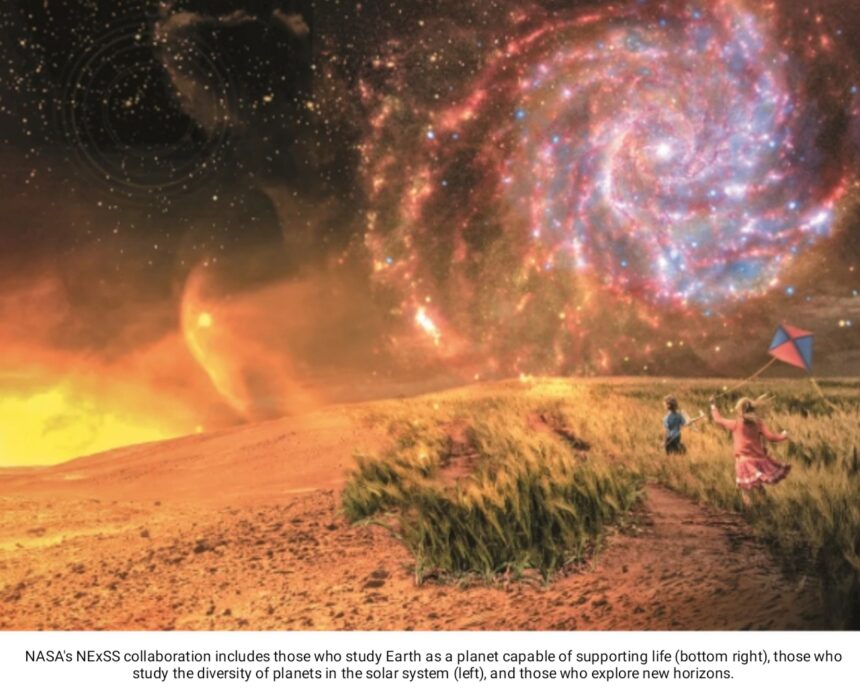
The question of whether humanity is alone in the universe remains one of the greatest scientific mysteries of the modern era. Across the observable universe, astronomers estimate there are hundreds of billions of galaxies, each containing hundreds of billions of stars, many of which are believed to host planetary systems. Yet despite decades of exploration and the discovery of thousands of exoplanets, Earth remains the only world where life has been conclusively confirmed. This unique status has profound implications for humanity. If Earth truly harbours the universe’s only living civilisation, then the survival of humankind carries significance far beyond our own planet. A global nuclear conflict, a catastrophic asteroid impact, or another existential disaster could erase not only human civilisation but potentially the only known form of conscious life capable of observing and understanding the cosmos, leaving the universe in complete silence.
At the same time, many scientists argue that the sheer scale of the cosmos makes it difficult to believe that Earth is the sole cradle of intelligent life. Numerous exoplanets have been identified within the so-called habitable zones of their parent stars, where conditions may allow liquid water—and potentially life—to exist. While no direct evidence of extraterrestrial civilisation has yet been found, the possibility that technologically advanced societies exist elsewhere in the Milky Way or in distant galaxies continues to drive scientific research and international space exploration efforts.
The prospect of encountering such an advanced civilisation, however, has long been the subject of both scientific debate and caution. Renowned theoretical physicist Stephen Hawking repeatedly warned that contact with an alien civilisation far more advanced than humanity might not necessarily benefit Earth. He compared such an encounter to Christopher Columbus’s arrival in the Americas—a meeting that proved devastating for many indigenous populations. Hawking argued that an advanced extraterrestrial civilisation could regard humanity as insignificant, much as humans view microscopic organisms, and there is no guarantee such a civilisation would approach Earth with peaceful intentions.
Although humanity has yet to discover definitive evidence of intelligent extraterrestrial life, the search continues through increasingly sophisticated telescopes, deep-space missions, and international scientific collaborations. Whether humanity is truly alone or one civilisation among many remains unanswered, but the outcome of that search could fundamentally reshape our understanding of life, intelligence, and humanity’s place in the cosmos. Until then, Earth remains the only known sanctuary of life—a reminder of both the extraordinary rarity of our existence and the shared responsibility to protect it.
Cosmic loneliness or unseen neighbors? New interest in the question of alien life