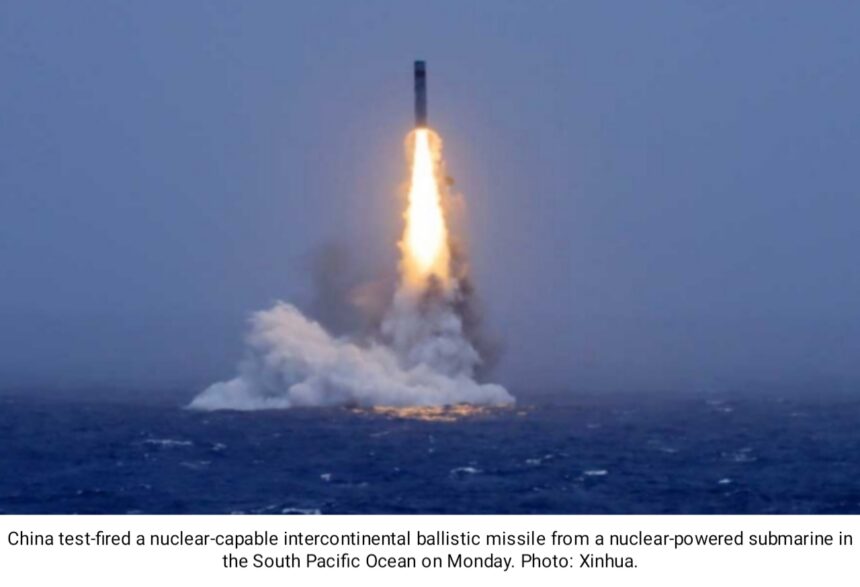
China has reportedly conducted a high-profile test of its submarine-launched JL-3 intercontinental ballistic missile (ICBM) from a Type 094 strategic nuclear submarine, demonstrating not only its evolving sea-based nuclear deterrent but also what analysts describe as a far broader test of integrated strategic command, missile tracking, satellite support, and long-range communications. According to available information, Beijing notified several countries before the launch in an effort to reduce the risk of miscalculation, while Japan publicly criticized the test over regional security concerns. During the exercise, the missile reportedly traveled approximately 7,300 kilometers before accurately reaching its designated impact area in the Pacific Ocean, although many defense analysts believe the JL-3’s maximum operational range could extend to between 10,000 and 12,000 kilometers, potentially placing large portions of the continental United States within reach when launched from Chinese strategic submarines. Beyond the missile’s performance itself, military observers argue that the most significant aspect of the operation was China’s extensive deployment of a sophisticated tracking and telemetry network. Beijing reportedly positioned four specialized vessels to monitor the missile throughout its flight, including Yuan Wang 5, previously deployed near Fiji, Yuan Wang 3 operating near the Philippines, Yuan Wang 6, and the advanced intelligence and tracking vessel Liao Wang 1 near the Solomon Islands. These ships, combined with China’s expanding satellite infrastructure, reportedly enabled continuous monitoring of the missile from launch to impact, allowing the People’s Liberation Army to evaluate real-time communications, telemetry, guidance, navigation, and command-and-control performance across vast distances. Defense experts note that while submarine-launched ballistic missile tests are routinely conducted by major nuclear powers, the integration of multiple tracking assets over such a broad operational area reflects China’s growing ability to support long-range strategic operations far beyond its immediate coastline. If the reported performance is accurate, the exercise would represent not merely another missile launch but a comprehensive validation of China’s expanding global military support architecture, reinforcing its second-strike nuclear capability while demonstrating increasingly sophisticated coordination between naval, space, and strategic forces. Although Beijing has not publicly disclosed all operational details, the reported success of the exercise is likely to draw close attention from the United States and its regional allies, as it highlights China’s continued investment in advanced strategic deterrence and long-range military capabilities, adding another dimension to the intensifying security competition across the Indo-Pacific region.
JL-3 test: Did China demonstrate new strategic military capabilities?