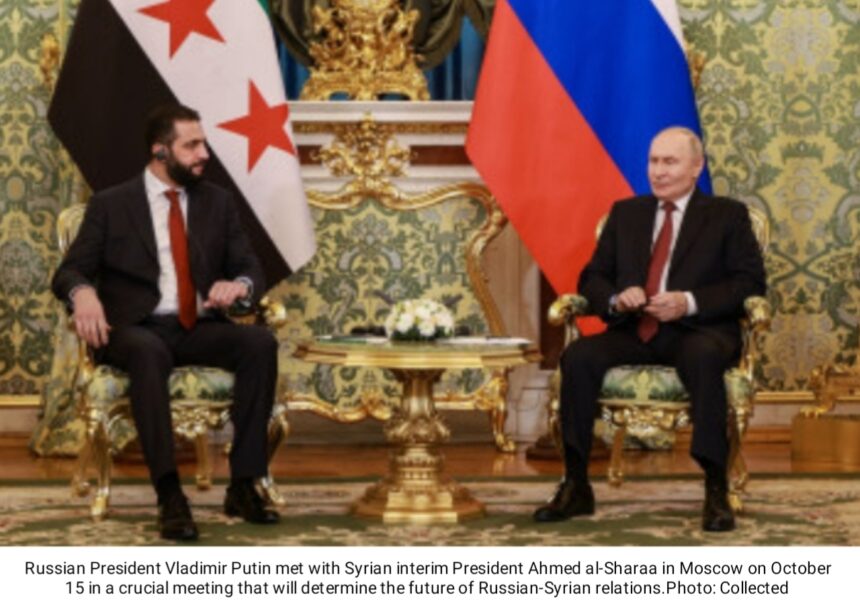
For decades, Syria remained firmly within the Soviet and later Russian sphere of influence, with Moscow emerging as one of Damascus’s most important political and military partners in the Middle East. Since the 1960s, successive Syrian governments maintained close strategic ties with Moscow, while Russia’s military presence on Syria’s Mediterranean coast became a key element of the Kremlin’s regional strategy. Russia’s naval and air facilities, along with the airports and ports surrounding them, provided Moscow with a strategically important foothold in the Mediterranean. During Syria’s long civil war, Russia intervened militarily in support of Bashar al-Assad’s government, carrying out extensive air operations that helped shift the balance of the conflict, while rights groups and international organisations documented widespread civilian casualties and destruction associated with the war. Yet after Assad’s fall, Syria’s new leadership did not immediately move to sever relations with Moscow or demand the immediate withdrawal of Russian forces from the country. Instead, Damascus chose negotiation. That decision reflects what analysts would describe as realpolitik: the practice of pursuing achievable national interests through pragmatic diplomacy rather than allowing ideological or emotional considerations to dictate policy. The new Syrian leadership could have demanded that Russia leave immediately, particularly given Moscow’s role in supporting Assad during the war. Instead, Syrian authorities have continued discussions with the Kremlin over the future of Russia’s military presence. That approach has now produced an initial diplomatic outcome, with Syria and Russia reaching an understanding over the future status and operation of Russian military facilities in the country. Under the emerging arrangement, Russia would not completely withdraw from its bases, but neither would it retain the same level of unrestricted control that it enjoyed under the previous Syrian government. The facilities would remain, while Syrian authorities would gain a greater role in areas surrounding them and in activities previously dominated by Russia. One of the most significant elements concerns civilian infrastructure linked to the Russian military presence. Airports, commercial ports and other civilian facilities adjacent to or associated with Russian bases would increasingly fall under Syrian control or supervision, strengthening Damascus’s claim to sovereignty over its territory. At the same time, the Russian military facilities could take on a broader role as joint training centres, allowing Syrian forces to receive training and benefit from Russian military expertise and infrastructure. On the surface, the arrangement may appear deeply contradictory. Russia was one of the principal military actors supporting Assad during the Syrian conflict, and its forces were accused by rights organisations and Western governments of conducting operations that caused extensive civilian suffering. Yet the same Russian military establishment could now become a partner in rebuilding and training Syria’s armed forces. The contrast illustrates one of the central realities of international politics: former adversaries can become partners when strategic interests change. For Damascus, an immediate confrontation with Moscow could have carried significant military and geopolitical risks. Russia, meanwhile, has strong strategic reasons to preserve its presence on the Mediterranean coast, particularly given the importance of its Syrian facilities to its wider regional posture. The emerging compromise therefore offers potential benefits to both sides. Russia can preserve a strategically valuable military foothold, while Syria can expand its sovereignty and administrative authority over infrastructure and territory previously dominated by Moscow. Syrian forces could also benefit from access to Russian training and military capabilities as Damascus attempts to rebuild state institutions and security structures after years of war. The arrangement nevertheless carries significant political and moral sensitivities. It means Syrian forces could receive training from officers belonging to a military that, only a few years ago, was fighting on the opposite side of Syria’s devastating civil war. For many Syrians, that history is unlikely to disappear simply because a new diplomatic relationship has emerged. But international diplomacy rarely operates according to simple categories of friend and enemy. States frequently cooperate with countries whose past actions they strongly opposed when doing so serves their present national interests. Syria’s approach to Russia therefore represents more than a dispute over military bases. It is part of a broader attempt by the new leadership to rebuild state institutions, restore sovereignty, strengthen its military capabilities and establish workable relationships with major international powers. The success of this strategy will ultimately depend on whether Russia respects Syria’s expanded authority, whether Damascus can effectively exercise control over the relevant infrastructure and whether both sides implement the terms of their understanding in practice. For now, however, Syria appears to have chosen pragmatism over confrontation. The policy does not necessarily mean forgetting Russia’s role in the Syrian war, nor does it erase the grievances of those who suffered during the conflict. Instead, it reflects a calculation that Syria may be better positioned to protect its long-term interests by negotiating with Moscow than by attempting to force Russia out altogether. In the language of international politics, this is realpolitik in practice: not abandoning the past, but recognising that the future of a state may sometimes require cooperation with yesterday’s adversary.
New relations beyond past bloodshed: Syria’s pragmatic steps with Russia