
Israeli Prime Minister Benjamin Netanyahu used one of the most politically charged stages in the world on Thursday to deliver a forceful defense of Israel’s military actions across the Middle East, but his appearance at the United Nations General Assembly was immediately overshadowed by a mass walkout of delegates and protests inside the chamber.
As Netanyahu approached the podium during the 81st session of the UN General Assembly in New York on September 24, dozens of representatives left the hall. The departure left large sections of the chamber visibly empty as the Israeli prime minister began speaking. Jeers and protests could be heard, while members of Israel’s delegation stood and applauded Netanyahu. The presiding officer repeatedly called for order.
Reuters reported that the walkout came as Netanyahu sought to defend Israel’s actions in Gaza, Lebanon and against Iran while facing growing international criticism over the country’s military campaign and diplomatic position.
Rather than softening his tone in response to the departures, Netanyahu confronted the protesters directly. He described those who walked out as “moral cowards” and challenged other delegates to leave as well.
The scene set the tone for a speech in which Netanyahu repeatedly presented Israel as fighting on several fronts simultaneously. He argued that Israel, a country he compared in size to the US state of New Jersey, had been engaged in a multi-front conflict for three years.
“In the last three years, our heroic soldiers have fought a war on seven fronts,” Netanyahu said, according to reports of the speech. He identified Hamas, Hezbollah, the Houthis, Iran, armed groups in Iraq and Syria, and Palestinian militants in the West Bank as part of what he described as the wider conflict facing Israel.
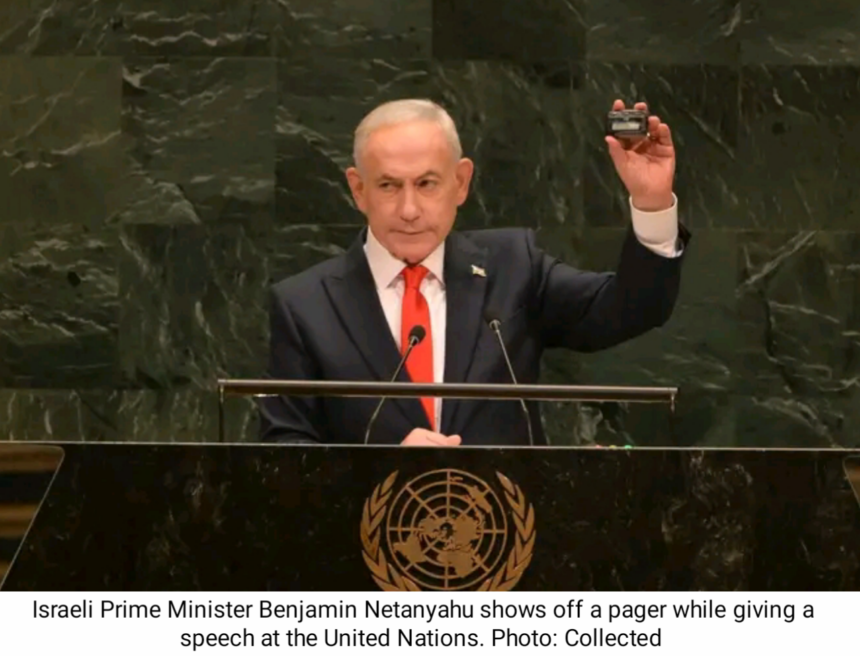
One of the most striking moments came when Netanyahu produced a pager while discussing Israel’s confrontation with Hezbollah in Lebanon.
Holding the device before the General Assembly, he referred to the September 2024 explosions involving pagers used by Hezbollah members. “Remember the beepers?” he asked. “Hezbollah certainly does.”
The reference was to a highly controversial operation in which thousands of pagers used by Hezbollah members exploded across Lebanon and parts of Syria on September 17, 2024. The blasts killed people and injured thousands, with civilians among those affected. Hezbollah blamed Israel for the operation. Israel did not initially publicly acknowledge responsibility, but Netanyahu later acknowledged Israel’s role, according to reports.
The pager operation became one of the most unusual episodes in the long-running confrontation between Israel and Hezbollah. The devices had reportedly been modified before reaching their users, allowing explosives to be detonated remotely. The attack was followed a day later by further explosions involving communications equipment, dramatically escalating tensions between Israel and Hezbollah.
Netanyahu used the incident as evidence of Israel’s ability to strike Hezbollah’s military infrastructure. He also referred to Hezbollah’s large arsenal of rockets and missiles, saying Israel had destroyed a substantial part of it.
The presentation of the pager was highly symbolic. Instead of describing the 2024 operation only in military terms, Netanyahu physically displayed one of the devices associated with it before an international audience. The moment appeared designed to reinforce his argument that Israel had successfully disrupted Hezbollah’s military capabilities.
But the reaction inside the General Assembly showed how sharply divided the international response to Israel remains.
The walkout occurred at the very beginning of Netanyahu’s address, producing images of an unusually sparse chamber. Some delegates remained in their seats while others exited. Israeli representatives applauded their prime minister as he continued.
Netanyahu’s speech was also marked by repeated attacks on Israel’s critics.
Iran occupied a central place in his remarks. Netanyahu described Iran’s government in highly hostile terms and argued that Israel and the United States had prevented Tehran from developing nuclear weapons capable of threatening Israel.
He said he had made a long-standing commitment to prevent Iran from acquiring nuclear weapons and defended Israel’s military actions against Iranian nuclear facilities.
Netanyahu also predicted that Iran’s current political leadership would eventually fall, saying the end of the Iranian government was not far away.
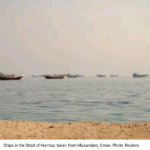
Iran, however, remains governed by its existing political system and continues to oppose Israel and the United States on several regional fronts. The confrontation between Washington, Tehran and their respective allies has become one of the central security issues surrounding the 2026 UN General Assembly. The wider regional crisis has also involved disputes over the Strait of Hormuz, where maritime security and energy supplies have become major international concerns.
Netanyahu’s comments came only days after other leaders used the UN platform to criticize Israel’s military campaign and call for greater international pressure to end the conflict in Gaza.
The Israeli prime minister rejected allegations that Israel was committing genocide in Gaza. He described the accusation as false and defended Israel’s conduct during the war.
Israel has consistently rejected genocide allegations, saying its military campaign is directed against Hamas and that it takes steps to provide humanitarian assistance to Gaza. Critics, however, have accused Israel of causing catastrophic civilian suffering through its military operations and restrictions affecting the territory.
The dispute has become one of the most divisive issues at the United Nations, with governments taking sharply different positions over Israel’s conduct, Palestinian statehood and the future of Gaza.
Netanyahu also turned his attention to Turkey and President Recep Tayyip Erdogan.
He called Erdogan a “tyrant” and accused Turkey of supporting Hamas. Turkey has strongly criticized Israel’s military actions in Gaza and has backed Palestinian statehood. Erdogan has repeatedly called for international pressure on Israel and has described the humanitarian situation in Gaza as unacceptable. Reuters reported earlier this week that Erdogan used his own UN address to criticize the international system and call for wider recognition of a Palestinian state.
Netanyahu also criticized Qatar, accusing the country of supporting Hamas and influencing Western institutions and media. Qatar has played a significant role in mediation efforts related to Gaza and negotiations involving Israel and Hamas.
Another target was New York City Mayor Zohran Mamdani, who has previously criticized Netanyahu and Israel’s conduct in Gaza.
Netanyahu accused Mamdani of antisemitism and claimed that Jewish residents of New York felt less safe after his election. Mamdani has rejected Netanyahu’s characterization of his political position, while his previous statements have included strong criticism of Israel’s military actions and support for Palestinian rights. Reuters reported before Netanyahu’s UN appearance that the Israeli prime minister intended to confront criticism from the New York mayor during his speech.
Netanyahu also criticized Britain and France over their criticism of Israel and accusations relating to Israeli settlements and colonialism. He pointed to the historical role of European powers in colonialism while defending Israel against contemporary accusations.
The speech was therefore broader than a discussion of the wars involving Israel. Netanyahu used the UN platform to address Iran, Hezbollah, Hamas, Turkey, Qatar, European governments and political opponents in the United States.
At the center of his argument was the idea that Israel is facing a coordinated campaign from multiple adversaries.
Netanyahu said Israel had fought across seven fronts over the previous three years and portrayed the country’s military operations as necessary for its survival.
His argument was particularly focused on Iran.
He defended Israel’s decision to strike Iranian nuclear facilities and said the operation had been necessary to prevent Iran from obtaining nuclear weapons. Netanyahu also praised US President Donald Trump as an important partner in Israel’s confrontation with Iran and other regional adversaries.
The Iranian delegation was not present in the chamber during Netanyahu’s address, according to reports. Netanyahu nevertheless addressed the Iranian leadership directly and said that one day the Iranian people would be free.
The speech came at a particularly sensitive moment for Netanyahu domestically.
Israel is heading toward elections on October 27, and Netanyahu’s appearance at the United Nations came during an increasingly active political campaign. Reuters reported that his New York visit was brief and that he was not scheduled for a meeting with senior US leaders during the trip.
That domestic political context added another layer to an already highly charged international appearance.
For Netanyahu, the UN address provided an opportunity to defend Israel’s military record before representatives of nearly every country in the world. But the walkout at the start of the speech also demonstrated the depth of opposition confronting Israel at the international level.
The contrast was striking.
As dozens of delegates left the chamber, Netanyahu continued speaking to those who remained. His Israeli delegation applauded, while the presiding officer attempted to maintain order.
The scene reflected the wider diplomatic divide surrounding Israel.
For supporters of Israel, Netanyahu’s speech was an attempt to explain why the country believes its military campaigns are necessary after years of attacks by Hamas, Hezbollah and other armed groups.
For critics, the speech reinforced concerns over Israel’s military conduct in Gaza and its broader regional operations.
The pager display became the clearest visual symbol of that divide.
To Netanyahu, the device represented Israel’s ability to penetrate Hezbollah’s communications network and strike a major armed organization.
To critics, the episode remains associated with a large-scale operation in which explosions killed and wounded people across Lebanon and Syria, including civilians.
The 2024 pager attack also demonstrated how the conflict had moved beyond conventional battlefields. Communications technology, intelligence operations and covert methods had become part of the confrontation between Israel and Hezbollah.
By bringing a pager into the General Assembly, Netanyahu transformed that episode into a physical reminder of the conflict.
“Remember the beepers?” he asked the chamber.
His message was clear: Israel’s military campaign against Hezbollah had produced results, and he wanted world leaders to remember them.
But the reaction inside the UN suggested that the international debate over Israel’s actions remains far from settled.
The walkout, the protests and the empty seats showed that Netanyahu was speaking to an audience deeply divided over Israel’s conduct in Gaza, Lebanon and its confrontation with Iran.
At the same time, Netanyahu showed no indication that he intended to moderate his position.
He defended Israel’s military actions, rejected accusations of genocide, attacked several foreign leaders and predicted the eventual fall of Iran’s leadership.
His speech ended with a message of determination.
“We will win,” Netanyahu said, presenting Israel’s position as one of necessity rather than choice.
The events surrounding the speech illustrated the increasingly polarized diplomatic environment facing Israel. The United Nations remains one of the few places where opposing governments can publicly confront one another on the same stage, but Netanyahu’s appearance demonstrated how difficult consensus has become over the wars reshaping the Middle East.
The pager in his hand, the empty seats behind him and the applause from his own delegation together created a striking picture of the current international dispute.
Netanyahu came to the United Nations to defend Israel.
He left behind an image of a General Assembly sharply divided over the wars, alliances and competing claims that have defined the Middle East conflict in recent years.