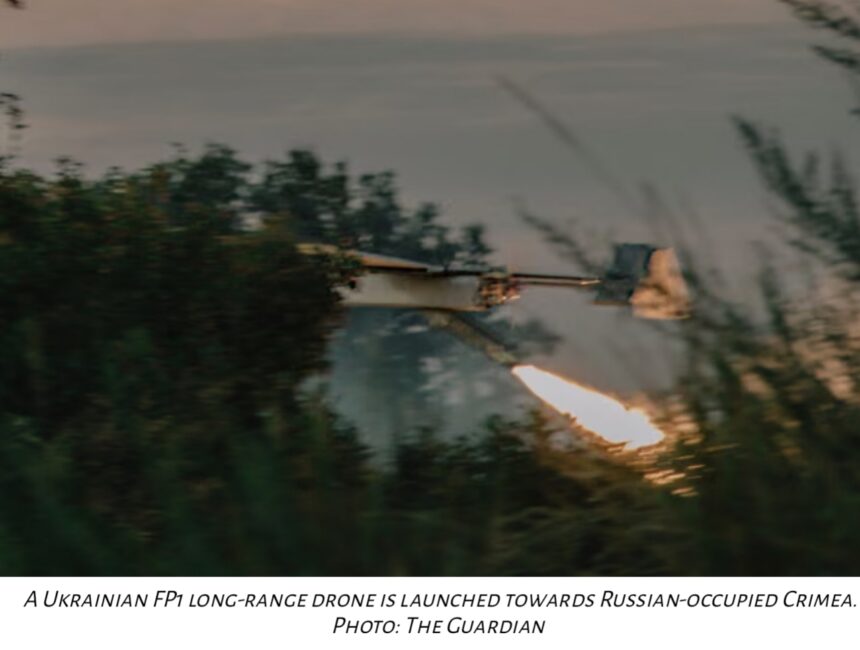
As the sun dipped below vast fields of yellow sunflowers in eastern Ukraine, the quiet of the evening was shattered by the distinctive growl of what sounded like a moped engine—an increasingly familiar signal on one of the world’s most technologically advanced battlefields. Moments later, a Ukrainian long-range drone burst into the twilight sky, trailing flames and thick black smoke before disappearing toward the horizon, reportedly on a mission aimed at Russian-occupied Crimea. More than four years after Russia launched its full-scale invasion of Ukraine, the conflict has undergone a profound transformation, evolving from a conventional war dominated by tanks, artillery and trench warfare into a high-intensity contest for control of the skies through unmanned aerial systems. Military analysts say the battlefield has become a testing ground for next-generation warfare, where drones now perform missions ranging from intelligence gathering and battlefield surveillance to precision strikes deep behind enemy lines, reshaping military doctrine at an unprecedented pace. Ukrainian commanders argue that innovation, rapid adaptation and domestic drone production have become central pillars of Kyiv’s defense strategy, while Russia has simultaneously expanded its own arsenal of long-range drones, loitering munitions and electronic warfare capabilities in an effort to counter Ukrainian operations. The result is an increasingly sophisticated technological confrontation in which both sides race to develop more capable, longer-range and more resilient unmanned systems capable of penetrating heavily defended airspace. Crimea, annexed by Russia in 2014 and transformed into a major military hub, remains one of Ukraine’s most strategically significant targets, serving as a key logistics, naval and command center for Russian operations across southern Ukraine and the Black Sea. Defense experts say the expanding drone campaign is redefining the nature of modern warfare by allowing relatively low-cost unmanned aircraft to challenge far more expensive conventional military assets, while reducing risks to pilots and enabling sustained long-range operations. As both Moscow and Kyiv continue investing heavily in drone technology, electronic countermeasures and artificial intelligence, analysts believe the war is increasingly becoming a global laboratory for future military innovation, with lessons likely to influence defense planning, procurement strategies and battlefield tactics far beyond Eastern Europe. The accelerating drone race underscores not only the changing character of the Ukraine conflict but also the emergence of a new era in warfare, where technological superiority, industrial capacity and the speed of innovation may prove as decisive as traditional firepower on the battlefield.
The sky is now the battlefield: The decisive role of drone technology in the Ukraine-Russia conflict