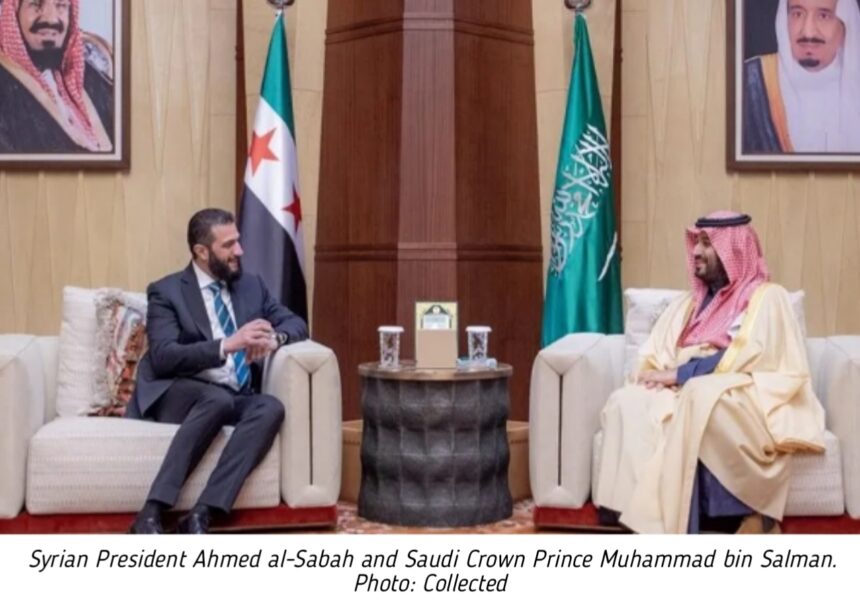
Syrian President Ahmad al-Sharaa and Saudi Crown Prince Mohammed bin Salman held a high-level telephone conversation on Thursday, reaffirming their commitment to strengthening bilateral relations, enhancing regional security cooperation, and supporting diplomatic efforts to reduce tensions across the Middle East amid a rapidly evolving security environment.
According to the Saudi Press Agency, the call was initiated by President al-Sharaa, who strongly condemned what he described as an attempted attack by Iran-backed armed groups in Iraq against Saudi oil facilities. During the conversation, the Syrian leader reaffirmed Damascus’ support for the Kingdom’s sovereignty, territorial integrity, and national security, emphasizing that attacks targeting critical energy infrastructure threaten not only regional stability but also global economic security.
The discussion reflected the growing political and diplomatic engagement between Damascus and Riyadh as both governments seek to deepen cooperation following years of strained relations. The two leaders reviewed opportunities to expand bilateral ties in areas including security coordination, political dialogue, economic cooperation, and regional diplomacy.
President al-Sharaa and Crown Prince Mohammed bin Salman also exchanged views on the rapidly changing geopolitical landscape in the Middle East. They stressed the importance of de-escalation, dialogue, and collective regional efforts aimed at preventing further conflict while promoting peace, stability, and sustainable security. Both leaders agreed that continued coordination among regional states is essential to addressing shared security challenges, including cross-border threats, armed groups, and attacks on strategic infrastructure.
The telephone conversation comes against the backdrop of heightened regional tensions following military strikes carried out Tuesday night by United States and Saudi forces against targets linked to Iran-backed groups in Iraq. Saudi Arabia said the operation was conducted under Article 51 of the United Nations Charter, describing it as an act of self-defense following attacks on Saudi oil facilities. Iranian officials, however, condemned the strikes, arguing that they violated Iraq’s sovereignty and risked further destabilizing an already volatile region.
The latest developments underscore the increasingly complex security dynamics across the Middle East, where competition among regional powers, proxy conflicts, and strategic energy interests continue to shape diplomatic and military calculations. Analysts say attacks on energy infrastructure remain among the most sensitive flashpoints because of their potential impact on global oil markets and international energy security.
Observers note that Thursday’s conversation between the Syrian and Saudi leaders signals a continued normalization of relations between Damascus and Riyadh, with both governments placing greater emphasis on political dialogue and coordinated security policies. The call also highlights Saudi Arabia’s broader strategy of strengthening partnerships with regional states while seeking to contain security threats through a combination of diplomacy and deterrence.
Although no specific agreements were announced following the discussion, officials described the exchange as constructive and focused on reinforcing cooperation to confront common regional challenges. Both sides reiterated their commitment to supporting initiatives that promote peace, reduce tensions, and preserve stability across the Middle East.
The phone call is expected to add momentum to ongoing diplomatic efforts aimed at preventing further escalation in the region, as governments continue balancing security concerns with broader objectives of regional cooperation, economic development, and long-term political stability. With conflicts and rivalries continuing to influence the strategic landscape, closer coordination between Arab states is increasingly viewed as a key element in shaping the future security architecture of the Middle East.
Syrian President holds crucial phone call with Saudi Crown Prince amid Middle East tensions