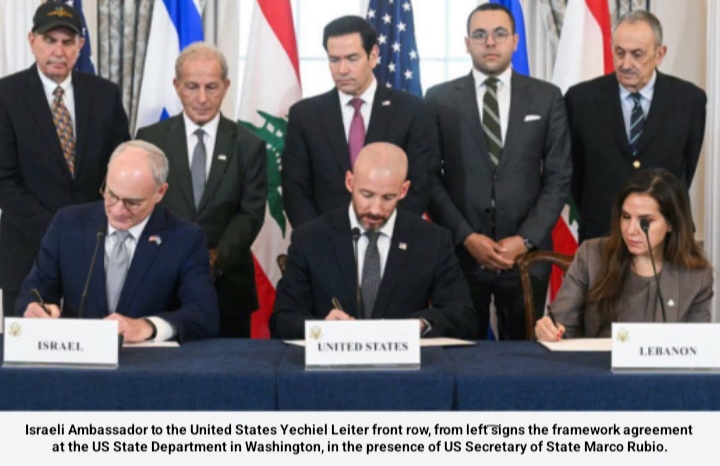
Washington, D.C. | International Desk: In a significant diplomatic breakthrough aimed at reducing tensions in the Middle East, Israel and Lebanon have signed a U.S.-brokered framework agreement in Washington, marking what officials describe as the first step toward ending years of cross-border conflict. While the agreement has been welcomed as an important diplomatic milestone, analysts caution that its long-term success will depend on implementation, the withdrawal of Israeli forces, and the position of Hezbollah, which has rejected the deal.
Speaking at the signing ceremony at the U.S. Department of State on Friday, U.S. Secretary of State Marco Rubio described the agreement as “the beginning of the beginning,” emphasizing that substantial work remains before lasting peace can be achieved. The agreement was signed by Lebanon’s Ambassador Nada Mouawad, Israel’s Ambassador Yechiel Leiter, and representatives of the United States, making it an officially trilateral framework.
According to the U.S. administration, the agreement is designed to restore Lebanon’s sovereignty, strengthen the authority of the Lebanese Armed Forces across the country’s territory, dismantle the military infrastructure of non-state armed groups—primarily Hezbollah—and ultimately facilitate a phased withdrawal of Israeli troops from Lebanese territory. To oversee implementation, the parties will establish a trilateral Military Coordination Group for Lebanon, responsible for monitoring progress and ensuring compliance with each stage of the agreement.
The framework also introduces two initial “pilot zones,” where Israeli forces will gradually withdraw while the Lebanese Army assumes full security responsibilities. Once non-state armed groups have been successfully disarmed in these areas, international reconstruction efforts will begin, allowing displaced civilians to return safely to their homes after months of conflict and destruction.
Israeli Prime Minister Benjamin Netanyahu stated that Israeli forces would only complete their withdrawal after Hezbollah is fully disarmed and Israel’s security concerns have been addressed. He stressed that Israel would not compromise its national security and would retain the right to act against future threats if necessary.
To support the implementation process, the United States announced an immediate humanitarian assistance package worth $100 million, coordinated with the United Nations, alongside more than $30 million in additional assistance to strengthen the operational capabilities of the Lebanese Armed Forces under existing legal frameworks.
Lebanese Prime Minister Nawaf Salam welcomed the agreement, saying its primary objective is to secure the complete withdrawal of Israeli forces from all Lebanese territory while restoring full state authority. President Joseph Aoun also described the agreement as an important step toward reaffirming Lebanon’s sovereignty and expressed hope that it would pave the way for hundreds of thousands of displaced citizens to return home.
Despite the diplomatic progress, Hezbollah has firmly rejected the agreement. The organization did not participate in the negotiations and continues to insist that Israel must withdraw from Lebanese territory without conditions. Hezbollah Secretary-General Naim Qassem has also rejected any normalization of relations with Israel. Senior Hezbollah lawmaker Hassan Fadlallah warned that any attempt by the Lebanese Army, backed by the United States, to enforce the agreement through military force could push Lebanon toward civil conflict. He reiterated that Hezbollah would retain its weapons and resist any effort to implement provisions it considers unacceptable.
The agreement comes after nearly three years of escalating hostilities that began in October 2023, during which southern Lebanon suffered widespread destruction. Israeli military operations expanded beyond border regions to include Beirut and the Bekaa Valley, leaving more than 4,000 people dead and forcing over one million residents to flee their homes. Although previous ceasefire arrangements reduced the intensity of fighting, Israel continues to control approximately one-fifth of southern Lebanese territory.
Even on the day the agreement was signed, reports indicated renewed Israeli airstrikes in southern Lebanon, highlighting the fragile security environment. Israel maintains that these operations are necessary to preserve a security buffer zone aimed at preventing future attacks by Hezbollah.
Regional experts argue that while the new framework agreement represents an important diplomatic opening, achieving lasting peace will require overcoming deep political, military, and security obstacles. The decades-long state of hostility between Israel and Lebanon, combined with Hezbollah’s continued armed presence and opposition to the agreement, remains a significant challenge. Although Israel has declared that it has no permanent territorial ambitions inside Lebanon, statements from several senior Israeli officials advocating a prolonged military presence continue to raise concerns about the agreement’s future.
As a result, the Washington framework agreement may provide a promising foundation for de-escalation and regional stability, but its ultimate success will depend on sustained political commitment, effective implementation, and the willingness of all influential actors to prevent a return to conflict.
U.S.-Brokered Israel-Lebanon Framework Agreement Marks First Step Toward Peace, but Major Challenges Remain