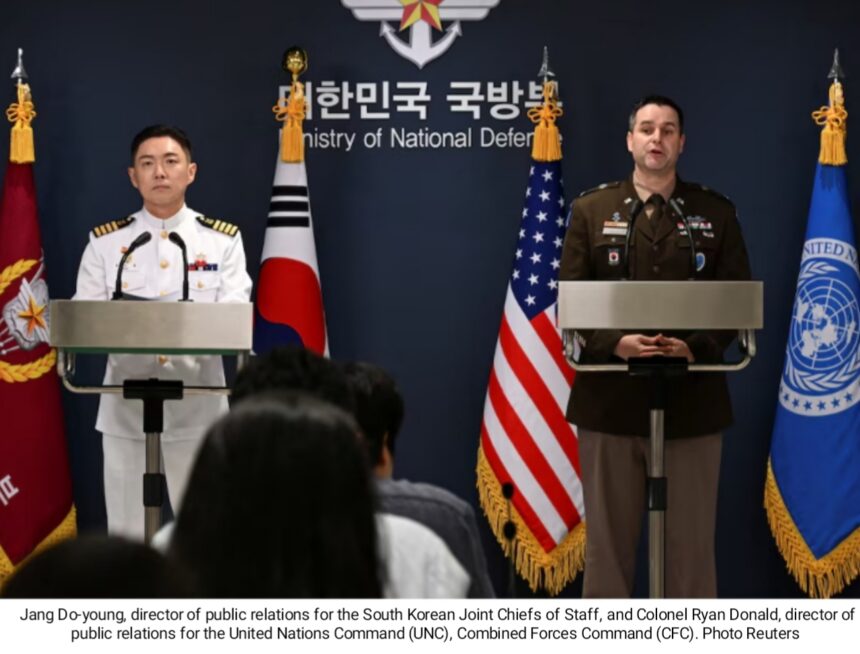
South Korea and the United States are set to conduct their annual Ulchi Freedom Shield (UFS) joint military exercise from August 17 to 27, as the two allies seek to strengthen their ability to respond to North Korea’s rapidly evolving military capabilities, including the growing use of drones, electronic warfare, GPS disruption and cyberattacks. The large-scale exercise will combine military training with emergency preparedness drills involving the South Korean government and is intended to test the allies’ ability to coordinate operations and maintain readiness in the event of a crisis on the Korean Peninsula. Officials said the exercise reflects the changing nature of modern warfare, with unmanned systems, cyber operations and electronic warfare becoming increasingly important on the battlefield. Colonel Ryan Donald, director of public affairs for the Combined Forces Command, United Nations Command and U.S. Forces Korea, said North Korea’s military capabilities have been influenced by lessons learned from the battlefield in Ukraine, where North Korean troops have reportedly been deployed alongside Russian forces. “DPRK soldiers have deployed and fought in Ukraine, and they’ve taken those lessons they’ve learned there and brought them back to North Korea,” Donald said, referring to the Democratic People’s Republic of Korea, North Korea’s official name. He said the development had changed the nature of the threat posed by Pyongyang and that the allies’ training would take those capabilities into account. The exercise, however, remains focused strictly on responding to threats on the Korean Peninsula and defending South Korea, officials said. About 18,000 South Korean troops are expected to participate in this year’s drills, a level broadly similar to previous exercises, according to Captain Jang Doyoung of South Korea’s Joint Chiefs of Staff. Washington and Seoul describe the annual exercise as defensive, designed to strengthen combined military readiness and the ability to deter aggression, but North Korea has routinely condemned such drills as provocative military actions that could further inflame tensions in the region. The latest exercises come at a particularly sensitive moment, as relations between the two Koreas remain deeply strained and Pyongyang continues to expand its nuclear and missile capabilities despite United Nations Security Council sanctions. North Korea last week launched a short-range ballistic missile toward the sea, underscoring the continuing security challenges facing South Korea and its allies. Pyongyang has continued developing nuclear weapons, ballistic and cruise missiles, artillery systems and other conventional military capabilities, while its leadership has adopted an increasingly confrontational stance toward Seoul. North Korea has also moved further away from its previous policy of pursuing eventual reunification with South Korea, revising its constitution this year to remove references to reunification and define its territory in direct opposition to the South. The North has separately described itself as a “responsible nuclear weapons state” and reaffirmed its intention to advance its nuclear weapons programme, raising concerns in Seoul, Washington and across the wider Asia-Pacific region. Against this backdrop, the Ulchi Freedom Shield exercise is expected to serve as a major test of the South Korean and U.S. militaries’ ability to operate together under increasingly complex battlefield conditions, including potential drone swarms, GPS interference, cyberattacks and electronic warfare. The drills also highlight the broader transformation of security dynamics in East Asia, where North Korea’s expanding nuclear and conventional arsenal, its growing military cooperation with Russia and the lessons emerging from the war in Ukraine are forcing the United States and South Korea to adapt their defence planning and operational capabilities. While officials insist the exercise is defensive and aimed at protecting South Korea, the military drills are likely to be closely monitored by Pyongyang, which has historically responded to large-scale U.S.-South Korean exercises with warnings, weapons tests and heightened military activity. The latest UFS exercise therefore comes at a time when efforts to maintain deterrence on the Korean Peninsula are increasingly intertwined with wider geopolitical tensions, technological changes in warfare and the growing strategic importance of cyber, space and unmanned military capabilities.
US-South Korea hold major joint military drills to counter North Korea’s growing military capabilities