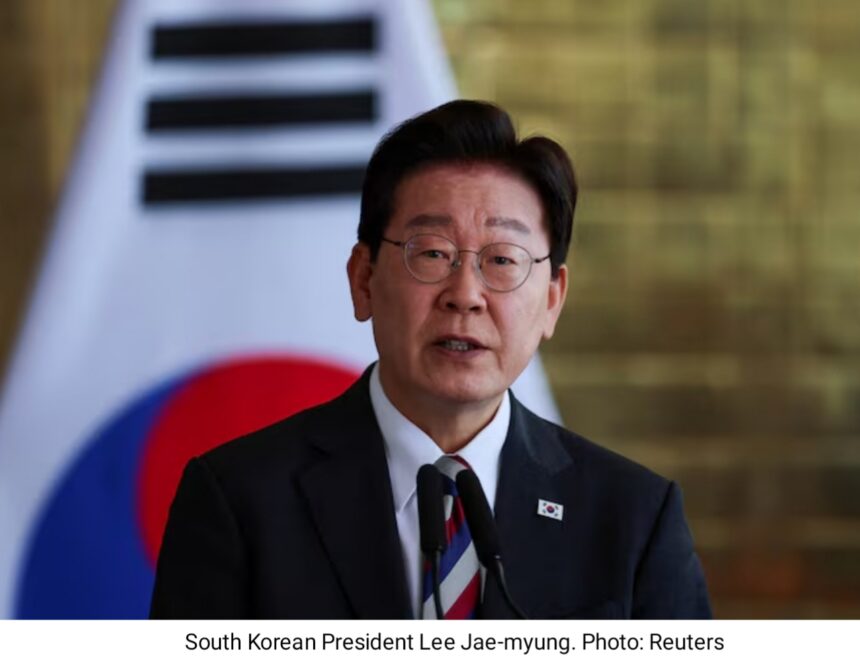
SEOUL, August 15, 2026 — South Korean President Lee Jae Myung has called for renewed dialogue with North Korea and urged the two Koreas to pursue peaceful coexistence, saying effective and lasting safeguards are needed to prevent military tensions from escalating into armed conflict. In a major speech on Saturday marking Korea’s liberation from Japanese colonial rule, Lee said Seoul would seek direct communication with Pyongyang and work to replace the armistice that halted the 1950-53 Korean War with a durable peace regime. His remarks came as inter-Korean relations remain deeply strained, with military tensions, North Korea’s nuclear programme and competing security policies continuing to divide the peninsula. Lee said the two Koreas and other concerned parties should explore through dialogue how to formally bring the Korean War to an end. The 1950-53 conflict was halted by an armistice rather than a peace treaty, leaving the Korean Peninsula without a comprehensive peace settlement more than seven decades later. Lee argued that this prolonged and unstable security structure should eventually be replaced by a system capable of preventing confrontation and containing crises before they escalate. He also said negotiations could examine practical and effective measures to curb North Korea’s nuclear capabilities, indicating that Seoul’s proposed dialogue would extend beyond political engagement to the peninsula’s most sensitive security issue. At the same time, Lee stressed that South Korea would take pre-emptive and sustained steps to reduce tensions and establish multiple layers of safeguards to prevent further deterioration. The policy is aimed at keeping the door open to diplomacy while maintaining mechanisms to ensure that an unexpected military or political crisis does not rapidly develop into a wider conflict. Lee’s latest appeal largely continues his pledge last year to respect North Korea’s political system and pursue peaceful coexistence with Pyongyang. But the prospects for engagement remain uncertain. North Korean leader Kim Jong Un has abandoned Pyongyang’s previous reunification policy, described South Korea as its most hostile state and ordered stronger frontline defences. North Korea has repeatedly rejected or criticised Seoul’s calls for dialogue and has opposed South Korea’s plans for nuclear-powered submarines. Pyongyang has also denounced joint U.S.-South Korean military exercises as provocations and views such military activities as a threat to its security. Seoul and Washington, meanwhile, argue that maintaining a strong deterrent is necessary because of North Korea’s missile and nuclear programmes. That mutual security dilemma remains one of the biggest obstacles to reducing tensions on the Korean Peninsula. Against this backdrop, Lee’s proposal is being viewed as more than a call for a single meeting. It forms part of a broader diplomatic effort to prevent accidental military clashes, restore political communication and gradually establish a more stable security framework. If North Korea returns to negotiations, future talks could address nuclear risks, military confidence-building measures, border tensions and the formal conclusion of the Korean War. However, major political and strategic obstacles remain, particularly the deep mistrust that has developed between Seoul and Pyongyang over decades. Lee also addressed South Korea’s relations with Japan in his liberation-day speech. He said the two countries must confront the difficult history of Japanese colonial rule while also looking toward the future. He expressed hope for a new era of peace and prosperity with Japan as a close neighbour. Lee’s simultaneous emphasis on dialogue with North Korea and stronger ties with Japan points to Seoul’s broader diplomatic strategy for strengthening stability in Northeast Asia. The success of the initiative, however, will depend not only on Pyongyang’s response but also on the positions of the United States, Japan, China and other powers involved in the security architecture surrounding the Korean Peninsula. For now, Seoul’s message is clear: South Korea intends to maintain its deterrence capabilities while keeping the door to diplomacy open and seeking to move from the current armistice-based framework toward a genuine and lasting peace regime. The central question is whether Pyongyang will respond to Seoul’s appeal and return to the negotiating table. North Korea’s response could become the most important factor shaping the future direction of inter-Korean relations.
Seoul wants to end 73-year-long ceasefire, proposes permanent peace arrangement