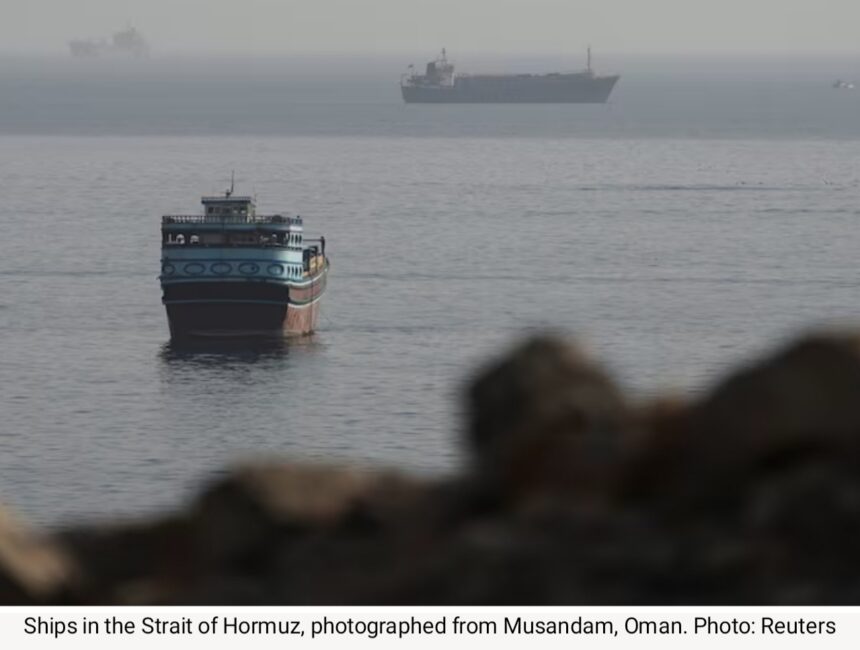
Oil prices rose on Monday as uncertainty continued over when the strategically vital Strait of Hormuz will fully reopen, despite Iran saying that an agreement with Oman to establish new shipping lanes had reached its final stages, while insisting that Washington must meet additional conditions before normal maritime traffic can resume. Brent crude futures climbed 91 cents, or 1.09%, to $84.46 a barrel by 0056 GMT, while U.S. West Texas Intermediate crude futures gained 61 cents, or 0.78%, to $78.79 a barrel. Both benchmarks had fallen by more than 7% last week as traders became increasingly optimistic that Iran and Oman were close to an arrangement that could facilitate the reopening of the Strait of Hormuz, one of the world’s most strategically important energy corridors, through which roughly one-fifth of global oil supplies moved before the conflict disrupted shipping. Iran said on Sunday that an agreement with Oman was in its “final stages”, but reiterated that reopening the waterway would depend on Washington meeting additional conditions, including compensation to Iran for extensive U.S. attacks. The uncertainty has kept traders cautious, with market participants reluctant to fully remove the geopolitical risk premium from crude prices until there is concrete evidence that commercial shipping can safely resume. Tim Waterer, chief market analyst at KCM Trade, said traders had been conditioned by the repeated changes in the negotiations and were therefore waiting for tangible signs such as verified tanker movements or formal agreements before further reducing the risk premium. The situation has been further complicated by the absence of direct negotiations between Iran and the United States. Iranian Foreign Minister Abbas Araqchi said on Sunday that Tehran was not engaged in talks with Washington and would not begin new negotiations as long as the United States continued to violate an interim agreement signed in June. The uncertainty surrounding the Strait of Hormuz has also been accompanied by renewed attacks on energy infrastructure in the region, raising fresh concerns over global oil supplies. An oil facility in Saudi Arabia was attacked over the weekend, while the Iran-aligned Houthi movement claimed on Sunday that it had targeted Saudi Aramco’s Jazan refinery. The incident came just two days after Saudi Arabia signed a joint defence pact with Turkey and Pakistan amid growing regional instability linked to the conflict involving the United States, Israel and Iran. Separately, the United Arab Emirates’ ADNOC said on Friday that 15 of its vessels had been attacked while transiting the Strait of Hormuz since the beginning of the conflict, underscoring the growing risks faced by commercial shipping in one of the world’s most important maritime chokepoints. Although the emerging Iran-Oman arrangement could eventually provide a framework for reopening the waterway, the absence of a broader political settlement means that the outlook for shipping remains uncertain. For global energy markets, the key question is no longer simply whether Iran and Oman can finalize an agreement on shipping lanes, but whether the wider conditions demanded by Tehran can be met and whether commercial vessels will be able to operate safely and consistently through the strait. Until tanker traffic resumes on a sustained basis, traders are likely to maintain a geopolitical risk premium in oil prices, while any further attacks on energy facilities or shipping could quickly intensify concerns about supply disruptions. The continuing uncertainty around Hormuz therefore leaves global energy markets exposed to renewed price volatility, with prolonged disruption potentially affecting crude supplies, shipping costs, inflation and economic activity well beyond the Middle East.
Oil prices rise again on uncertainty over opening of Strait of Hormuz