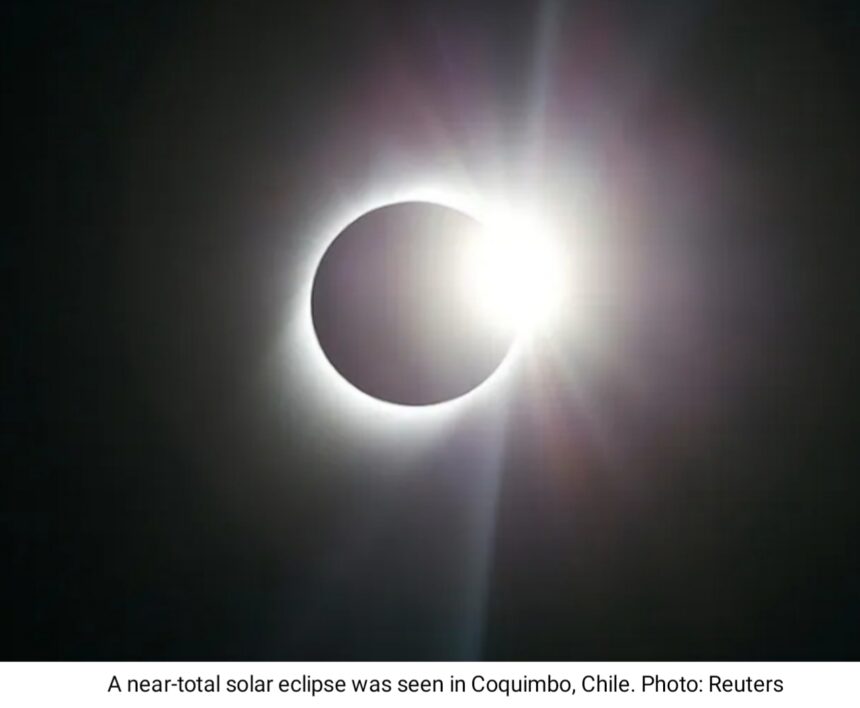
A rare total solar eclipse is set to cross parts of the Arctic, Greenland, Iceland and Europe on Wednesday, August 12, offering millions of people a spectacular opportunity to witness one of nature’s most dramatic astronomical events as the Moon moves directly between the Earth and the Sun, briefly turning daylight into darkness. Beginning at around 15:34 GMT, the Moon’s shadow will travel rapidly across the planet, passing from the Arctic region towards Greenland and Iceland before reaching the Iberian Peninsula, with totality lasting for as long as about two minutes and 18 seconds at the most favourable locations. The event is particularly significant for mainland Europe because it will be the continent’s first total solar eclipse visible from its mainland since 1999, making it a major attraction for astronomers, photographers, scientists and skywatchers. An estimated 15 million people living across Spain, Iceland, parts of Greenland, Portugal and Russia are expected to be within the narrow path of totality, where the Moon will completely obscure the Sun’s visible disc. Spain will offer some of the best viewing conditions, particularly across northern and eastern parts of the country, where cities including León, Valladolid, Zaragoza, Teruel and Valencia lie within or close to the path of totality. Depending on the precise location, totality in Spain will occur in the evening and may last for roughly 110 seconds, although the duration will vary along the eclipse track. Madrid and Barcelona, two of Spain’s largest cities, will fall just outside the path of complete totality, but residents will still experience an extraordinary partial eclipse, with more than 99 percent of the Sun expected to be covered. Beyond the narrow zone where the Sun disappears completely, the eclipse will be visible in partial form across a much wider area. Large parts of Western Europe, portions of northwestern Africa and sections of North America will see the Moon cover at least part of the solar disc. In total, nearly 980 million people—roughly one in eight people worldwide—will have the opportunity to see the Sun partially obscured, although the quality of the viewing experience will depend heavily on location, weather conditions and the position of the Sun above the horizon. Across major European cities, the eclipse will be particularly striking. Paris is expected to experience around 92 percent solar coverage, while London could see approximately 91 percent and Berlin around 85 percent. In many parts of Europe farther east, however, the Sun will set before the eclipse reaches its maximum phase, meaning observers may not witness the deepest stage of the event. A similar limitation will affect parts of North Africa. Algiers is expected to experience around 98 percent coverage and Casablanca about 87 percent, but in both cities the Sun will set before the eclipse is fully completed. Across the Atlantic, the timing will be more favourable in parts of North America because the eclipse will occur during daylight hours, although the region lies far from the central path of totality. In Canada, the northeastern city of St John’s is expected to see approximately 53 percent of the Sun covered, while coverage will fall to about 18 percent in Montreal and 8 percent in Toronto. In the United States, parts of Alaska will experience the deepest eclipse, with roughly 37 percent coverage in some areas, while the remainder of the country will see a much smaller portion of the Sun obscured. The astronomical phenomenon occurs when the Moon passes between the Earth and the Sun and casts its shadow across the planet’s surface. Depending on the alignment and apparent size of the Moon relative to the Sun, solar eclipses can occur in several forms: partial, total, annular and hybrid. During a partial eclipse, the Moon covers only part of the Sun. During a total solar eclipse, however, the Moon completely blocks the bright solar disc, temporarily transforming daytime conditions into an eerie twilight and allowing observers within the path of totality to see the Sun’s faint outer atmosphere, known as the corona. An annular eclipse occurs when the Moon is too far from Earth to completely cover the Sun, leaving a bright ring or “ring of fire” visible around the lunar disc. Hybrid eclipses are considerably rarer and can shift between total and annular appearances along different parts of their path. The possibility of a total solar eclipse is the result of a remarkable coincidence in the dimensions and distances of the Sun and Moon. The Sun is approximately 400 times wider than the Moon, but it is also roughly 400 times farther from Earth, causing the two celestial bodies to appear almost the same size in Earth’s sky. That apparent similarity allows the Moon, despite being vastly smaller than the Sun, to occasionally cover the entire solar disc. Solar eclipses themselves are not exceptionally rare on a global scale. According to NASA, between two and five solar eclipses occur somewhere on Earth each year, when all types are included. Total solar eclipses, however, are much less common at any particular location because the Moon’s darkest shadow covers only a relatively narrow strip of the Earth’s surface. Globally, total eclipses occur on average around 66 times per century, or roughly once every one and a half years, but any individual location may wait many decades—or even centuries—for another opportunity to witness totality. The August 12 eclipse is therefore expected to generate significant public interest, particularly across Spain, where large numbers of people are preparing to travel to areas inside the path of totality in search of clear skies and unobstructed views. Scientists and amateur astronomers are also expected to use the event as an opportunity to observe the solar corona and study changes in the Sun’s outer atmosphere during the brief period when the bright solar surface is completely hidden. Beyond its scientific significance, the eclipse is likely to become a major cultural and tourism event, with hotels, viewing sites and public spaces in parts of Spain and other areas along the eclipse path expected to attract visitors from around the world. Authorities and astronomy organisations are also urging the public to observe the eclipse safely, as looking directly at the Sun outside the brief period of totality can cause serious and permanent eye damage. Special-purpose eclipse glasses or approved solar viewing equipment are required for safe observation during the partial phases. The spectacle will be brief, but its geographical reach will be enormous. For those standing directly beneath the Moon’s shadow, daylight will temporarily give way to darkness as the Sun’s visible surface disappears, while millions more across Europe, Africa and North America will watch the Moon slowly cross the solar disc. And for those who miss the August 12 event, another major opportunity will follow relatively soon: the next total solar eclipse is scheduled for August 2, 2027, when the path of totality will cross southern Spain, North Africa and Yemen. For astronomers and skywatchers, Wednesday’s eclipse will be more than a spectacular interruption of daylight—it will be a rare reminder of the precise celestial mechanics governing the Earth, Moon and Sun, and of how a phenomenon lasting only a few minutes can capture the attention of hundreds of millions of people across the globe.
The sun will disappear into the moon’s shadow, a rare total solar eclipse will occur across Europe