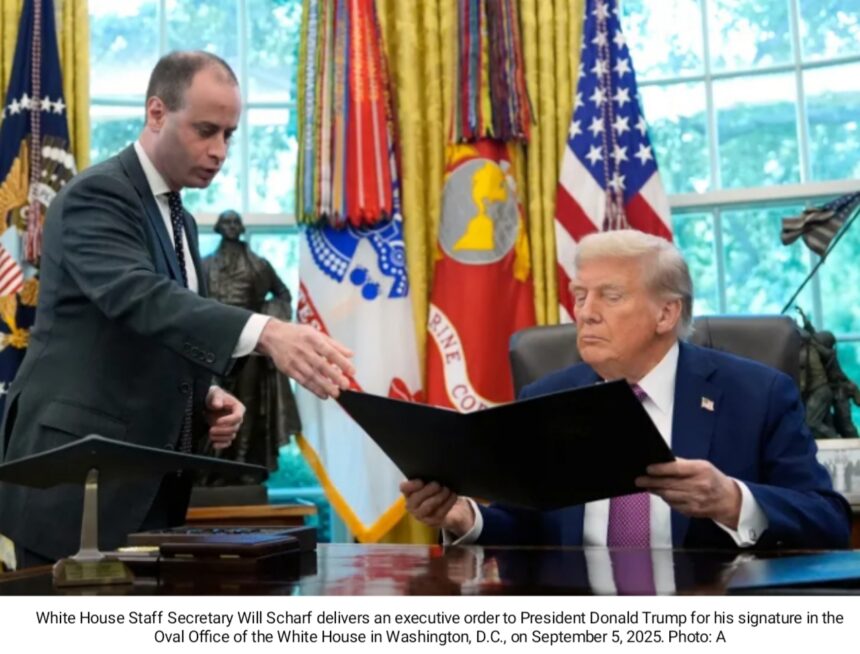
US President Donald Trump has appointed White House Staff Secretary Will Scharf as his next White House counsel, elevating a longtime legal ally to one of the administration’s most influential legal positions at a politically sensitive moment ahead of November’s midterm elections. Scharf will take over as White House counsel on September 1, replacing David Warrington, who is leaving the administration for the private sector. He will also hold the title of assistant to the president, moving from a position focused largely on managing documents and administrative matters for the Oval Office to becoming the White House’s top legal adviser. Trump praised Scharf on his Truth Social platform, describing him as “Tough, Strong, and Smart” and highlighting his experience as a federal prosecutor as well as his work representing Trump in several high-profile legal cases. Scharf joined Trump’s legal team in 2023 and became involved in the federal election-interference case brought by former Special Counsel Jack Smith. He was part of Trump’s legal team when the case reached the US Supreme Court, which in 2024 ruled that presidents are entitled to broad immunity from criminal prosecution for official acts. Scharf’s relationship with Trump goes back even further. During Trump’s first administration, he worked on the confirmation of federal judges, including Supreme Court Justices Brett Kavanaugh and Amy Coney Barrett, according to US media reports. After Trump returned to the White House in January 2025, Scharf was appointed White House staff secretary, placing him close to the president’s daily decision-making process. In that role, he oversaw documents and other materials submitted to Trump and was frequently seen alongside the president during executive-order signing ceremonies, giving him an inside view of how major administration policies were developed and implemented. Scharf has also played a prominent role in one of the Trump administration’s most controversial construction projects — the proposed White House ballroom. Trump appointed Scharf chairman of the National Capital Planning Commission in July 2025, and the commission later approved plans for a roughly $400 million ballroom to be built on the site of the demolished East Wing of the White House. The project has triggered a broader legal and constitutional dispute over the limits of presidential authority and whether the administration can make such a major alteration to the White House complex without explicit congressional approval. A federal appeals court recently upheld an order blocking above-ground construction, ruling that the project requires congressional authorization. Trump has said he plans to take the dispute to the Supreme Court. Scharf had previously argued that the planning commission had authority over the construction project, while acknowledging that the demolition preceding the construction raised separate questions about jurisdiction and authority. His move to the White House counsel’s office could therefore place him at the centre of the administration’s legal strategy surrounding the ballroom project and other challenges to presidential authority. The timing of Scharf’s appointment is also significant. Democrats have pledged to investigate Trump and his administration if they regain control of Congress in the November midterm elections. Such investigations could focus on executive actions, presidential authority, administration policies and other decisions that have already generated legal and political controversy. As White House counsel, Scharf will be responsible for advising the president on constitutional and legal matters, reviewing legislation and executive actions, coordinating the administration’s response to lawsuits and helping prepare the White House for potential congressional investigations. His appointment also continues a broader pattern in Trump’s second administration of elevating lawyers who have previously represented the president personally. Todd Blanche, who represented Trump in his criminal cases, was recently confirmed by the US Senate as attorney general in a closely contested vote. D John Sauer, who argued Trump’s presidential-immunity case before the Supreme Court, was appointed solicitor general, while former Trump lawyer Emil Bove moved from a senior Justice Department position to a federal appeals court after his confirmation. The appointments have fueled debate over the relationship between Trump’s personal legal interests and the institutional responsibilities of the US government’s legal system. For the Trump administration, however, Scharf’s appointment places a lawyer with extensive knowledge of the president’s legal strategy and political priorities at the centre of the White House legal operation. Once he assumes office on September 1, Scharf will face a series of potentially significant challenges, including litigation over the White House ballroom, disputes over presidential authority, congressional oversight and the possibility of intensified investigations if Democrats make major gains in November. His transition from managing the president’s documents to becoming the administration’s chief legal adviser marks a significant expansion of his influence inside the White House and could make him one of the most consequential legal figures in Trump’s administration as the president approaches a politically critical period.
Trump appoints Scharf as White House counsel to bolster president’s legal defense