
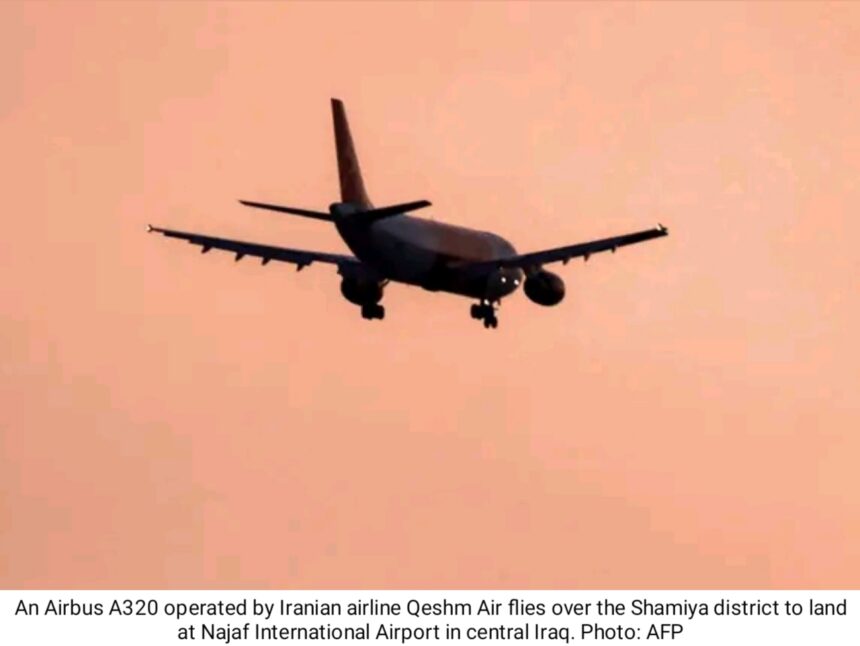
Iraqi airports have suspended flights operated by Iranian airlines, sharply reducing one of Tehran’s remaining regional air links after the United States expanded sanctions against Iran’s aviation sector and warned foreign companies providing services to sanctioned Iranian carriers that they could face secondary sanctions. The restrictions have affected Baghdad, Najaf, Erbil and Sulaymaniyah, effectively closing major Iraqi entry points to Iranian commercial airlines and adding a new layer of pressure to an aviation network already disrupted by the wider conflict involving Iran and the United States.
The latest developments began with restrictions at Baghdad International Airport and were followed by the suspension of Iranian flights at Najaf International Airport and airports in Iraq’s Kurdistan Region. Najaf’s airport administration announced that all incoming and outgoing flights to and from Iran would be suspended from 2 a.m. on September 25 until further notice, citing official instructions from the competent authorities. The airport instructed airlines and other operators to stop carrying out procedures connected with the affected flights and said any decision to resume services would be communicated officially.
The suspension at Najaf was particularly significant because the city is one of the most important destinations for Iranian travellers in Iraq. Najaf is home to the shrine of Imam Ali and is a major centre of Shiite religious learning. The city also serves as an important gateway for travellers heading to nearby Karbala, where the shrine of Imam Hussein is located. Iranian airlines have traditionally played a major role in transporting pilgrims between Iran and Iraq, making the new restrictions more than a simple commercial aviation disruption. They affect religious travel, family visits, education, medical journeys and other cross-border movement between the two neighbouring countries.
The scale of Najaf’s dependence on Iranian aviation was visible in its flight schedule. Shafaq News reported that on one recent Wednesday, 18 of the airport’s 20 scheduled flights were bound for Iranian destinations. An employee of an Iranian airline at Najaf told AFP that Iranian carriers normally operated at least 20 flights a day from the airport, although the exact number of flights varied. The sudden suspension therefore removed a substantial part of the airport’s regular international traffic.
The restrictions also spread beyond Najaf. Airports in Erbil and Sulaymaniyah in Iraq’s Kurdistan Region suspended flights to and from Iran on September 25. The director of Erbil International Airport confirmed that the suspension covered both Erbil International Airport and Jalal Talabani International Airport in Sulaymaniyah. The move followed the earlier suspension of Iranian flights at Baghdad International Airport, leaving Iranian commercial carriers with far fewer options for maintaining direct services to Iraq.
The Baghdad decision was reported earlier in the week. Reuters reported on September 22 that Iraq had ordered its civil aviation authority to suspend Iranian flights to Baghdad beginning Wednesday, citing two sources familiar with the matter. The decision followed a warning from the United States that airports and aviation-service providers facilitating operations by Iranian carriers could face sanctions.
The pressure originates from a broader US campaign against Iran’s aviation sector. On September 8, the US Department of the Treasury announced sanctions against 36 targets connected to Iran’s aviation industry under what Washington calls Operation Economic Outcast. Treasury said the targets included Iranian airlines as well as foreign intermediaries and companies involved in aviation-related services and procurement networks. According to the US government, the targeted aviation networks have been used to move weapons, personnel and illicit cargo and to obtain aircraft and sensitive technology.
The September 8 action included 27 Iranian airlines, according to Treasury records, alongside other companies and individuals in several countries. The sanctions also affected firms connected to the supply and support network surrounding Mahan Air. The US Treasury said foreign companies dealing with the remaining Iranian airlines could face the risk of being cut off from the US financial system.
The sanctions have practical consequences for airlines even when the airlines themselves are not directly based in the United States. International aviation depends on a wide network of airport operators, fuel suppliers, maintenance companies, ground handlers, financial institutions, insurers, aircraft lessors and other service providers. A company that believes it could become the target of US sanctions may decide to stop servicing an Iranian airline rather than risk losing access to the US financial system or international business relationships.
That concern appears to have played an important role in the disruption in Iraq. Shafaq News reported that ground-handling companies had stopped servicing Iraq-Iran flights at airports across the country, effectively bringing air travel between the two countries to a standstill. A source at Iraq’s Ministry of Transport said flights had already been operating at reduced capacity since March because of the war and that Iranian carriers had been among the last airlines continuing to operate the routes.
The issue is therefore not limited to whether an airport formally bans an Iranian aircraft. An international flight requires a functioning chain of services on the ground. Aircraft need fuel, baggage handling, passenger processing, maintenance support, security services and other airport operations. If companies providing those services decide that continuing to work with a sanctioned airline exposes them to unacceptable financial or legal risks, flights can become impossible even without a conventional aviation ban.
This is one reason the US sanctions have had a broader regional effect. The United Arab Emirates has also suspended flights operated by Iranian airlines to and from the country. Other regional routes have faced restrictions or cancellations, while airlines and airports have adjusted their operations amid the growing pressure on Iranian aviation.
Iranian aviation authorities have responded by attempting to preserve some international connections. Iran’s Civil Aviation Organization announced earlier in the week that flights from Tehran to Baghdad and Muscat would be cancelled. Iranian airlines have subsequently been left with a smaller number of international routes, including services involving Turkey, Russia, China and Armenia, although the availability and continuity of those routes remain subject to changing conditions.
The loss of Iraqi routes is particularly important because Iraq has historically been one of the most accessible destinations for Iranian passengers. The geographical proximity between the two countries makes air travel between them relatively practical, while the large volume of religious travel creates a steady demand. For Iranian pilgrims visiting Najaf and Karbala, the suspension means that air travel can no longer provide the same direct access to Iraq’s major Shiite religious centres.
Travellers now face fewer options. Some passengers may have to use alternative countries as transit points or travel by land after reaching another destination. Reports cited by Iran International described travellers considering routes through Turkey followed by long bus journeys toward Iran, with border delays potentially adding further time. Such alternatives can make international travel considerably more expensive and complicated, particularly for elderly pilgrims, families, students and patients travelling for medical care.
The disruption also creates a difficult position for Iraq. Baghdad maintains close political, economic and geographic ties with Iran while remaining closely connected to the United States. Iraq has sought to balance its relationship with both countries, but the expansion of US sanctions increases the cost of maintaining commercial links with Iranian entities that Washington has designated.
For Iraq’s aviation sector, the question is therefore partly economic. Airport operators and private ground-service companies must weigh the revenue generated by Iranian flights against the potential consequences of violating or triggering US sanctions. The decision becomes more complicated when international banking and dollar-based transactions are involved. Companies dependent on international financial systems may be reluctant to expose themselves to sanctions risks, even if the flights themselves are important to local economies.
The political sensitivity is especially high in Najaf. Iranian visitors are a major component of religious tourism to the city, and restrictions on Iranian flights directly affect the movement of pilgrims. The Iranian consulate in Najaf reacted strongly to the suspension, highlighting the religious significance of the city and questioning why its airport had been closed to travellers from Iran. The statement reflected the political and religious importance of the route for both countries.
Iran has also issued warnings over the regional consequences of restrictions on its airlines. Mohammad Mokhber, an adviser to Iran’s supreme leader, said in a social-media post that if Iranian airlines were prevented from flying and receiving airport services, other countries in the region could face consequences. His statement did not provide details about how Tehran might respond. Earlier, Iran’s Supreme National Security Council secretary Mohsen Rezaei had also warned neighbouring countries against cooperating with Washington’s campaign against Iranian aviation.
The warnings add another layer of uncertainty for regional aviation. Airports across the Middle East have already faced disruptions because of conflict, airspace restrictions and changing security conditions. Airlines have had to reconsider routes, schedules and aircraft deployments as governments introduce new restrictions. The latest measures against Iranian airlines could therefore have effects beyond Iran-Iraq travel if other countries become concerned about sanctions exposure or possible regional retaliation.
The US government, however, presents the aviation sanctions as part of a wider strategy to isolate Iran economically. Treasury officials say Iran’s aviation sector has been used to support activities that Washington considers a threat, including the movement of military personnel and illicit cargo. The September 8 sanctions were designed to target what the US describes as the remaining financial and logistical networks supporting Iranian airlines.
The new restrictions are also part of a longer history of US sanctions against Iran’s aviation industry. Iranian airlines have faced restrictions for years, affecting access to aircraft, spare parts, financing and international aviation services. The September measures expanded the number of directly targeted airlines and extended pressure to foreign companies involved in supporting them.
One important consequence is the shrinking number of reliable international options available to Iranian carriers. Iranian airlines have continued to operate despite years of sanctions, often relying on older aircraft, alternative procurement networks and regional connections. But the effectiveness of the latest measures depends partly on whether foreign airports and service providers are willing to continue working with them.
For passengers, the impact is immediate. Flights can be cancelled with limited notice, tickets can become unusable and travellers may be forced to seek alternative routes. Religious pilgrims are particularly exposed because many journeys are planned around specific dates and religious events. Students and patients travelling between the two countries can also face difficulties if alternative routes require long journeys or additional visas.
For airlines, the restrictions can produce a cycle of declining connectivity. Fewer airports mean fewer destinations. Fewer destinations can reduce passenger demand and aircraft utilisation. At the same time, restrictions on fuel, maintenance, insurance, finance and ground services can raise operating costs. If more airports follow the Iraqi and UAE decisions, Iranian carriers could face an increasingly fragmented international network.
The immediate question is whether the Iraqi suspensions are temporary or will remain in place for an extended period. Najaf airport has said that flights will remain suspended until further notice and that any decision to resume services will be announced officially. Similar restrictions at Erbil and Sulaymaniyah have also been announced without a clear timetable for restoration.
The answer may depend on developments between Washington, Tehran and regional governments. If US sanctions enforcement remains unchanged, airlines and airport-service companies may continue to avoid transactions involving sanctioned Iranian carriers. If diplomatic negotiations lead to changes in the sanctions regime, aviation restrictions could eventually be reviewed. At present, however, there is no confirmed timetable for a restoration of normal Iraq-Iran air services.
The latest developments show how economic sanctions can affect civilian transport far beyond the companies directly named on a sanctions list. By increasing the financial and legal risks for the wider network that supports Iranian airlines, Washington has placed pressure on airports and aviation companies in neighbouring countries as well. Iraq’s decision to suspend Iranian flights demonstrates the practical consequences of that strategy.
For Iran, the loss of access to major Iraqi airports represents a significant contraction of its regional aviation network. For Iraq, it creates a difficult balance between maintaining ties with a neighbouring country and protecting its airports and service providers from international sanctions exposure. For travellers, the result is simpler but more immediate: fewer flights, longer journeys and greater uncertainty.
As of September 26, 2026, flights linking Iranian airlines with Baghdad, Najaf, Erbil and Sulaymaniyah have been suspended, while other regional routes have also been disrupted. Whether these measures become a temporary interruption or a longer-term restructuring of Iran’s international aviation network will depend on the next phase of US sanctions enforcement, Iranian responses and the wider political and security situation in the Middle East.