

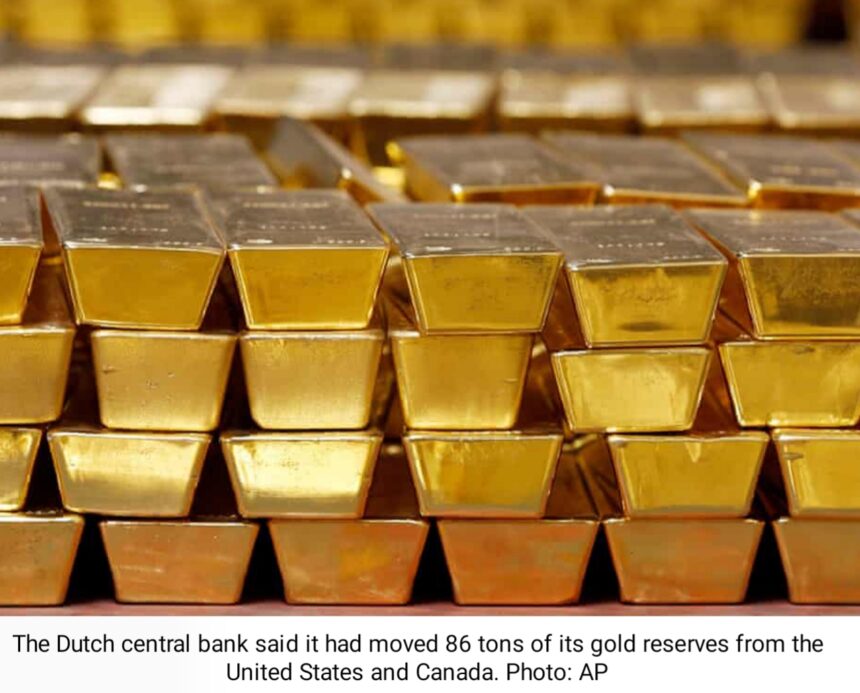
AMSTERDAM — The Netherlands has moved 86 tonnes of its gold reserves from storage facilities in the United States and Canada to London, citing growing geopolitical uncertainty and the need to ensure that its reserves can be deployed more rapidly in the event of a major crisis. De Nederlandsche Bank (DNB), the Dutch central bank, said the operation was carried out between March and August this year as part of a broader effort to strengthen the resilience, flexibility and operational readiness of the country’s gold reserves.
According to DNB, gold held in London can be traded and mobilised more easily than reserves stored in New York or Ottawa because London is home to one of the world’s deepest and most liquid gold markets. The central bank said that having a larger share of its reserves in London would allow it to access and deploy the gold more quickly should a financial, economic or geopolitical emergency occur. “This makes it the quickest for DNB to deploy in a crisis situation,” the bank said, stressing that the move was designed to improve the usability of its reserves rather than signal that the Netherlands expects an immediate crisis.
DNB President Olaf Sleijpen said the central bank does not expect to need to deploy its gold reserves, but argued that maintaining the ability to do so quickly is an important element of national financial preparedness. The decision comes against a backdrop of heightened geopolitical tensions, economic uncertainty and growing concerns among governments and central banks about the resilience of international financial systems.
The Netherlands held a total of 612.4 tonnes of gold at the end of 2025, with a value estimated at €72.2 billion, or approximately $83.7 billion. Before the latest restructuring, around 31.3% of Dutch gold reserves were held in New York, while another 19.7% were stored in Ottawa. Following the operation, the share held in each of those locations has fallen to 18.5%. Meanwhile, London’s share has increased substantially, rising from 18.1% to 32.1% of the Dutch gold stock. A further 30.8% remains stored within the Netherlands itself.
The operation was not conducted entirely through the physical transportation of gold bars. DNB said it combined purchases and sales with the physical movement of bullion in order to reduce the risks associated with transporting a large quantity of precious metal. More than 27 tonnes of physical gold were moved from the United States and Canada to Zeist in the Netherlands, while an equivalent amount was transferred from Zeist to London. This approach enabled the central bank to avoid melting down large numbers of existing gold bars while also spreading the logistical and security risks associated with moving substantial quantities of bullion.
The Dutch decision reflects a broader trend among central banks that have been reassessing the location and accessibility of their gold reserves over the past decade. Gold has regained importance as a strategic reserve asset amid heightened geopolitical tensions, sanctions, currency volatility and concerns about the stability of the global financial system. While central banks continue to hold significant amounts of their bullion in traditional financial centres, some have increasingly focused on diversification and the ability to access their reserves rapidly when required.
Laurent Schwartz, president of the Paris-based National Gold Counter, which facilitates gold trading in France, said central banks had been moving their reserves between locations for roughly a decade. He noted that the current political environment in the United States could also encourage some institutions to consider alternative storage locations. London, he said, remains one of the deepest and most liquid gold markets in the world, making it particularly attractive for central banks seeking rapid access to bullion during periods of financial stress. Gold stored in London can also be more easily lent to other financial institutions, providing central banks with additional flexibility in managing their reserves.
John Plassard, an analyst at Cite Gestion Private Bank, said the Dutch move appeared primarily aimed at ensuring that gold would be immediately available if a crisis emerged. At the same time, he cautioned that the broader implications could become significant if other central banks followed the same path. A sustained shift away from New York and other traditional US storage locations could potentially raise questions about confidence in the United States as a major global financial centre.
The Netherlands’ decision also comes amid a wider European debate over the security and location of national gold reserves. Earlier this year, concerns were raised in Germany over the safety of gold held in New York. Germany’s powerful Bundesbank, however, has so far decided not to move its reserves away from the United States. The institution told German public broadcaster ARD in January that the Federal Reserve Bank of New York remains an important storage location for Germany’s gold and continues to play a significant role in its reserve-management strategy.
For the Netherlands, the latest move appears to represent a calculated adjustment rather than a complete withdrawal from North American storage facilities. The country continues to hold significant quantities of gold in both New York and Ottawa, while maintaining nearly one-third of its reserves domestically. The increased allocation to London therefore provides an additional layer of diversification while giving the Dutch central bank greater access to a highly liquid international market.
The significance of the move extends beyond the 86 tonnes involved. At a time when geopolitical tensions are reshaping global trade, financial relationships and reserve-management strategies, the location of central-bank gold has become an increasingly important strategic consideration. For institutions such as DNB, the question is no longer simply how much gold a country owns, but also where that gold is stored, how quickly it can be accessed and how effectively it can be deployed during an emergency.
The Dutch central bank’s decision therefore highlights a broader shift in the way governments are thinking about financial resilience. While DNB has made clear that it does not expect to use its gold reserves in the immediate future, its decision to increase the proportion held in London suggests that accessibility and flexibility are becoming increasingly important factors in central-bank reserve management. Whether the Dutch move remains an isolated adjustment or becomes part of a wider European trend away from traditional storage locations in North America could ultimately depend on how geopolitical and financial risks evolve in the years ahead.