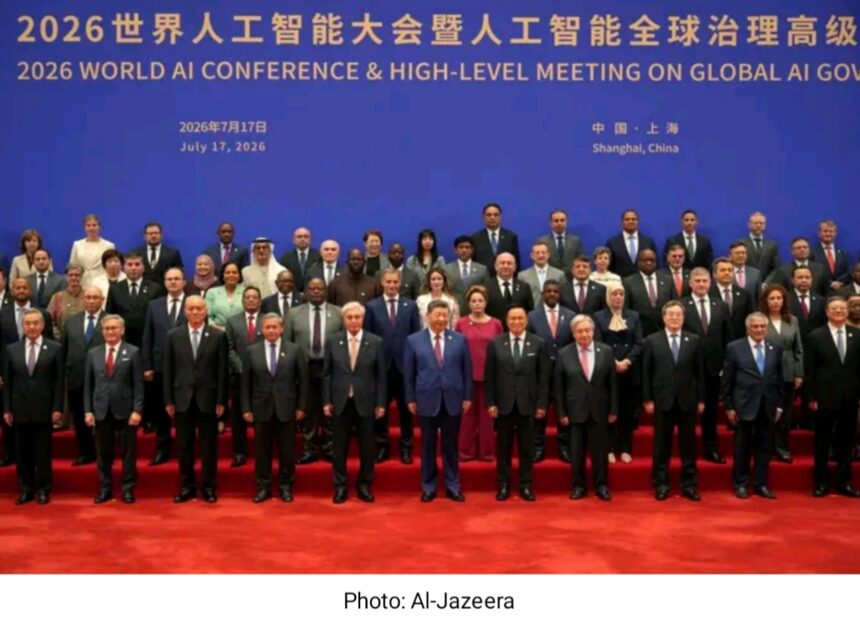
International Desk: Chinese President Xi Jinping has unveiled a new international artificial intelligence alliance, marking a significant step in Beijing’s efforts to strengthen global cooperation in one of the world’s most strategically important technologies. The initiative comes at a time when competition over artificial intelligence has become a defining feature of international politics, economic development, and national security, with China and the United States vying for leadership in the rapidly evolving sector.
According to Chinese officials, the alliance aims to bring together governments, research institutions, universities, technology companies, and international organizations to promote cooperation in artificial intelligence research, innovation, governance, safety, and practical applications. Beijing argues that artificial intelligence should serve as a shared resource for global development rather than remain concentrated in the hands of a small number of technologically advanced nations.
The announcement reflects China’s broader strategy to expand its influence in emerging technologies while presenting itself as a champion of international cooperation. Beijing has repeatedly called for an open, inclusive, and fair system of global artificial intelligence governance, emphasizing that developing countries should have equal access to technological innovation and the opportunities created by digital transformation.
The launch of the alliance also comes amid intensifying technological rivalry between China and the United States. In recent years, Washington has tightened restrictions on the export of advanced semiconductors, artificial intelligence processors, and other critical technologies to China, citing national security concerns. Beijing, in turn, has accelerated domestic innovation while strengthening partnerships with countries across Asia, Africa, the Middle East, and Latin America to reduce dependence on foreign technology and build alternative international technology networks.
Chinese officials say the new alliance will encourage joint scientific research, talent development, knowledge sharing, technical standards, and cooperation on responsible artificial intelligence governance. It is also expected to support the development of digital infrastructure and help participating countries improve their technological capabilities in areas such as healthcare, education, agriculture, transportation, manufacturing, and public services.
Analysts view the initiative as part of China’s broader effort to shape the future rules governing artificial intelligence. As the technology becomes increasingly central to economic growth, industrial competitiveness, military modernization, and cybersecurity, the country that plays a leading role in setting international standards could gain substantial long-term strategic advantages.
However, the proposal has also attracted scrutiny from some governments and technology experts. Critics argue that international cooperation on artificial intelligence must be accompanied by strong safeguards for data privacy, cybersecurity, transparency, and ethical oversight. They warn that the rapid expansion of artificial intelligence without widely accepted global standards could create new security risks and deepen geopolitical competition.
Beijing has rejected concerns that its initiative is intended to divide the international technology landscape, insisting instead that the alliance is designed to promote responsible innovation, mutual trust, and shared prosperity. Chinese officials say cooperation, rather than technological confrontation, is essential for ensuring that artificial intelligence benefits all countries and contributes to sustainable global development.
With artificial intelligence expected to generate trillions of dollars in economic value over the coming decade, Xi Jinping’s new alliance represents more than a technological partnership. It signals China’s determination to play a leading role in shaping the future of global innovation, digital governance, and international technology cooperation. As more countries evaluate whether to join the initiative, the alliance is likely to become an important indicator of the evolving balance of power in the global technology race.
Xi Jinping makes big move in global technology competition, forms new artificial intelligence alliance