
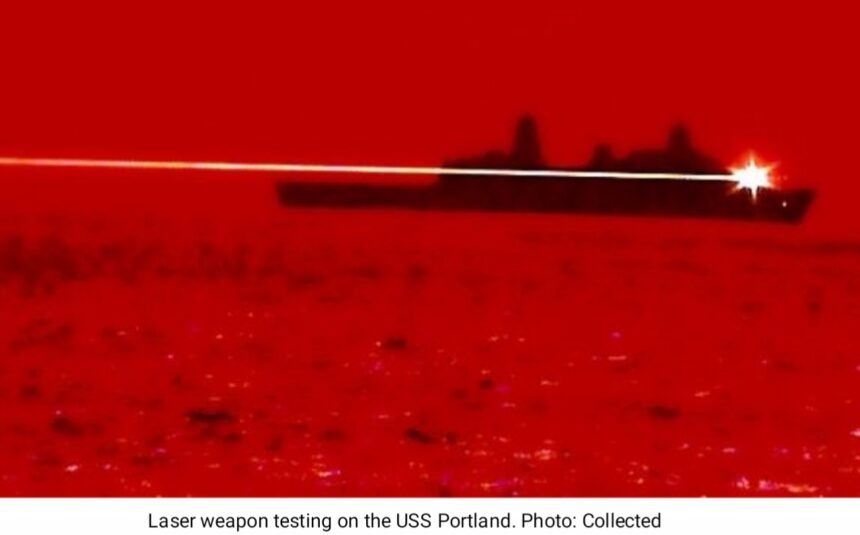
The United States military is increasingly turning to high-energy laser weapons as a new layer of air defense amid the continuing conflict with Iran, with reports indicating that directed-energy systems have been deployed in and around the Strait of Hormuz to counter Iranian drones and incoming cruise missiles.
The reported deployment marks a major step in the long-running American effort to move laser weapons from experimental programs into operational military service. At the same time, the U.S. Army has awarded a $464.8 million production agreement to AeroVironment for its Enduring-High Energy Laser, or E-HEL, program, signaling that the technology is moving beyond limited testing toward wider field deployment. The Army described the agreement as its first production contract for a high-energy laser weapon system.
The development comes as modern conflicts have demonstrated the growing threat posed by relatively inexpensive unmanned aircraft. Iran and Iranian-backed forces have relied heavily on drones, creating a challenge for military forces that have traditionally depended on interceptor missiles and other kinetic weapons. The attraction of laser systems is partly economic: once installed and supplied with sufficient electrical power, a laser can engage multiple targets without carrying a conventional stock of missiles.
According to a recent report by Kurdistan24, U.S. forces have been using laser weapons in the Strait of Hormuz during the current Iran conflict against Iranian drones and cruise missiles. The report said the U.S. Department of Defense confirmed the use of the systems and described their cost advantage compared with conventional kinetic interceptors.
How the laser systems work
High-energy laser weapons operate differently from conventional air-defense systems. Instead of launching a physical interceptor toward an incoming target, the system generates a concentrated beam of electromagnetic energy and directs it at the target.
The beam can remain focused on a particular part of a drone or other aerial object for several seconds. This period is often described as “dwell time.” The concentrated energy creates intense heat that can damage sensors, electronics, propulsion systems or the structure of the target.
The systems reportedly being used in the Middle East include the U.S. Navy’s High Energy Laser with Integrated Optical-dazzler and Surveillance, commonly known as HELIOS. Kurdistan24 reported that the system uses a laser in the 60-kilowatt class and is designed for installation on large naval vessels.
The U.S. Navy has been developing HELIOS as a multi-function directed-energy system. Such systems can be used to track and engage unmanned aircraft while also providing surveillance and optical-dazzling capabilities. The broader objective is to give naval forces another method of defending ships against drones and other aerial threats.
Unlike missiles, laser weapons do not require a new physical interceptor for every engagement. Their firing capacity is therefore linked primarily to the availability of electrical power, cooling and the operating condition of the system. This gives directed-energy weapons a fundamentally different logistical profile from conventional missile defenses.
Cost is a major attraction
One of the main reasons the U.S. military is investing heavily in laser weapons is the cost of engaging large numbers of relatively inexpensive drones.
Modern surface-to-air missiles can cost hundreds of thousands or even millions of dollars depending on the system and mission. Using expensive interceptors against inexpensive drones can therefore place significant pressure on military stockpiles.
Laser weapons potentially change that equation. Once a system is deployed, the energy required for an individual engagement can be much cheaper than the cost of firing a missile. The U.S. Army has specifically highlighted the low cost-per-shot characteristic of its E-HEL program.
This does not mean that lasers will replace missiles. Instead, the U.S. military is developing layered air-defense systems in which different weapons can be used against different types of threats.
A laser may be particularly useful against drones that are slow enough to remain within the system’s engagement envelope. Missiles and guns can continue to provide other layers of defense against targets that lasers cannot effectively engage.
The Army’s $464.8 million laser contract
The Army’s September 2 announcement represented a significant change in the status of American directed-energy programs.
The service awarded AeroVironment an Other Transaction Agreement for production under the Enduring-High Energy Laser program. According to the Army, E-HEL is intended to provide soldiers with a scalable directed-energy capability against unmanned aircraft systems while maintaining a low cost per engagement.
AeroVironment separately announced that the contract is valued at $464.8 million. The company said its LOCUST X3 laser family would form the basis of the Army program and that dozens of systems are expected to be delivered over the coming years.
The LOCUST X3 is a 30-kilowatt-class system designed primarily for counter-drone missions. Reports indicate that it is intended to engage Group 1 through Group 3 unmanned aircraft systems, providing the Army with an additional layer of protection against drones.
The system is designed around a modular architecture that can be adapted to different platforms. The Army said E-HEL can be deployed from fixed bases, semi-fixed tactical positions and mobile combat vehicles. The modular approach is also intended to make future upgrades easier as laser technology develops.
The production agreement is significant because it represents a transition from prototype development toward procurement. For decades, high-energy lasers were largely associated with research projects, demonstrations and limited testing. The Army’s decision to place a production order indicates that the service now sees directed energy as a capability that can be integrated into operational formations.
Xbox-style controllers in military use
One of the more unusual aspects of the emerging laser weapons program is the use of gaming-style controllers.
Reports on the systems say operators can use modified controllers similar to those associated with Xbox consoles. The concept is based on the idea that modern gaming controllers already provide an intuitive interface for precise movement and targeting.
Task & Purpose reported that the LOCUST family uses an Xbox controller and quoted AeroVironment’s vice president of directed-energy systems explaining that the interface is familiar to younger service members who have grown up playing video games.
The use of such controllers does not mean that operating a military laser is equivalent to playing a video game. The weapon system still depends on sophisticated sensors, targeting software, power management and military command systems. The controller is simply the human interface used by the operator to direct the system.
The approach could have practical advantages. A familiar control system may reduce the time required for basic operator training and allow personnel to interact with the weapon more naturally.
Hegseth demonstration
The growing attention around laser weapons has also reached the highest levels of the U.S. defense establishment.
According to Kurdistan24, Defense Secretary Pete Hegseth attended a laser weapons demonstration at White Sands Missile Range in New Mexico in June 2026. The report said Hegseth used a gaming-style controller and was able to shoot down a drone after a short period of training.
The demonstration highlighted one of the central arguments behind the new systems: the ability to combine sophisticated automated tracking and targeting technology with a relatively simple operator interface.
The military is seeking systems that can detect and track aerial threats rapidly while allowing human operators to authorize and control engagements.
Why the Strait of Hormuz matters
The Strait of Hormuz is one of the world’s most strategically important maritime passages. Large volumes of global energy exports pass through the narrow waterway, making the area particularly sensitive during periods of military confrontation between Iran and the United States.
For U.S. forces operating in the region, drones and cruise missiles create a difficult defensive problem. Ships and military installations must be protected against threats that can be relatively inexpensive compared with the defensive missiles used to intercept them.
A laser mounted on a warship could potentially provide an additional defensive layer against drones while reducing dependence on physical interceptor stocks.
The operational environment also offers a major test for directed-energy technology. A laser system must function reliably under demanding conditions, including heat, dust, humidity and changing atmospheric conditions.
Lasers still have important limitations
Despite their advantages, laser weapons are not a universal replacement for missiles.
Atmospheric conditions can affect laser performance. Rain, dust, smoke, humidity and other factors can interfere with the propagation of a high-energy beam. The system also needs a sufficiently clear line of sight to maintain the required dwell time on a target.
Another challenge is the threat posed by large numbers of drones arriving simultaneously. A laser may engage targets individually, but its ability to deal with a large swarm depends on the number of systems available, targeting speed, power capacity and the characteristics of the incoming drones.
Kurdistan24 also reported that laser systems face difficulties in some weather conditions and may struggle against large drone swarms.
For that reason, U.S. planners continue to emphasize layered defense. Lasers can form one part of a broader system that includes electronic warfare, guns, conventional missiles, sensors and other technologies.
From experiments to battlefield systems
The current development of American laser weapons is the result of decades of research.
The concept of using directed energy for missile and aircraft defense has existed for many years. During the Cold War, the Strategic Defense Initiative associated with President Ronald Reagan helped generate major interest in advanced technologies for intercepting ballistic missiles.
Modern laser programs are different in scale and purpose. Instead of attempting to create a single system capable of defending against every type of strategic missile, current programs focus on practical battlefield missions such as countering drones, protecting ships and defending military installations.
The shift toward production is particularly important. The Army’s E-HEL program is designed around a weapon that can be manufactured and deployed in meaningful numbers rather than remaining primarily a laboratory experiment.
Jared Keller, publisher of the Laser Wars newsletter, told Kurdistan24 that the current period represents an unusually strong moment for the transition of laser technology from laboratories to operational military use. His assessment is an expert opinion rather than an official U.S. government forecast.
A new layer in the drone war
The rapid spread of drones has changed modern warfare. Unmanned aircraft can provide surveillance, conduct attacks and overwhelm conventional defenses at comparatively low cost.
The conflict involving Iran has further demonstrated the importance of counter-drone technology. For the United States, the challenge is not simply destroying individual drones. It is developing a sustainable defense architecture capable of handling repeated attacks without rapidly exhausting expensive interceptors.
This is where directed-energy weapons could become particularly important.
The Army’s E-HEL system is explicitly being developed as part of a layered counter-unmanned-aircraft defense. The service says the system is intended to provide an affordable and adaptable capability that can evolve as aerial threats change.
AeroVironment has also said the production program will support multi-year fielding of dozens of LOCUST X3 systems.
What comes next
The U.S. military is now moving toward a future in which laser weapons could become a regular component of air-defense networks.
The immediate focus is countering drones, but the technology is also being developed for other missions. Higher-powered systems are being pursued for defense against larger unmanned aircraft and potentially cruise missiles.
In July 2026, Lockheed Martin announced that the U.S. Department of War had awarded it a contract under the Joint Laser Weapon System program to develop a transportable 500-kilowatt laser weapon system for cruise-missile and unmanned-aircraft defense.
Such developments suggest that American directed-energy programs are expanding across multiple power levels and operational roles.
However, the technology remains subject to engineering and battlefield limitations. Power generation, cooling, weather, line of sight, target tracking and the ability to engage multiple targets remain important factors. Lasers are therefore more likely to supplement existing defenses than immediately replace conventional weapons.
The reported deployment in the Strait of Hormuz, combined with the Army’s nearly $465 million production agreement, nevertheless represents an important development in the history of directed-energy weapons.
For decades, high-energy lasers were discussed primarily as a technology of the future. The United States is now moving toward a model in which these systems are produced, fielded and tested in operational environments.
The experience in the Middle East could provide further information about how effective such weapons are under real combat conditions. Their performance against drones, cruise missiles and larger or more numerous threats will help determine how quickly they become a standard part of American air-defense architecture.
For now, the direction is clear: the U.S. military is investing heavily in weapons that use electrical energy rather than conventional ammunition to defeat aerial threats. The $464.8 million E-HEL production agreement is one of the clearest signs yet that high-energy lasers are moving from experimental technology toward a deployable military capability.
Source: U.S. Army, AeroVironment, Kurdistan24 and other publicly available reporting.