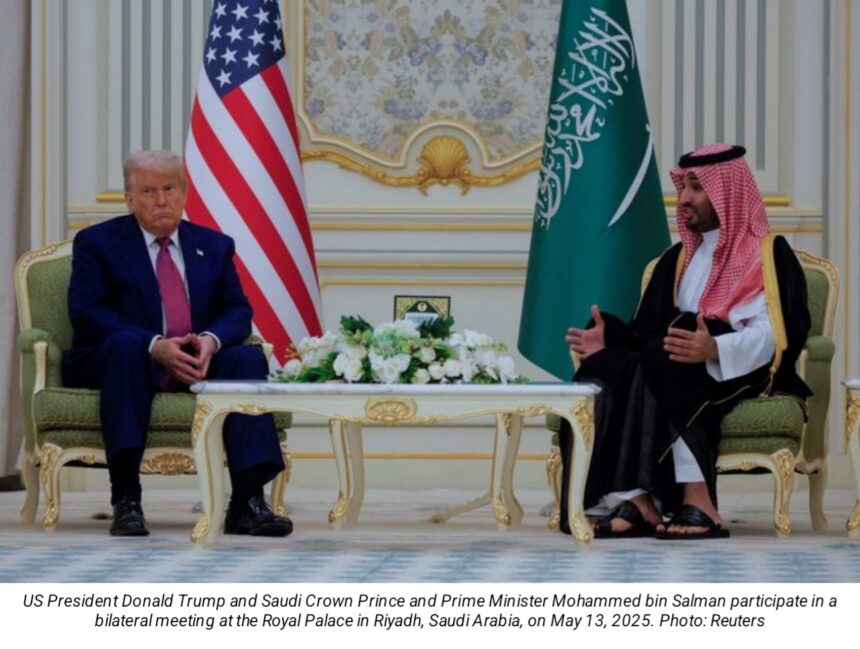
WASHINGTON/RIYADH — The United States has drafted a civilian nuclear cooperation agreement that would allow Saudi Arabia to enrich uranium on its own soil, but the proposal remains unsigned as President Donald Trump has yet to give his final approval, according to a CNN report published on Saturday. The report said negotiations on the framework were completed in October 2025, but the agreement has been delayed amid heightened tensions with Iran and concerns over strong bipartisan opposition in the U.S. Congress, where lawmakers have long warned against the proliferation of sensitive nuclear technology in the Middle East.
The proposed agreement has attracted intense international scrutiny because uranium enrichment is one of the most sensitive elements of the nuclear fuel cycle. While low-enriched uranium is commonly used to generate electricity in civilian nuclear reactors, the same technology can, if further developed, produce highly enriched uranium suitable for nuclear weapons. Most countries operating civilian nuclear programs import enriched fuel rather than developing domestic enrichment capabilities, making Saudi Arabia’s reported request a significant departure from what has traditionally been considered the preferred non-proliferation model.
Arms control experts have cautioned that granting Riyadh the right to enrich uranium could complicate global efforts to prevent the spread of nuclear weapons, particularly in a region already marked by deep geopolitical rivalries. Their concerns have been reinforced by previous remarks from Saudi Crown Prince Mohammed bin Salman, who said the kingdom would pursue a nuclear weapon if Iran were to successfully acquire one, a statement that has frequently been cited in debates over Saudi Arabia’s long-term nuclear ambitions.
Another major point of controversy involves international oversight. According to the report, critics argue that the proposed arrangement may not include the stringent inspection measures typically associated with the International Atomic Energy Agency (IAEA), raising questions about the transparency and verification of any future Saudi nuclear facilities. Such concerns have prompted comparisons with the United Arab Emirates’ 2009 nuclear agreement with Washington, widely regarded as the “gold standard” because Abu Dhabi voluntarily renounced domestic uranium enrichment and accepted comprehensive international safeguards.
Supporters of the agreement argue that closer nuclear cooperation would strengthen the long-standing strategic partnership between Washington and Riyadh while helping Saudi Arabia diversify its energy sector under its economic transformation plans. They also contend that if the United States refuses to engage, Saudi Arabia could instead seek comparable nuclear technology from competitors such as Russia or China under less restrictive conditions, potentially reducing U.S. influence over the kingdom’s nuclear development.
Opponents, however, warn that relaxing long-standing non-proliferation standards for a key Middle Eastern ally could establish a precedent with far-reaching consequences beyond the Gulf. They argue that allowing additional countries to acquire sensitive fuel-cycle technologies may encourage a regional nuclear competition and undermine decades of international efforts to limit the spread of weapons-capable nuclear infrastructure. As a result, the proposed agreement has emerged as one of the most closely watched foreign policy and security issues facing the Trump administration, with implications extending well beyond U.S.-Saudi relations to the broader architecture of nuclear non-proliferation and Middle East stability.
US is now giving nuclear bomb technology to Saudi Arabia to deter Iran