
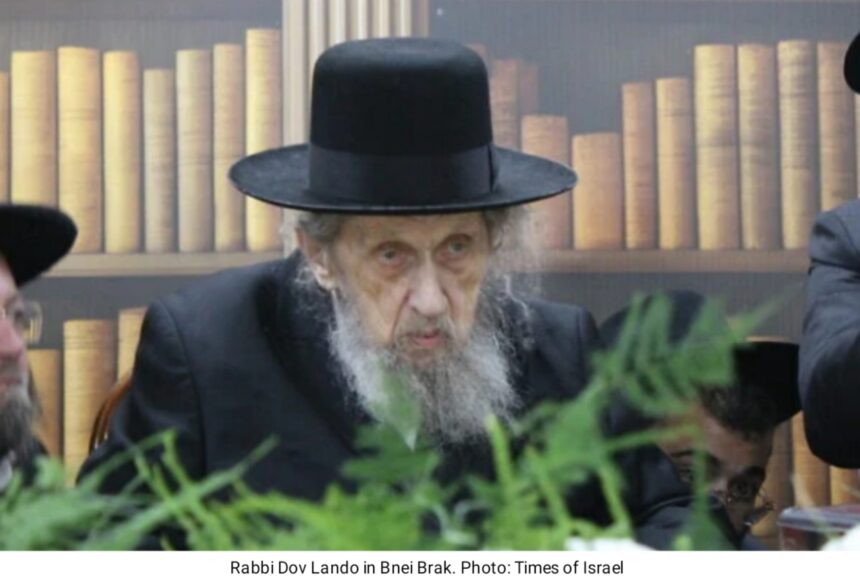
JERUSALEM — A video featuring Rabbi Dov Landau, a senior spiritual leader of Israel’s ultra-Orthodox Jewish community, has sparked a political storm after he sharply criticised Zionism, compulsory military service and the establishment of a Jewish state, arguing that the Zionist movement has brought profound suffering upon Jews and that they might have been safer without an independent state of their own. The remarks, attributed to the 96-year-old rabbi and recently circulated in Israeli media, have intensified an already heated national debate over the relationship between religion and state, the military obligations of ultra-Orthodox Jews, and the political influence of religious parties ahead of Israel’s next national election. The controversy has placed renewed pressure on Prime Minister Benjamin Netanyahu, whose governing coalition relies on the support of ultra-Orthodox political factions, including United Torah Judaism (UTJ), an alliance that includes Landau’s Degel HaTorah party.
Landau is widely regarded as one of the most influential authorities within Israel’s Lithuanian ultra-Orthodox Jewish community. Born in Poland, he was educated within the Lithuanian Jewish religious tradition and became a leading figure in the world of traditional Jewish scholarship. He heads a prominent yeshiva, a religious institution devoted to the study of Jewish texts, in Bnei Brak, a major centre of ultra-Orthodox life near Tel Aviv. He is also associated with the senior religious leadership that guides important decisions within his community. Through his spiritual influence over Degel HaTorah, Landau has a significant connection to Israel’s parliamentary politics, even though his authority comes primarily from his religious standing rather than an elected office. Degel HaTorah operates within the United Torah Judaism alliance, which has supported Netanyahu’s right-wing coalition and played an important role in parliamentary negotiations over religious education, military exemptions and public policy.
Although the video has only recently attracted widespread attention, Israeli media reports indicate that the footage dates back approximately a year. In it, Landau reportedly presents Zionism as a destructive ideology that has damaged Jewish life both materially and spiritually. He argues that the establishment and preservation of a Jewish state have contributed to hostility between Jews and Arabs, suggesting that Jews could have lived more peacefully with their Arab neighbours without the political framework created by Zionism. His reported comments challenge a central principle of modern Israeli national identity: the belief that a sovereign Jewish state is necessary to protect the Jewish people from persecution and guarantee their security. Landau is said to have suggested that an international administration or a Palestinian-led governing arrangement could have offered Jews a safer environment than the existing Israeli state. Such views stand in sharp contrast to the dominant political position in Israel, where Zionism remains a defining element of national identity across much of the political spectrum, despite substantial disagreements over its historical meaning, territorial ambitions and current policies.
The rabbi’s criticism extends beyond the political foundations of Israel to the role of the military in protecting the state. Compulsory military service has long been a source of tension between Israel’s secular majority and the ultra-Orthodox community, many of whose religious students have historically received exemptions or deferments while studying in yeshivas. Landau reportedly criticised religious soldiers who support Zionism, arguing that they risk their lives because their rabbis teach a distorted understanding of the Torah. He also questioned the justification for military operations, suggesting that some campaigns are conducted less to protect human life than to preserve the state’s pride and political standing. These claims have added a particularly sensitive dimension to the controversy because the Israeli military occupies a central place in the country’s security policy and national identity. They also come amid an increasingly contentious debate over whether ultra-Orthodox men should be required to serve alongside other Israeli citizens.
For many Israelis, the question of military service has become a test of equality and national responsibility. Secular and religiously observant citizens who serve in the armed forces, as well as their families, have argued that the burden of military duty should be shared more fairly, particularly during periods of prolonged conflict. Ultra-Orthodox leaders, however, have defended exemptions for full-time religious students, maintaining that Torah study is essential to Jewish communal life and deserves protection from state interference. The dispute has placed religious parties in a difficult position: they seek to preserve longstanding exemptions while remaining influential participants in governments that depend on the military for national security. Landau’s reported remarks have further complicated the debate by challenging not only the extent of military service but also the ideological foundations of the state that the military is expected to defend.
Landau also reportedly delivered a severe rebuke to secular Israelis, questioning their relationship with Jewish religious tradition and describing the state they have built as one founded on religious rejection and disbelief. His criticism reflects a longstanding ideological divide within Israeli society. While secular Zionists generally regard national sovereignty as a political achievement and a means of protecting Jewish self-determination, many ultra-Orthodox communities have historically approached Zionism with deep suspicion. Their objections have varied across religious movements and periods, but some have rejected the idea that a modern secular state can legitimately claim to represent the Jewish people before the coming of the Messiah. Other ultra-Orthodox factions have participated in Israeli politics for decades, seeking to protect religious institutions, educational systems and communal interests without necessarily embracing secular nationalism. Landau’s position, as described in the circulating footage, appears to place him among the more forceful critics of Zionist statehood, exposing divisions that have existed within Jewish religious and political life since before Israel’s establishment in 1948.
The reaction from Israeli political leaders has been sharply critical. Gadi Eisenkot, a former military chief of staff and leader of the opposition-linked Yashar party, reportedly condemned the remarks as an unacceptable expression of anti-Zionism. Opposition leader Yair Lapid described the statements as shameful for Jews, while former prime minister Naftali Bennett characterised them as antisemitic, anti-Zionist and an attack on the Israeli military. Their responses reflect the political sensitivity of any public challenge to Zionism, particularly when it comes from a prominent Jewish religious authority whose followers have a direct connection to parties represented in the Knesset. For these politicians, the controversy is about more than a religious disagreement: it concerns the legitimacy of the state, the standing of its armed forces and the political responsibilities of groups that benefit from its institutions while disputing some of its founding principles.
Netanyahu has not publicly responded to the newly circulated video, according to the account of the controversy. His silence has become a political issue in its own right because his government depends on the support of ultra-Orthodox lawmakers. Netanyahu has previously criticised Landau over a separate dispute involving opposition to the recruitment of religious students into the military. In July, Landau reportedly accused those promoting the recruitment of ultra-Orthodox students of incitement, prompting criticism from the prime minister. The latest episode presents Netanyahu with a difficult choice. A forceful condemnation could anger religious allies whose parliamentary support may be necessary for his government to survive, while silence risks allowing opponents to argue that his commitment to Zionism, military security and equal civic obligations is subordinate to the demands of coalition politics.
Opposition figures have consequently called for United Torah Judaism to be excluded from any future governing coalition. They have also attacked Netanyahu for maintaining political cooperation with parties whose influential religious leaders, in their view, reject the ideological foundations of the Israeli state. Yair Golan, leader of the Democrats party, has argued that Netanyahu’s failure to respond forcefully is driven by political self-preservation. According to Golan’s criticism, the prime minister cannot afford to alienate Landau and the religious factions associated with him because their support could determine whether his coalition remains in power. Golan’s position reflects a broader opposition strategy of portraying Netanyahu as dependent on hard-line religious partners even when their positions conflict with the national-security and Zionist principles he publicly promotes.
The electoral calculations behind the controversy are significant. Netanyahu’s coalition is reportedly trailing the parliamentary threshold required to form a government, with polling suggesting that his political bloc could fall short of the 61 seats needed for a majority in the 120-member Knesset. A Channel 12 poll cited in reports on the dispute indicates that United Torah Judaism could win approximately eight seats. Although election polls are snapshots rather than predictions of a final result, the figures illustrate why the support of a relatively small religious alliance can have an outsized effect on the formation of an Israeli government. In a fragmented parliamentary system, parties representing specific religious, ideological or regional constituencies can become decisive coalition partners when larger blocs fail to secure a majority independently.
For Netanyahu, losing the support of United Torah Judaism could make an already difficult electoral contest more complicated. The prime minister must balance the demands of religious parties with pressure from voters who believe military service should be compulsory for a broader section of the population. He must also address criticism from political opponents who accuse him of placing coalition survival ahead of national unity. If he distances himself from Landau’s remarks, he risks provoking a backlash from religious leaders and voters who regard the rabbi as a respected authority. If he avoids confrontation, opponents can use the controversy to question whether his government has a consistent position on Zionism, military service and the obligations shared by citizens.
Political analyst Ihab Jabareen has described the situation as a difficult dilemma for Netanyahu. A strong response to Landau could cost the prime minister the support of ultra-Orthodox factions that are important to his political survival. Remaining silent, meanwhile, could allow opposition parties to tell right-wing voters that a leader who regularly invokes national security and Zionism is dependent on a religious movement whose spiritual leadership questions Zionist statehood. The controversy therefore threatens to turn a religious dispute into a wider test of political credibility, particularly among voters who place military service and national security at the centre of their political choices.
The episode also highlights a distinction that is often overlooked in discussions of Israeli politics: opposition to Zionism among Jewish groups does not necessarily represent a single ideological position. Some ultra-Orthodox critics oppose Zionism on theological grounds, arguing that Jewish sovereignty should not have been established through a secular nationalist movement. Other critics challenge Zionism because of its consequences for Palestinians, the structure of the Israeli state or the conflict between Jewish national self-determination and competing claims to the same territory. These positions differ in their historical origins, political objectives and attitudes towards Palestinians. Landau’s reported argument, rooted in an ultra-Orthodox religious worldview, should therefore be understood within the specific tradition from which it emerges rather than treated as representative of all Jewish religious opposition to Zionism.
At the same time, the controversy illustrates how religious authority can influence electoral politics even when religious leaders do not hold government positions themselves. In Israel, ultra-Orthodox parties have frequently negotiated over education funding, religious institutions, personal-status laws and exemptions from military service. Their participation in coalition governments gives their leaders substantial influence over public policy. Statements from senior rabbis can consequently have political consequences beyond their immediate religious audiences, particularly when they challenge widely held assumptions about statehood, citizenship and national security.
As the next election approaches, the debate surrounding Landau is likely to remain connected to several broader questions facing Israel: whether military obligations can be distributed more equally, how much influence religious authorities should exercise over government decisions, and whether coalition agreements can reconcile sharply conflicting visions of the state. The controversy also exposes the limits of Netanyahu’s political balancing act. His government must maintain the support of religious partners while responding to public pressure over security, military service and the meaning of national responsibility.
Landau’s reported remarks have brought these tensions into the open at a politically sensitive moment. What began as the circulation of an older video has developed into a debate over the relationship between Jewish religious tradition and Zionist nationalism, the future of ultra-Orthodox military exemptions and the alliances that may determine Israel’s next government. Whether Netanyahu chooses to confront his religious partners or continue relying on their support, the dispute has highlighted a central challenge in Israeli politics: maintaining a governing majority in a country where competing definitions of Jewish identity, statehood and civic duty increasingly shape the struggle for political power.