

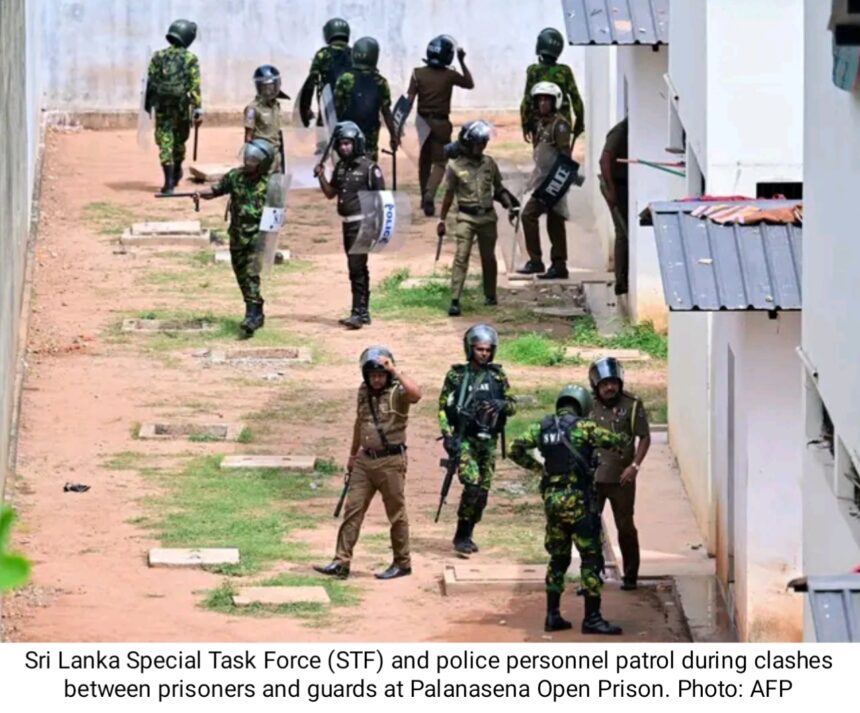
COLOMBO, Sri Lanka — Sri Lanka has deployed riot police and special security forces to restore order after deadly prison disturbances erupted at three separate correctional facilities, leaving at least three inmates dead and more than 20 others injured, raising fresh concerns over security inside the country’s prison system.
The latest violence began late Thursday at the New Magazine Prison in Colombo, where around 40 inmates reportedly broke out of their cells, triggering clashes that resulted in the death of one prisoner. Hours later, another riot broke out at Kuruwita Prison, approximately 80 kilometres southeast of the capital, where two additional inmates were killed during efforts to contain the unrest.
According to Public Security Minister Ananda Wijepala, a total of 23 prisoners were injured in the two incidents and were transported to nearby hospitals for medical treatment. Authorities said police units and special forces eventually regained control of both facilities after several hours of operations.
At the same time, police were also called to an open prison in the coastal city of Negombo, where protesting inmates climbed onto rooftops and gathered in open compounds. Officers fired tear gas to disperse the crowd and restore order, while riot police worked to return prisoners to their wards.
Addressing Parliament, Wijepala said preliminary investigations suggest the violence may be linked to rival criminal gangs and narcotics trafficking networks operating inside the prison system. However, officials believe the nearly simultaneous disturbances at multiple prisons could indicate a broader and more organised effort.
“When all these incidents are viewed together, there appears to be planning behind them and a possible attempt at sabotage,” the minister said, adding that authorities would refrain from drawing firm conclusions until a comprehensive investigation is completed.
Security has since been strengthened at prisons across the country as investigators examine whether the riots were coordinated by organised criminal groups seeking to destabilise prison operations or challenge government authority.
The latest unrest comes barely one month after one of the deadliest episodes in Sri Lanka’s prison history. In early July, two days of intense fighting at a prison in Negombo left 10 prison officials and 20 inmates dead, exposing deep-rooted problems within the country’s overcrowded correctional system and prompting calls for urgent reforms.
Analysts say recurring prison violence reflects longstanding challenges, including overcrowding, the growing influence of organised crime, narcotics trafficking, and the difficulty authorities face in maintaining control over powerful criminal networks operating from behind bars. The repeated outbreaks have also raised questions about intelligence failures and the effectiveness of prison security measures.
The Sri Lankan government has pledged a full investigation into the latest incidents while reviewing security protocols across correctional facilities nationwide. Officials say additional police and special task force personnel will remain on high alert until authorities are satisfied that the threat of further unrest has passed.
The renewed violence underscores the continuing challenges facing Sri Lanka’s prison administration as it seeks to contain criminal networks, improve security, and prevent further bloodshed inside the country’s correctional institutions.