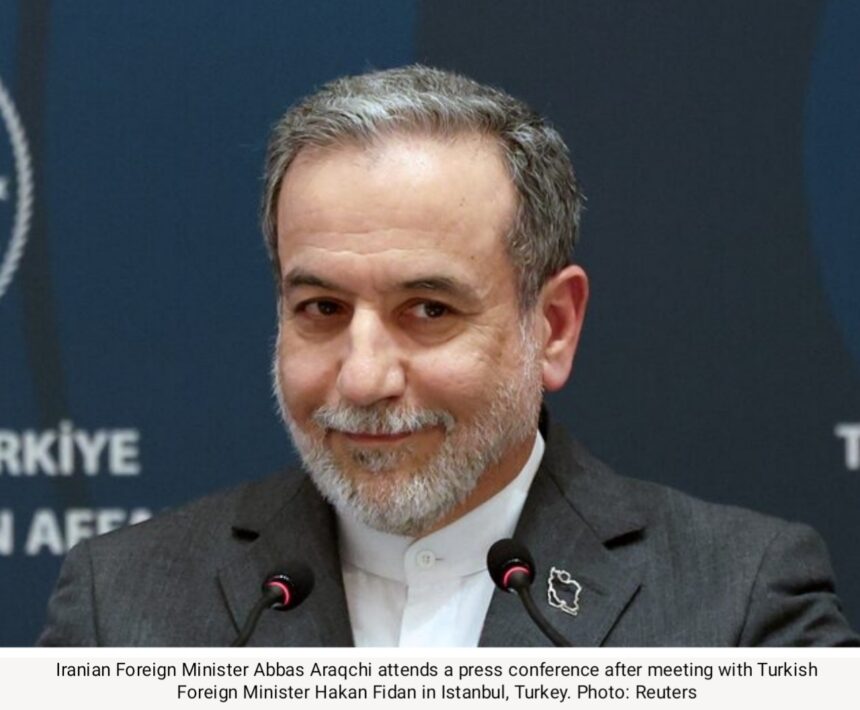
A new geopolitical chapter may be emerging across the Middle East and the wider Muslim world following the signing of a joint defence agreement between Saudi Arabia, Türkiye and Pakistan, with Iran’s Foreign Minister Abbas Araghchi signalling that Tehran views greater cooperation among Muslim countries as a potentially positive development. The agreement, announced in Mecca, establishes a collective-security principle under which an armed attack against any one of the three signatories would be treated as an attack against all three, creating a new framework for military cooperation among three strategically important countries spanning the Middle East and South Asia. The announcement immediately drew international attention, particularly because Saudi Arabia has traditionally relied heavily on the United States and Western partners for its external security, while Türkiye has pursued an increasingly independent regional foreign policy and Pakistan has maintained longstanding military and strategic ties with Riyadh. Against that backdrop, attention quickly shifted towards Tehran, where Iranian officials have repeatedly argued that the security of the region should be managed primarily by regional states rather than by foreign military powers. Araghchi did not explicitly name the Mecca defence agreement in his message, but his emphasis on Muslim unity, self-reliance and resistance to external pressure was widely interpreted as a significant diplomatic signal. In a post on his official social-media account, Araghchi stressed that when Muslim countries stand together, they can confront challenges posed by harmful external forces and argued that the time had come for greater reliance on their own capabilities and for strengthening genuine solidarity among Muslim nations. He also referred to Iran’s ability to demonstrate its strength in the face of what he described as the world’s most expensive military force, a formulation that appeared to carry an indirect message towards the United States and its extensive military presence in the Middle East. Tehran has long opposed the deployment of US forces and other foreign military assets across the region, arguing that such deployments contribute to instability and prevent regional countries from developing an independent security architecture. The timing of Araghchi’s remarks is particularly significant because relations between Iran and Saudi Arabia have undergone a cautious process of rapprochement after years of intense strategic rivalry. Although major differences remain between Tehran and Riyadh over regional security, influence and a number of conflicts across the Middle East, the two countries have in recent years demonstrated a greater willingness to use diplomacy and direct engagement to manage their differences. The emergence of a Saudi-led or Saudi-backed regional defence arrangement therefore raises questions about whether Riyadh could gradually seek a more diversified security policy rather than depending overwhelmingly on a single external power. If Saudi Arabia were to expand military cooperation with Türkiye, Pakistan and potentially other Muslim-majority countries while simultaneously maintaining or recalibrating its longstanding relationship with Washington, the resulting security architecture could have significant implications for the balance of power in the Gulf. Such a development, however, should not automatically be interpreted as the creation of an anti-American military bloc. The practical significance of the Mecca agreement will depend on how the three countries translate the political commitment into military coordination, intelligence-sharing, joint planning, logistics and an agreed mechanism for responding to a future armed attack. Nevertheless, the political symbolism is considerable. Saudi Arabia, Türkiye and Pakistan represent three major military and political powers whose strategic interests extend well beyond their immediate borders, and their formal commitment to collective defence could create a new channel for cooperation among states that have historically maintained different relationships with Washington and other global powers. Türkiye’s role is particularly important because Ankara remains a NATO member while simultaneously seeking greater strategic autonomy and deeper relations with countries across the Middle East, Central Asia and the wider Muslim world. Pakistan, meanwhile, brings substantial military capabilities and a long history of defence cooperation with Saudi Arabia, while its geographical position gives the arrangement a strategic link between the Gulf and South Asia. Iran’s reaction adds another layer of complexity. Tehran has maintained close political and economic ties with Türkiye and longstanding strategic relations with Pakistan, despite occasional differences over border security and regional policy. A broader convergence among these countries could therefore create opportunities for dialogue that extend beyond traditional rivalries. For Iran, the prospect of Muslim-majority states assuming greater responsibility for regional security also aligns with one of Tehran’s longstanding foreign-policy themes: reducing dependence on Western military powers and strengthening what Iranian officials describe as an indigenous regional security order. Yet significant obstacles remain. The countries involved have different alliances, competing interests and varying approaches to regional conflicts, while Saudi Arabia continues to maintain an important strategic relationship with the United States and Türkiye remains a member of NATO. Pakistan, for its part, has traditionally attempted to balance its relationships with Saudi Arabia, Türkiye, Iran, China and the United States. These realities make the creation of a unified military bloc considerably more difficult than the signing of a political defence agreement. The question now is whether the Mecca pact will remain a limited trilateral security arrangement or become the foundation for a wider network of defence cooperation among Muslim-majority countries. Araghchi’s call for Muslim unity does not amount to a formal Iranian commitment to join such an arrangement, and Tehran has not announced any decision to participate in the Saudi-Türkiye-Pakistan defence framework. Nevertheless, his message highlights the possibility of a broader debate over whether Muslim countries can develop greater strategic and military autonomy without relying exclusively on external powers. If such cooperation expands, it could reshape calculations in the Gulf, influence the future role of US forces in the region and create new diplomatic channels between countries that have traditionally been divided by competing alliances. For Washington, the emergence of a more coordinated regional security architecture would present a complex strategic challenge, although the extent of that challenge would depend on whether the new partnership develops into an operational military structure or remains primarily political. For Iran, meanwhile, greater regional defence cooperation among Muslim states could potentially strengthen Tehran’s longstanding argument that the Middle East should develop its own security mechanisms. For Saudi Arabia, the agreement could provide an additional layer of strategic flexibility at a time when regional instability has raised questions about the reliability and sustainability of traditional security arrangements. And for Türkiye and Pakistan, the pact offers an opportunity to strengthen their roles in a rapidly changing regional order. The significance of the Mecca agreement will therefore ultimately depend not on its symbolism alone but on whether its signatories can overcome their differing strategic priorities and build effective mechanisms for collective defence. What is already clear, however, is that the regional security debate is becoming increasingly broader than the traditional competition between Washington and Tehran or the longstanding rivalry between individual Middle Eastern powers. A new conversation is emerging around regional self-reliance, Muslim solidarity and the possibility of a security architecture in which countries of the region assume a greater share of responsibility for their own defence. Araghchi’s latest message, while stopping short of explicitly endorsing the Mecca agreement, has added political weight to that debate and underscored Tehran’s interest in a regional order less dependent on external military powers.
A new path beyond US-dependent security? Iran’s message regarding the Saudi alliance