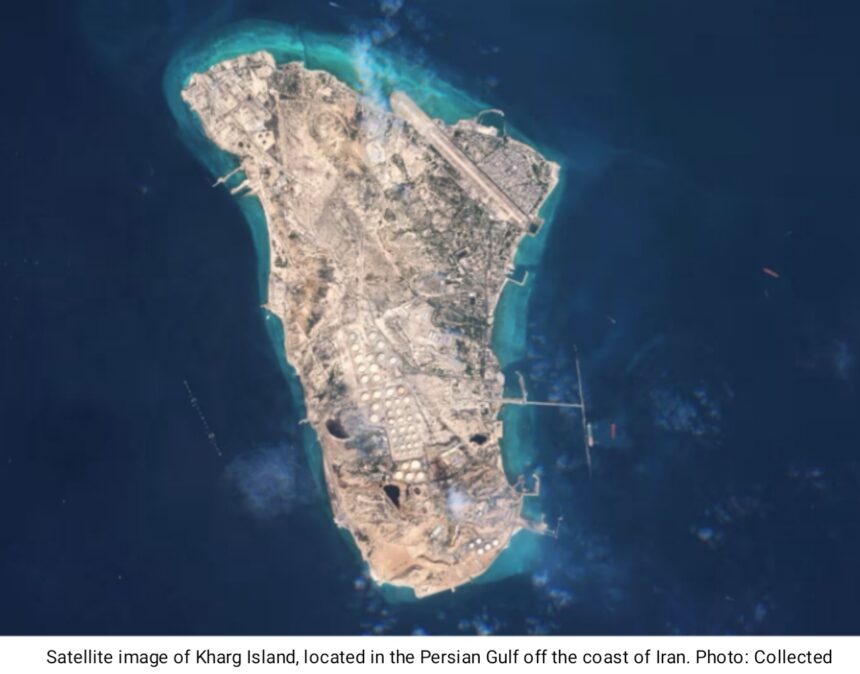
KHARG ISLAND, Iran — Iran is once again seeking to restore oil operations at Kharg Island, the strategically vital crude oil export hub in the Persian Gulf, after weeks of disruption. Crude loading from the island’s export terminal resumed in June following a prolonged interruption, but renewed U.S. naval pressure and the worsening crisis around the Strait of Hormuz have since placed Iran’s export infrastructure under fresh strain.
It is important to clarify that Kharg Island is primarily not an oil production centre. Rather, it serves as Iran’s principal crude oil export and loading hub. After crude oil is transported by pipeline from oil fields across Iran, it is stored at Kharg and then transferred through offshore loading facilities onto large tankers bound largely for Asian markets. As a result, disruption at Kharg would represent far more than the closure of a single port: it could directly affect Iran’s foreign-exchange earnings, government revenues and the wider international oil market.
Although small in geographical size, Kharg Island plays an outsized role in Iran’s energy economy. As much as 90% of Iran’s crude oil exports have historically passed through the island’s terminal. This concentration makes Kharg one of the most strategically sensitive points in Iran’s energy infrastructure and a major pressure point in any confrontation involving Tehran and Washington.
In March 2026, the United States carried out major strikes on Iranian military installations on and around Kharg Island. Washington said the targets were military infrastructure and that the island’s core oil and gas facilities were not directly destroyed. That distinction allowed Iran’s oil-export system to retain the potential to resume operations even amid the wider conflict. In June, after the U.S. naval blockade was eased, reports emerged that crude loading had restarted at Kharg after an interruption of roughly six weeks.
The recovery, however, proved fragile. At the beginning of August, tanker activity around Kharg Island had almost disappeared. Maritime and satellite-based information cited in recent reports indicated that no tanker-loading activity had been observed at the island’s main oil terminal after July 31. At the same time, the United States intensified naval pressure on Iran, creating further obstacles to the movement of Iranian crude.
The consequences could extend beyond shipping delays. If crude cannot be exported for an extended period, storage capacity at Kharg could come under increasing pressure, forcing Iranian producers to reduce output. Such a development would create a difficult chain reaction: fewer exports would reduce government revenue and foreign-currency inflows, while lower production could weaken Iran’s broader energy sector and make it more difficult to restore normal output once shipping conditions improve.
For Tehran, the economic stakes are particularly high. Oil remains one of the country’s most important sources of foreign-exchange revenue. A prolonged interruption to exports could intensify fiscal pressures, complicate the management of crude inventories and reduce the government’s ability to finance essential imports and domestic spending. At the same time, a sustained decline in Iranian oil supplies could introduce additional volatility into international crude markets.
The Kharg crisis is closely linked to developments in the Strait of Hormuz, one of the world’s most important energy corridors. The narrow waterway connects the Persian Gulf with international shipping routes and carries a substantial share of global oil and gas shipments. The latest conflict has sharply reduced maritime traffic through the strait. A Reuters report said shipping activity in the Strait of Hormuz on August 14 had fallen to extremely low levels compared with the period before the war.
The disruption has transformed the Strait of Hormuz into a central economic battleground. For Iran, maintaining access to international energy markets is essential to preserving its revenue streams. For Washington, restricting those flows provides a powerful means of applying economic pressure without necessarily targeting every component of Iran’s domestic energy infrastructure directly.
The broader U.S. strategy therefore appears to extend beyond limiting Iran’s military capabilities. Economic pressure has become an equally important element of the confrontation, and Kharg Island sits at the heart of that strategy because of its central role in Iran’s crude-export network.
Yet any attempt to seize Kharg Island or directly destroy its oil infrastructure would carry significant risks for the United States. The island lies close to Iran’s mainland and remains within the effective range of Iranian missile and drone systems. A prolonged U.S. military presence around Kharg could expose American forces and commercial shipping to retaliatory attacks, potentially transforming an economic blockade into a much broader military confrontation.
There is also a growing environmental dimension to the crisis. The Persian Gulf is already under considerable ecological pressure, and the risks increase when oil infrastructure, tankers and maritime routes operate amid military confrontation. Reuters reported on August 14 that oil slicks had been detected around Qeshm and Sirri islands. While not all such incidents have been directly linked to Kharg Island’s oil facilities, the reports highlight the wider environmental dangers associated with disrupted tanker traffic and damage to energy infrastructure.
The central question for Iran is now how long its economy can withstand a near halt in oil exports. Tehran has previously demonstrated an ability to adapt to sanctions and shipping restrictions through alternative trading networks, covert shipping practices and the use of intermediary buyers. But a sustained blockade affecting the country’s principal export terminal and the Strait of Hormuz would present a far more serious challenge.
Washington, meanwhile, also faces the costs of maintaining prolonged pressure on Iranian energy exports. A significant and sustained reduction in global oil supplies could push crude prices higher, increasing costs for consumers and industries in the United States and elsewhere. The economic consequences of a prolonged disruption could therefore extend well beyond Iran and affect inflation, transportation costs and energy security across major economies.
Kharg Island has consequently become the focal point of three interconnected struggles: Iran’s effort to preserve its economic survival, Washington’s campaign to impose maximum economic pressure, and the international effort to prevent a major disruption to global energy supplies.
If the Strait of Hormuz remains severely restricted and U.S. naval pressure continues, Iran’s crude exports through Kharg could remain disrupted for an extended period. Should that situation persist, the consequences would not be confined to Iran’s economy. They could spread through Asian energy markets, global crude prices and the wider international energy system.
For now, Kharg Island remains more than an oil terminal. It is a critical pressure point in the confrontation between Iran and the United States — a place where military strategy, economic warfare, maritime security and global energy markets increasingly converge.
Iran resumes oil operations on Kharg Island amid US presence