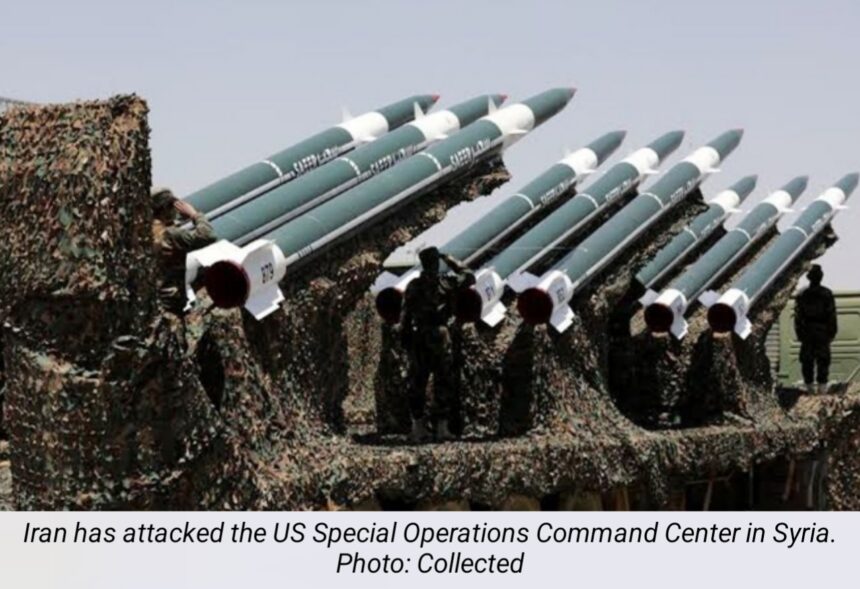
The conflict in the Middle East has entered a more dangerous phase after Iran’s Islamic Revolutionary Guard Corps (IRGC) claimed it had carried out a strike on a United States special operations command center located at the Al-Tanf military base in southern Syria. The claim, first reported by Iran’s semi-official Tasnim News Agency, has not been independently verified, and there has been no immediate confirmation or official response from the U.S. military.
According to the IRGC, the attack was launched in retaliation for the deaths of Iranian military personnel in the city of Iranshahr in southeastern Iran. Iranian officials described the operation as a direct response to what they called continued U.S. military aggression, signaling a further escalation in the already volatile confrontation between Washington and Tehran.
The IRGC also issued a warning over the Strait of Hormuz, one of the world’s most strategically important maritime routes for energy exports. It said that if U.S. military operations against Iran continue, Tehran could move to prevent oil and natural gas shipments from passing through the waterway. Such a move, if carried out, could have significant consequences for global energy markets, as a substantial share of the world’s seaborne oil trade transits through the strait.
Meanwhile, Iranian state media reported that U.S. forces carried out a sixth consecutive night of air and missile strikes targeting multiple locations across southern and southeastern Iran. The state broadcaster said at least one person was killed and several others were wounded in a strike on a residential area in Bandar Abbas. Additional strikes reportedly hit two bridges near Bandar Khamir in Hormozgan Province, where several people were said to have been killed or injured. Iranian media also reported explosions on Qeshm Island and in the city of Sirik, although the extent of the damage remains unclear.
None of the reported casualties or battlefield claims from either side could be independently verified. The United States has not immediately commented on the reported attacks or the allegations made by Iran, leaving many details of the incidents unconfirmed.
Military analysts say Al-Tanf remains one of the most strategically significant U.S. military positions in Syria, serving as a key hub for operations aimed at countering armed groups and maintaining a presence near the Syrian-Iraqi border. Any confirmed attack on the installation would mark a significant escalation in the long-running confrontation between Iran and the United States and could increase the risk of a broader regional conflict.
Security experts also warn that renewed military exchanges between the two countries could destabilize the wider Middle East, drawing neighboring countries into the crisis and threatening international shipping lanes and global energy supplies. Continued hostilities could place additional pressure on already fragile regional security and further complicate diplomatic efforts aimed at reducing tensions.
As international concern grows, governments and diplomatic observers are closely monitoring developments, urging restraint from all parties. With both Tehran and Washington maintaining firm positions and military activity continuing across multiple fronts, fears are mounting that the conflict could expand beyond its current scope, carrying far-reaching consequences for regional stability, international trade, and the global economy.
Iran-US conflict at new juncture, concerns grow over first-ever attack in Syria