
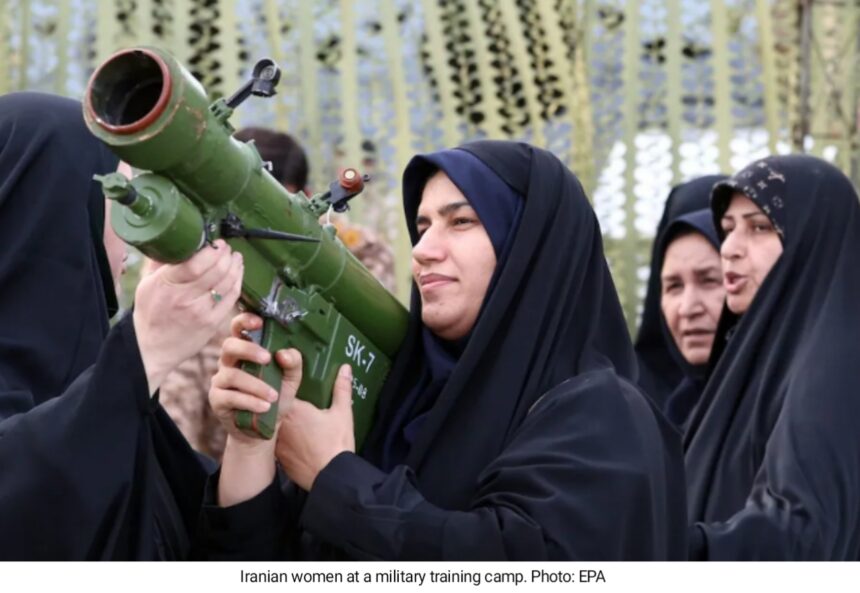
Iran has begun training women in weapons handling and urban defence as the country prepares for the possibility of another military confrontation with the United States.
Images and footage released by Iranian media show women taking part in training exercises at open-air facilities in Tehran. Some participants are seen wearing military-style uniforms and learning how to handle assault rifles.
Organisers say the programme is part of a wider mobilisation campaign aimed at preparing civilians for a potential new conflict. The training includes weapons familiarisation, urban defence, rescue operations, firefighting and navigation, with some elements specifically designed for women.
The programme comes amid renewed tensions between Tehran and Washington following US and Israeli military action against Iran. Iranian officials have repeatedly warned that any new attack would trigger a strong response, while at the same time maintaining that negotiations remain the only way to bring the conflict to an end.
Women join Iran’s wider mobilisation campaign
The women’s training programme is being organised under a mobilisation movement known as “Jan-fada”, a Persian term referring to those willing to sacrifice their lives.
According to Iranian organisers, the movement was launched this year after the United States and Israel began a bombing campaign against Iran.
Sasan Zare, a spokesman for the campaign, said military training had begun under the Basij militia. He claimed that more than 500,000 people registered within 100 minutes after enrolment opened for “national resistance” battalions.
The first 1,000 units were reportedly filled quickly, prompting Iranian authorities to approve another 1,000 units.
The figures have not been independently verified.
Women have emerged as a significant part of the mobilisation effort. Organisers say female volunteers are participating in both military training and planned neighbourhood-based relief and rescue units.
The programme is designed to prepare volunteers for a range of situations that could arise during a conflict, from direct defence to emergency response.
Weapons and urban warfare training
The training centres in Tehran are teaching participants about several types of weapons.
According to Iranian media reports, women are being introduced to Kalashnikov assault rifles and Dragunov sniper rifles. Training also includes familiarisation with rocket-propelled grenades and shoulder-fired air-defence systems.
Urban defence is another major component of the programme.
The emphasis on urban warfare reflects concerns that any future conflict could extend beyond military installations and strategic targets to major population centres.
Participants are also being trained in rescue work, firefighting and navigation. These skills could be used during emergencies caused by air strikes, fires, damaged buildings or disruptions to civilian infrastructure.
The first training ground was opened at Imam Hossein Square in Tehran. Iranian organisers say at least 14 such sites are planned across the capital, with additional centres expected to operate in provincial cities.
The facilities are being run with the involvement of the Basij, the Islamic Revolutionary Guard Corps and Iran’s regular army.
A revival of Khomeini’s mass mobilisation idea
Iranian authorities have presented the current campaign as a revival of the mass mobilisation model associated with the Iran-Iraq War.
After Iraq invaded Iran in 1980, Ayatollah Ruhollah Khomeini called for the creation of what became known as the “army of 20 million”.
Women played important supporting roles during the eight-year conflict, including in medical assistance, logistics, relief operations and other forms of wartime support.
The current programme draws on that historical experience while placing greater emphasis on direct weapons training for women.
The message from Tehran is that national defence should involve a broad section of society if another major conflict breaks out.
The scale of the programme, however, remains difficult to assess independently. Iranian authorities and organisers have released claims about registrations and participation, but outside verification is limited.
Iranian commanders warn of a wider war
The mobilisation effort has coincided with increasingly forceful warnings from Iranian military commanders.
Gen Ali Abdollahi, chief of Iran’s armed forces general staff, warned that if another war were launched against Iran, “its fire will engulf everyone”.
He also said US interests would be targeted without limit, referring to Iran’s response during the recent fighting.
Maj Gen Amir Hatami, commander of Iran’s army, said the war was not over and warned that Iranian forces would deliver a “crushing” response to any new attack.
Hatami also insisted that Iran had emerged victorious from the recent conflict.
The statements underline the continuing military tension between Iran and the United States. They also indicate that Tehran is attempting to deter further attacks by warning that a new conflict could have consequences far beyond Iran’s borders.
Tehran keeps the diplomatic channel open
Despite its military preparations and increasingly aggressive warnings, Iran has continued to call for negotiations.
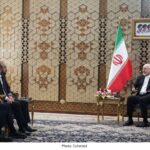
Foreign Minister Abbas Araghchi told foreign envoys in Tehran that there was no military solution to the conflict.
He warned that another attack would bring a response stronger than before, but said negotiations based on justice and fairness were the only way to end the confrontation.
His comments reflect Tehran’s broader position: Iran says it is prepared for another military confrontation while also seeking a diplomatic settlement.
The Strait of Hormuz remains one of the central issues in those discussions.
Araghchi said Iran could fully reopen the strategic waterway within seven days if its conditions were met and what Tehran describes as hostile measures were lifted.
The statement came as tensions surrounding the waterway continued to raise concerns over regional security and global energy supplies.
Iran links the Strait of Hormuz to negotiations
Mohammad Bagher Ghalibaf, Iran’s parliament speaker and chief negotiator, said Washington had recently transmitted proposals through a mediator.
However, he said Iran would not accept what he described as one-sided demands.
Ghalibaf said the Strait of Hormuz would remain closed until Iran’s seven conditions, linked to the Islamabad understanding, were met.
The strait is one of the world’s most important energy routes. Large volumes of oil and gas from the Gulf region pass through the narrow waterway before reaching international markets.
Any prolonged disruption could therefore have consequences for energy prices, shipping and global trade.
For Tehran, control over the waterway also provides a major source of leverage in its confrontation with Washington and its regional partners.
Economic pressure adds to Tehran’s challenges
Iran’s military mobilisation is taking place alongside growing economic pressure.
The United States has tightened sanctions on Iran and moved to restrict the country’s oil exports. The measures are putting additional pressure on Tehran’s main sources of foreign revenue.
Against that backdrop, Iranian Oil Minister Mohsen Paknejad resigned on Monday.
No immediate explanation was given for his departure.
The resignation comes as Iran faces a combination of military pressure, sanctions and uncertainty surrounding its energy exports. However, there is no confirmed indication that the minister’s resignation was directly connected to the military confrontation or US sanctions.
The economic situation remains an important factor in Tehran’s calculations. A prolonged confrontation could place additional pressure on government finances, energy exports and domestic economic conditions.
Why the women’s programme matters
The decision to train women to handle weapons carries significance beyond the immediate military exercises.
It suggests that Iran is attempting to prepare a broader section of the population for a possible conflict.
The programme combines military training with civil-defence activities. Volunteers may be expected to assist with security and defence, while others could focus on rescue, firefighting, relief work and emergency response.
This approach could become particularly important if fighting reaches densely populated urban areas.
In such circumstances, conventional military forces would have to deal with civilian casualties, damaged buildings, fires, disrupted transport and shortages of emergency services.
By establishing neighbourhood-based units, Iranian authorities appear to be preparing for the possibility that a future conflict could affect communities directly.
A message aimed at both domestic and foreign audiences
The training programme also carries a political message.
Inside Iran, it reinforces the government’s call for national mobilisation and resistance in the face of external threats.
Internationally, it demonstrates that Tehran is preparing for the possibility of another conflict rather than assuming that recent fighting has permanently ended the confrontation.
The participation of women gives the mobilisation campaign an additional public dimension. Images of women training with weapons have been circulated by Iranian media, highlighting the idea that resistance is not limited to professional soldiers.
At the same time, the government continues to emphasise diplomacy.
This combination of military preparation and diplomatic engagement is now central to Iran’s approach.
Tehran wants to demonstrate that it is capable of responding to another attack while maintaining that a negotiated settlement remains possible.
The road ahead
Iran’s decision to expand civilian military and emergency training comes at a sensitive moment in its relations with the United States.
The country is preparing volunteers, expanding neighbourhood-based units and training women in weapons handling and urban defence. Iranian commanders are warning of a severe response to any new attack.
Yet Iranian diplomats continue to call for negotiations and have linked the reopening of the Strait of Hormuz to the fulfilment of Tehran’s conditions.
The next phase of the crisis will depend heavily on whether diplomatic contacts can produce an agreement, whether the seven Iranian conditions can become a basis for negotiations, and whether Washington chooses further military or economic pressure.
For now, Tehran appears to be preparing for both possibilities.
The training of women is one visible part of that preparation. It reflects an effort to expand the country’s capacity for resistance and emergency response beyond conventional military forces.
At the same time, the continued diplomatic messaging from Iranian officials suggests that the government does not view military mobilisation as a substitute for negotiations.
Whether those two tracks can continue side by side without another major escalation remains uncertain.
What is clear is that Iran is treating the possibility of renewed conflict as a serious threat. The establishment of training centres, the recruitment of volunteers and the preparation of neighbourhood relief units show that Tehran is seeking to make its response broader than a conventional military campaign.
For ordinary Iranians, however, the expansion of military preparedness also reflects the growing uncertainty surrounding the country’s security and economic future as tensions with Washington remain unresolved.