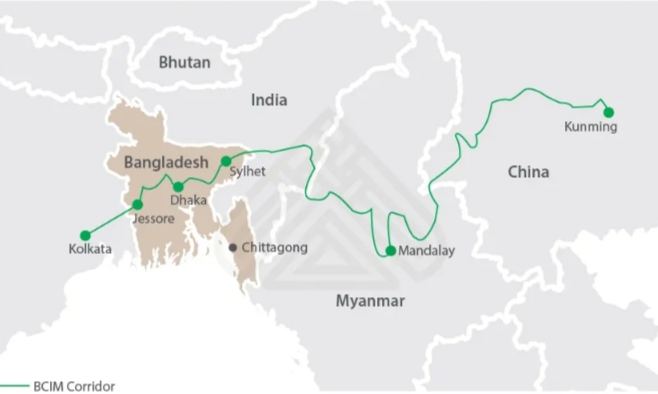
The China–Myanmar Economic Corridor (CMEC), one of the flagship components of China’s Belt and Road Initiative (BRI), has become a critical geopolitical flashpoint in South and Southeast Asia as Beijing seeks to secure direct access to the Indian Ocean while reducing its dependence on the strategically vulnerable Strait of Malacca. Stretching from Kunming in China’s Yunnan Province to the deep-sea port of Kyaukphyu on Myanmar’s western coast, the multi-billion-dollar corridor combines highways, railways, oil and gas pipelines, industrial zones, and port infrastructure into a single strategic network that could reshape regional trade and energy routes for decades.
At the center of the project is Kyaukphyu Deep-Sea Port in Myanmar’s Rakhine State, where China plans to establish one of its most important commercial gateways to the Bay of Bengal. Existing crude oil and natural gas pipelines already transport energy from Kyaukphyu directly into Yunnan Province, providing Beijing with an alternative supply route that bypasses the South China Sea and the Strait of Malacca—an area Chinese policymakers have long viewed as a strategic vulnerability in the event of regional conflict.
Chinese officials have consistently described the corridor as an economic development initiative designed to improve regional connectivity, expand trade, and stimulate growth in western China. The project also includes proposed high-speed railway links, upgraded highways, logistics hubs, and special economic zones intended to integrate Myanmar more closely into regional supply chains.
Despite its strategic importance, implementation has slowed considerably as Myanmar’s civil conflict continues to intensify. Since the military seized power in 2021, large sections of the proposed corridor have become affected by fighting between the military government and ethnic armed organizations, particularly in Rakhine State, where the Arakan Army has expanded its territorial control. Security concerns have complicated construction schedules, increased operational risks, and raised uncertainty over the protection of Chinese investments.
Beijing has repeatedly engaged in diplomatic efforts aimed at reducing hostilities and protecting key infrastructure, but analysts say continued instability remains one of the greatest threats to the corridor’s long-term viability. The deteriorating security situation has also made uninterrupted commercial transportation through parts of Myanmar increasingly difficult.
For Myanmar’s military administration, the corridor represents a major source of foreign investment at a time when the country faces international sanctions, economic decline, and diplomatic isolation. Officials expect Chinese-backed infrastructure projects to generate employment, modernize transportation networks, strengthen energy infrastructure, and expand industrial capacity. However, critics inside Myanmar have raised concerns regarding environmental impacts, transparency, land acquisition, and the possibility of long-term debt dependency linked to large-scale infrastructure financing.
Beyond Myanmar, CMEC has become an increasingly important element of strategic competition across the Indo-Pacific. India views China’s growing presence along the Bay of Bengal with caution and has accelerated implementation of its own connectivity initiatives, including the Kaladan Multi-Modal Transit Transport Project, aimed at strengthening regional access and balancing Beijing’s influence. The United States and its Indo-Pacific partners have likewise increased diplomatic and economic engagement across the region while closely monitoring China’s expanding infrastructure footprint.
The corridor has gained additional regional significance following discussions on a possible extension into Bangladesh. Chinese officials have proposed linking the existing corridor with Bangladesh’s Chattogram and Mongla ports through a future China–Myanmar–Bangladesh Economic Corridor, potentially creating a broader regional trade network across the Bay of Bengal. Bangladeshi authorities have stated that the proposal remains under evaluation and that no final decision has been announced.
Analysts say such connectivity could expand Bangladesh’s trade opportunities with western China and Myanmar through improved road and rail links. At the same time, unresolved security concerns, the ongoing conflict inside Myanmar, and the Rohingya crisis continue to pose significant diplomatic and strategic challenges for any future expansion.
As competition among major powers intensifies across the Indo-Pacific, the China–Myanmar Economic Corridor has evolved far beyond a conventional infrastructure project. It now represents a strategic intersection of trade, energy security, regional diplomacy, and geopolitical influence. While Beijing continues to advance the initiative as a cornerstone of its long-term regional strategy, the project’s ultimate success will depend on Myanmar’s internal stability, regional political developments, and the broader balance of power shaping the future of the Indian Ocean and the Bay of Bengal.
The struggle for influence in the Indian Ocean: The new rivalry between China, India and the West