
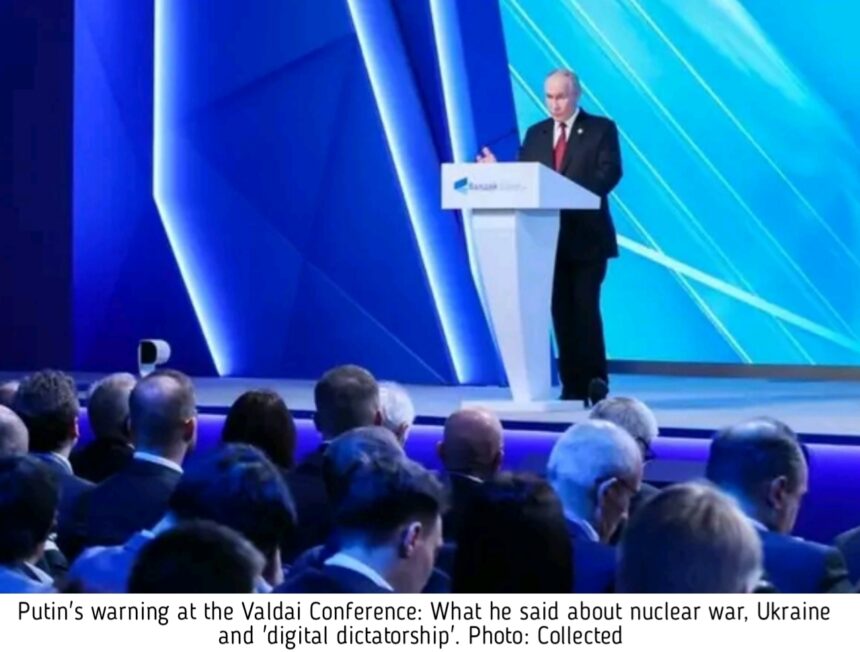
MOSCOW, Russia — Russian President Vladimir Putin used his annual address to the Valdai Discussion Club on October 1 to deliver a wide-ranging assessment of international security, the war in Ukraine, relations with the West, nuclear weapons and the rapid development of artificial intelligence.
Speaking for more than three hours at the 23rd annual meeting of the Valdai Discussion Club in the Moscow region, Putin described the international system as being in a period of profound transformation. He argued that geopolitical, economic, demographic and technological changes were creating a new global environment in which established power structures were being challenged.
The speech was closely watched because it came amid continued fighting in Ukraine, rising tensions between Russia and NATO and a renewed debate over the possibility of direct confrontation between Moscow and the Western military alliance.
One of the strongest elements of Putin’s remarks was his warning about nuclear escalation. He said a conventional confrontation between major powers could eventually develop into a nuclear conflict and urged governments to avoid a cycle of increasingly severe retaliation.
Putin also issued a direct warning concerning Kaliningrad, Russia’s western exclave located between NATO members Poland and Lithuania. He said Russia would respond with all weapons available to it if Russian territory were directly attacked, leaving open the possibility of nuclear weapons being used.
The remarks followed a Russian diplomatic warning to NATO over the possibility of the alliance attempting to isolate or cut off Kaliningrad. NATO Secretary General Mark Rutte said the alliance had responded by emphasizing its defensive posture and rejecting Moscow’s nuclear threats. Reuters reported that NATO does not assess Russia as posing an immediate threat to NATO territory.
Beyond military issues, Putin devoted significant attention to artificial intelligence. He warned that uncontrolled development and political use of AI could create what he called “digital totalitarianism,” in which algorithms controlled by others could influence individual behavior, identity and thought.
He argued that artificial intelligence could provide important benefits but insisted that ultimate political decisions should remain in human hands.
The speech therefore combined several themes that have increasingly shaped Moscow’s foreign-policy message: opposition to what Putin describes as Western dominance, support for a multipolar international order, warnings about nuclear escalation, Russia’s stated security concerns over NATO and Ukraine, and concerns about the political consequences of advanced technology.
A changing international order
Putin began by presenting the current period as a major transition in global affairs.
According to the official transcript published by the Valdai Discussion Club, he described the world as undergoing simultaneous changes across politics, technology, social structures, demographics, medicine, energy and military affairs. He argued that these developments were occurring so rapidly that governments and societies had not yet fully understood their consequences.
Putin said Russia expected the international system to move gradually away from what he called Western hegemony toward a more multipolar order.
He presented this transformation as a long-term process rather than a temporary diplomatic dispute. In his view, the rise of new economic and political centers was changing the distribution of global influence.
This argument is central to Moscow’s broader foreign-policy narrative. Russia has increasingly emphasized relations with China, India, Iran, the Gulf states, Brazil and other countries outside the traditional Western alliance system.
The Valdai Discussion Club itself reflects that international orientation. The 2026 meeting brought together participants from 40 countries, including China, India, Iran, Saudi Arabia, South Africa, Brazil, Turkey, the United Arab Emirates, the United Kingdom and the United States.
Putin argued that major technological and social changes were also contributing to uncertainty and international competition.
He warned that governments facing domestic political or economic difficulties could attempt to divert attention outward, while technological advances could create new opportunities and encourage states to take greater risks.
As a result, he said the continuation of international conflicts was likely.
Nuclear weapons and the risk of escalation
The most serious part of the speech concerned nuclear weapons.
Putin argued that the existence of nuclear arsenals creates a permanent risk that a conventional conflict between major powers could escalate beyond control.
He compared nuclear weapons to the dramatic principle known as “Chekhov’s gun,” suggesting that the continued presence of weapons capable of destroying civilization means the possibility of their eventual use cannot simply be ignored.
The Russian president called for governments to prevent such a scenario rather than assuming that nuclear weapons would never be used.
His comments came at a time when Russia and NATO remain deeply divided over the war in Ukraine and the security architecture of Europe.
The Kaliningrad issue has become particularly sensitive because of the territory’s geographic position. Russia’s exclave is separated from the rest of the country and lies between Poland and Lithuania, both members of NATO.
Putin said a direct attack on Russian territory would change the situation fundamentally.
“If it comes to a direct attack on the Russian Federation,” Putin said, referring specifically to Kaliningrad and potentially other territories, the use of all weapons available to Russia would become an immediate issue.
The statement was widely interpreted as including Russia’s nuclear arsenal.
Associated Press reported that Putin reiterated Moscow’s position that Russia does not plan to attack European countries but would respond to aggression with all weapons in its arsenal.
NATO rejects Moscow’s framing
The Russian warning has been rejected by NATO.
NATO Secretary General Mark Rutte said the alliance considers itself defensive and does not threaten Kaliningrad. He also described nuclear threats as unhelpful.
Reuters reported that NATO’s assessment remained that there was no immediate Russian military threat to NATO territory. Rutte said any major Russian attack on countries such as Finland, Poland or the Baltic states would likely be preceded by visible military preparations.
The disagreement reflects the wider security confrontation that has developed in Europe since Russia launched its full-scale invasion of Ukraine in February 2022.
Moscow argues that NATO expansion and Western military support for Ukraine have created an unacceptable security environment around Russia.
NATO and its members reject Russia’s justification for the war and have increased military preparedness in Europe while continuing to support Ukraine.
The competing positions have created a security environment in which statements about military exercises, weapons deployments, territorial access and possible future confrontation can carry significant strategic weight.
Putin’s argument about relations with the West
Putin devoted considerable attention to Russia’s relationship with Western countries.
He argued that tensions did not begin with the current Ukraine war but developed over decades following the collapse of the Soviet Union.
According to Putin, Russia attempted to establish closer relations with Western institutions after the Soviet collapse but was ultimately treated as a strategic rival rather than incorporated into a common European security structure.
He again criticized NATO’s eastward expansion and argued that Russia had been given assurances that the alliance would not continue moving toward Russian borders.
Western governments and NATO have rejected Moscow’s broader interpretation of European security arrangements and maintain that sovereign states have the right to choose their own alliances.
The dispute over NATO expansion remains one of the central issues in Moscow’s explanation of the Ukraine conflict.
Putin used the Valdai speech to reiterate that Russia considers the security interests of its own territory to be inseparable from the military alignment of neighboring countries.
Ukraine remains at the center
The war in Ukraine was another major subject of Putin’s address.
The conflict is approaching its fifth year, and Russia and Ukraine remain far apart over the conditions for ending hostilities.
Putin repeated Moscow’s argument that Russia’s military action was connected to its security concerns rather than an attempt to pursue unlimited territorial expansion.
He also reiterated Russia’s demand that Ukraine abandon its intention to join NATO and accept permanent neutrality.
At the same time, Putin said Russia was prepared to end the conflict through negotiations if an agreement could be reached on terms acceptable to Moscow.
His remarks came as Russian and Ukrainian forces continued attacks against military, energy and infrastructure targets.
Putin rejected proposals for a simple halt to long-range attacks in exchange for Ukraine stopping strikes on Russian oil facilities and other targets.
Al Jazeera reported that Putin said Moscow would prefer to resolve the conflict through negotiations but rejected what he described as an unbalanced arrangement involving a temporary halt to certain attacks.
The Russian president also acknowledged the economic effect of Ukrainian attacks on Russian oil infrastructure.
According to Reuters reporting on the speech, Putin said Ukrainian strikes on Russian oil refineries had reduced Russia’s gross domestic product by about 1%.
The Kaliningrad flashpoint
Kaliningrad occupied an unusually important place in Putin’s remarks.
The territory is Russia’s westernmost region and has significant military importance. It is geographically separated from the rest of Russia and bordered by NATO members Poland and Lithuania.
The possibility of a confrontation over access to Kaliningrad has been discussed by Russian and Western officials in recent months.
Moscow has warned that attempts to isolate the territory could trigger a military response.
Putin’s remarks went further by explicitly saying that a direct attack on Kaliningrad would raise the question of using all available Russian weapons.
Russia’s warning came after NATO received a diplomatic communication from Moscow concerning the territory. Reuters reported that Russia had warned it could use nuclear weapons if NATO attempted to cut Kaliningrad off from the rest of Russia.
For NATO, however, Kaliningrad remains Russian territory and the alliance says it has no plan to attack it.
The dispute therefore illustrates how military geography, alliance commitments and nuclear deterrence can interact in a highly sensitive region.
Warning against a cycle of retaliation
Putin repeatedly returned to the danger of escalation.
He warned that increasingly harsh retaliatory measures could create a chain of events that eventually becomes impossible to control.
The Russian president said governments should recognize that there could come a point when reversing the process becomes impossible.
His warning is particularly relevant to the Russia-NATO relationship because both sides possess large conventional military capabilities and nuclear arsenals.
The danger does not necessarily require either side to deliberately seek a nuclear conflict. Miscalculation, accidental escalation or a rapidly expanding conventional confrontation could create pressure for increasingly severe responses.
This is why statements involving nuclear weapons are closely monitored by governments and security analysts.
At Valdai, Putin presented his nuclear warning as a reason for restraint rather than as an announcement of an immediate decision to use nuclear weapons.
Putin’s warning about “digital totalitarianism”
Artificial intelligence was another major theme of the speech.
Putin warned that AI could create a form of “digital totalitarianism” if powerful algorithms were used to shape people’s behavior, identity and thinking without adequate human oversight.
He argued that AI should remain a tool rather than becoming a mechanism through which political decisions are effectively transferred to machines or controlled by a small group of institutions.
Reuters reported that Putin described the possibility of AI-driven “digital totalitarianism” as a dark and inhumane outcome comparable to historical forms of totalitarian rule.
The Russian president called for countries and communities to work together on rules governing technologies capable of influencing human behavior.
His argument reflects a broader global debate over AI governance.
Governments are currently struggling with questions involving automated decision-making, surveillance, misinformation, military applications, privacy and the control of advanced computing systems.
The issue is particularly sensitive because AI is increasingly being incorporated into national-security systems, military planning and information operations.
Putin’s comments therefore extended beyond the usual geopolitical themes of his Valdai speeches.
Human control over political decisions
One of the clearest messages in Putin’s AI discussion was that final political decisions should remain in human hands.
He argued that AI could assist governments and societies but should not become the ultimate authority over political choices.
The principle raises questions that extend well beyond Russia.
As AI systems become more capable, governments are considering how much authority should be delegated to automated systems and how humans should remain responsible for decisions involving security, justice and public policy.
The same issue has become increasingly important in military technology.
AI systems are being developed for intelligence analysis, targeting, surveillance and autonomous weapons. The possibility of machines making or influencing decisions involving the use of force has become a major international policy debate.
Putin’s warning at Valdai placed these technological concerns alongside the traditional dangers of nuclear weapons and military confrontation.
A broader message about the future
The combination of nuclear warnings, Ukraine, NATO, Kaliningrad and artificial intelligence gave Putin’s speech a broader theme: the world is entering a period in which technological and geopolitical changes are developing simultaneously.
From Moscow’s perspective, the existing international order is being challenged by the rise of new powers and the decline of what Putin calls Western dominance.
At the same time, Russia remains locked in a major war with Ukraine and a prolonged confrontation with Western governments.
The speech therefore served several purposes at once.
It reaffirmed Russia’s security narrative, warned NATO against further escalation, restated Moscow’s position on Ukraine and highlighted the risks associated with emerging technologies.
It also presented Russia as a major independent power seeking a role in what Putin described as a more multipolar international system.
What comes next
The practical consequences of Putin’s Valdai remarks will depend largely on developments on the battlefield in Ukraine and the broader relationship between Russia and NATO.
The nuclear warnings are likely to remain a central concern as long as the conflict continues and military support for Ukraine remains strong.
The Kaliningrad issue could also remain sensitive because of the territory’s geographic position and military importance.
At the same time, Putin’s comments on artificial intelligence point toward another area of international competition that is likely to grow independently of the Ukraine war.
Russia, the United States, China and European countries are all seeking greater influence over the development and regulation of advanced AI systems.
The Valdai speech brought these issues together in a single argument: technological change, geopolitical competition and military power are increasingly interconnected.
For the international community, the most immediate challenge remains preventing the Ukraine conflict and the wider Russia-West confrontation from escalating into a direct conflict between nuclear-armed powers.
Putin’s warning was explicit: continued escalation can eventually reach a point where governments lose the ability to control events.
Whether Moscow, Kyiv, Washington and European capitals can establish mechanisms to reduce that risk remains one of the most consequential questions surrounding the war.
The Valdai speech offered no simple solution. Instead, it reaffirmed the major positions that have defined Russia’s approach to the conflict while adding a broader warning about the dangers of nuclear escalation and uncontrolled technological power.
In that sense, Putin’s address was both a statement of Russia’s current strategic position and a warning about the risks Moscow believes are emerging in a rapidly changing international system.