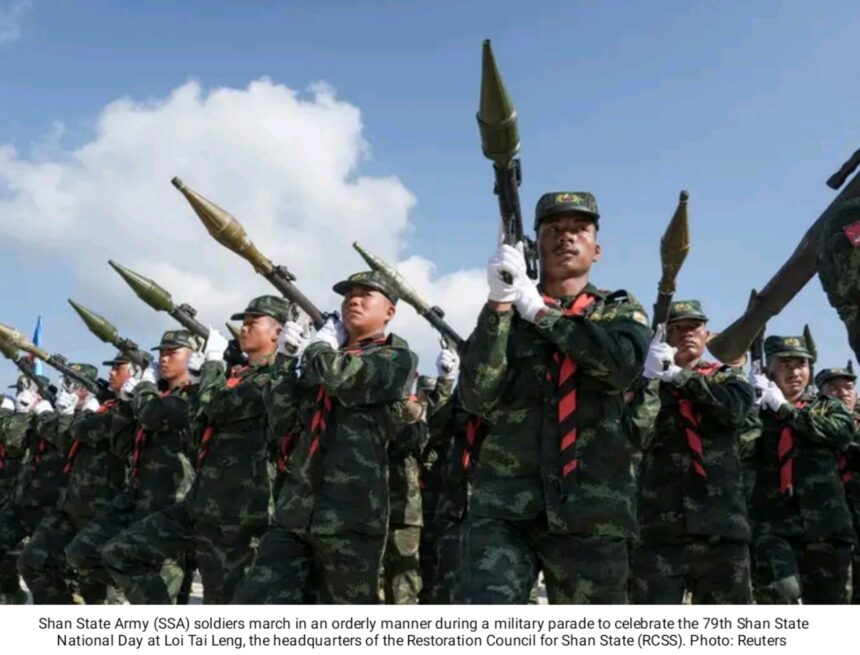
ষNAYPYIDAW, August 30, 2026: Myanmar’s military is showing signs of a significant battlefield recovery after years of territorial losses to ethnic armed organisations and pro-democracy resistance forces, with a combination of intensified air power, nationwide conscription, expanded manpower and stronger Chinese diplomatic and strategic support helping the junta regain important positions across several parts of the country. One of the clearest examples has emerged in Chin State, where opposition fighters abandoned the strategically important town of Falam in April after enduring a six-month military offensive involving more than 2,500 reported air strikes and a ground assault involving roughly 1,000 troops; the fall of Falam represented a major setback for resistance forces because the town hosts the only airport in Chin State and controls an important trade route toward the Indian border, while the military subsequently captured three additional towns in Chin and by late May claimed control of the state’s northern areas. The military’s renewed momentum has been driven in large part by its ability to use air power against resistance-held positions, allowing ground troops to advance against forces that often lack comparable aircraft, helicopters and heavy weapons; analysts say the junta has increasingly relied on air strikes as one of its most effective battlefield advantages, while recent UN reporting and conflict-monitoring data indicate that aerial attacks and other forms of military violence have continued to impose a devastating cost on civilians. Another critical factor has been conscription: Myanmar’s military activated its compulsory service law in 2024 as battlefield losses and defections depleted its ranks, and the recruitment drive has reportedly expanded the army’s manpower by tens of thousands, providing commanders with additional troops for offensives and allowing depleted units to be rebuilt after years of fighting. The recruitment system, however, has also become deeply controversial, with young people seeking to evade military service and resistance groups accusing the authorities of coercion and forced recruitment, while the broader conflict has continued to generate mass displacement and humanitarian suffering. Recent UN findings cited by Reuters indicate that at least 8,075 civilians have been killed since the 2021 coup, while internal displacement has risen to approximately 3.6 million people and 12.4 million people are facing acute hunger, underscoring the enormous humanitarian consequences of the military’s campaign to regain territory. China has emerged as another major factor in the changing battlefield equation, although Beijing’s role is complex and driven by its own security and economic interests rather than unconditional support for the junta; China has maintained influence over armed groups along its border, pressed for stability and sought to protect major infrastructure, trade routes and economic projects connecting the two countries, while diplomatic pressure from Beijing has also contributed to shifts in the behaviour of some armed organisations. In northern Shan State, for example, the military regained Kyaukme and Hsipaw in October 2025 after intense fighting, restoring an important corridor toward the Chinese border, while Lashio was also retaken after Chinese pressure contributed to the withdrawal of the Myanmar National Democratic Alliance Army, demonstrating how battlefield developments and Chinese diplomacy can interact. Yet the military’s recent advances should not be interpreted as proof that it has won the civil war: analysts describe the conflict as a broader strategic stalemate in which the junta has recovered selected territories but continues to face powerful ethnic armed organisations and resistance forces across large parts of the country. The military’s improved position therefore reflects a change in momentum rather than a decisive end to the conflict, with its reliance on air power, newly recruited personnel and external diplomatic relationships allowing it to recover ground while simultaneously exposing deep limitations in its ability to establish durable control over Myanmar’s vast and fragmented territory. The country remains divided among the military authorities, ethnic armed organisations, People’s Defence Force units and other local resistance groups, and fighting continues across multiple regions, making a rapid military victory by either side unlikely. The latest developments nevertheless mark an important turning point: a force that appeared increasingly vulnerable after major opposition advances has demonstrated an ability to adapt, replenish its manpower, exploit its air-power advantage and benefit from regional diplomacy, while China’s growing involvement in efforts to shape the conflict adds another layer to an already complex geopolitical struggle. For Myanmar’s civilians, however, the military’s territorial recovery has come with renewed displacement, air attacks, food insecurity and human-rights concerns, meaning that any battlefield gains by the junta are unfolding alongside a worsening humanitarian crisis. As the conflict enters another phase, the central question is no longer simply whether Myanmar’s military can survive, but whether its recent battlefield gains can be converted into lasting territorial control and political stability—or whether the country will remain trapped in a prolonged war in which shifting alliances, foreign influence, air power and waves of newly recruited soldiers repeatedly alter the balance without producing a decisive settlement.
Junta strikes again in Myanmar with airstrikes and forced conscription