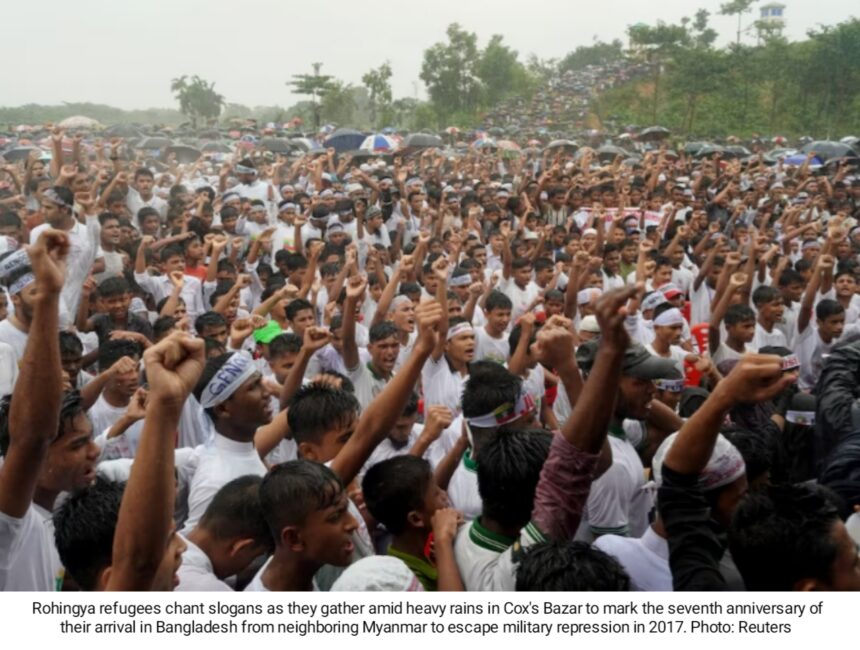
Renewed discussions over the repatriation of Rohingya refugees sheltering in Bangladesh have raised hopes of progress, but the continuing conflict and security crisis in Myanmar’s Rakhine State mean that any actual return remains highly uncertain.
Myanmar’s Ministry of Foreign Affairs said it had reviewed a list of 828,824 Rohingya submitted by Bangladesh and identified 308,797 people as former residents of Rakhine State. However, Myanmar has made clear that repatriation will not begin until security conditions in Rakhine have stabilized.
According to United Nations data, more than 700,000 Rohingya fled to Bangladesh in 2017 following a sweeping military crackdown in Myanmar. Nearly a decade later, large numbers remain in refugee camps in Cox’s Bazar, facing an uncertain future. International organizations and human rights groups have repeatedly warned that conditions for a safe, dignified and sustainable return have yet to be established in Myanmar.
Myanmar’s Foreign Ministry also said that information indicating involvement in terrorist activities had been found against 4,241 people on the verified list. In addition, the identity or citizenship status of 113,507 people could not be verified. These issues are likely to add further complexity to an already fragile repatriation process.
Bangladesh has consistently maintained that the safe, dignified and voluntary return of Rohingya refugees to their homeland is essential to achieving a lasting solution to the crisis. But the security situation in Rakhine remains the biggest obstacle.
Fighting between Myanmar’s military and the Arakan Army, an ethnic armed organization seeking greater autonomy for Rakhine, has intensified in recent years. The group has expanded its influence across large parts of the state, leaving many areas, including those close to the Bangladesh border, unstable and difficult to secure.
Myanmar has argued that Rohingya repatriation is primarily a bilateral issue between Bangladesh and Myanmar and should be handled directly by the two countries. Yet previous attempts demonstrate that administrative preparations alone cannot guarantee a successful return. Although Bangladesh and Myanmar launched repatriation initiatives in 2018 and 2019, no Rohingya refugees ultimately returned under those arrangements.
Meanwhile, Myanmar has agreed to take back around 5,000 Rohingya from Malaysia. Malaysia, however, has warned that the process will not proceed if returning refugees face serious risks to their safety.
The central question therefore remains whether Rakhine State has become sufficiently secure for Rohingya refugees to return with confidence in their lives, property, rights and future.
For Bangladesh, the Rohingya crisis is not only a humanitarian challenge but also a long-term diplomatic and security concern. The prolonged presence of a large refugee population is placing increasing economic, social and security pressure on communities in the border region. At the same time, continued fighting in Rakhine raises fears of further cross-border displacement.
Myanmar’s latest announcement should therefore be viewed as an administrative development rather than a guarantee of imminent repatriation. The recognition of 308,797 people as former residents of Rakhine State is significant, but the success of any return process will ultimately depend on whether Myanmar can provide security, citizenship and civil rights, freedom of movement, livelihoods and dignified living conditions.
Until those conditions are firmly established, the biggest question remains whether Myanmar’s latest recognition will translate into the safe and sustainable return of Rohingya refugees—or remain another step in a repatriation process that has repeatedly stalled.
Sources: Reuters; United Nations data
Myanmar agrees to take back over 300,000 Rohingya refugees in Bangladesh