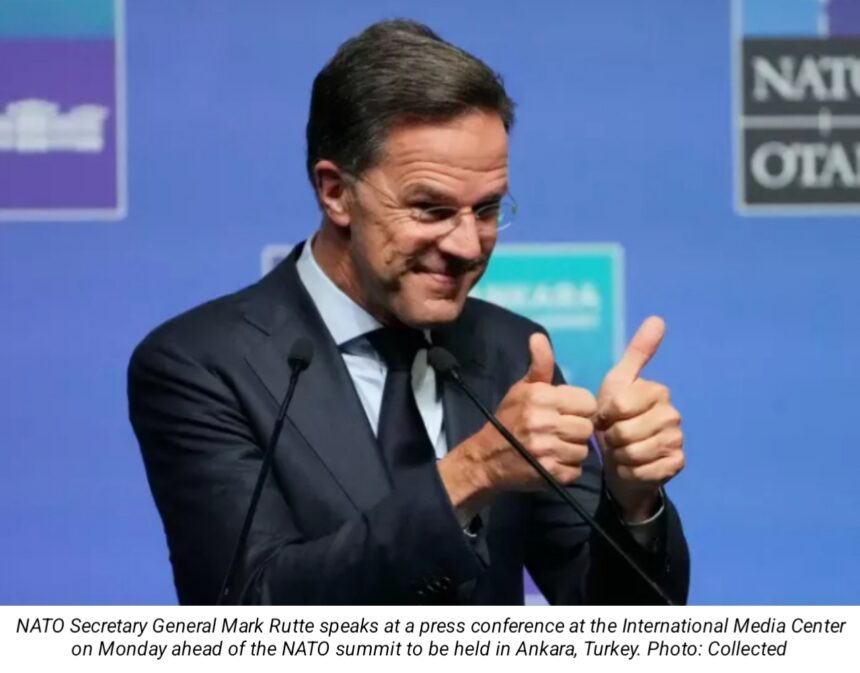
Türkiye has found itself at the center of renewed debate over NATO’s collective defense commitments after the alliance’s Secretary General was repeatedly asked whether NATO would invoke its mutual defense clause if a military conflict were to erupt between Türkiye and Israel. The exchange, which took place during a press conference in Türkiye, quickly drew attention across diplomatic and political circles, highlighting the complex security dynamics surrounding the Middle East and the North Atlantic alliance.
A journalist asked whether NATO’s collective defense provision—Article 5 of the Washington Treaty—would apply if hostilities broke out involving Türkiye, Israel and potentially Syria. Rather than providing a direct yes-or-no answer, the Secretary General emphasized that Turkish President Recep Tayyip Erdoğan is an experienced and prudent leader who would likely avoid any situation that could spiral out of control. He also described Türkiye as a highly valuable NATO ally capable of contributing to diplomacy and regional stability.
When pressed further on whether NATO would defend Türkiye if Israeli Prime Minister Benjamin Netanyahu’s actions made conflict unavoidable, the Secretary General again declined to speculate. Instead, he referred to the Hamas attack on Israel on October 7, 2023, saying it was important not to forget how that conflict began. Despite repeated follow-up questions asking whether NATO would ultimately defend Türkiye, he continued to avoid offering a definitive response, stating that he did not want to speculate about hypothetical future scenarios.
The exchange has fueled debate among political commentators and security analysts. Some argue that the Secretary General’s cautious language reflects NATO’s preference for avoiding commitments on hypothetical conflicts before specific circumstances are known. Others view the response as illustrating the political complexity surrounding any potential confrontation involving a NATO member and a close Western security partner that is not part of the alliance.
Under the Washington Treaty, Article 5 states that an armed attack against one NATO member shall be considered an attack against all. However, security experts note that the application of Article 5 is not automatic. Any response requires political consultation and consensus among the alliance’s members, with each state determining the measures it considers necessary under the circumstances. Since NATO’s founding, Article 5 has been formally invoked only once, following the terrorist attacks against the United States on September 11, 2001.
Türkiye remains one of NATO’s most strategically important members, possessing one of the alliance’s largest armed forces and occupying a critical geographic position linking Europe, the Middle East and the Black Sea region. Israel, while not a NATO member, maintains close security and defense cooperation with several NATO countries, particularly the United States. As a result, any direct confrontation between Türkiye and Israel would present an exceptionally complex diplomatic and strategic challenge.
At present, there is no direct military conflict between Türkiye and Israel, and NATO has announced no policy regarding such a hypothetical scenario. The questions raised during the press conference therefore concerned a possible future contingency rather than an existing military situation. Analysts say the Secretary General’s remarks should be viewed as a diplomatic effort to avoid escalating tensions while leaving future alliance decisions to be determined by the facts and political consultations that would exist if such a crisis were ever to occur.
NATO Chief Avoids Direct Answer on Whether Alliance Would Defend Türkiye in a Hypothetical Conflict with Israel