

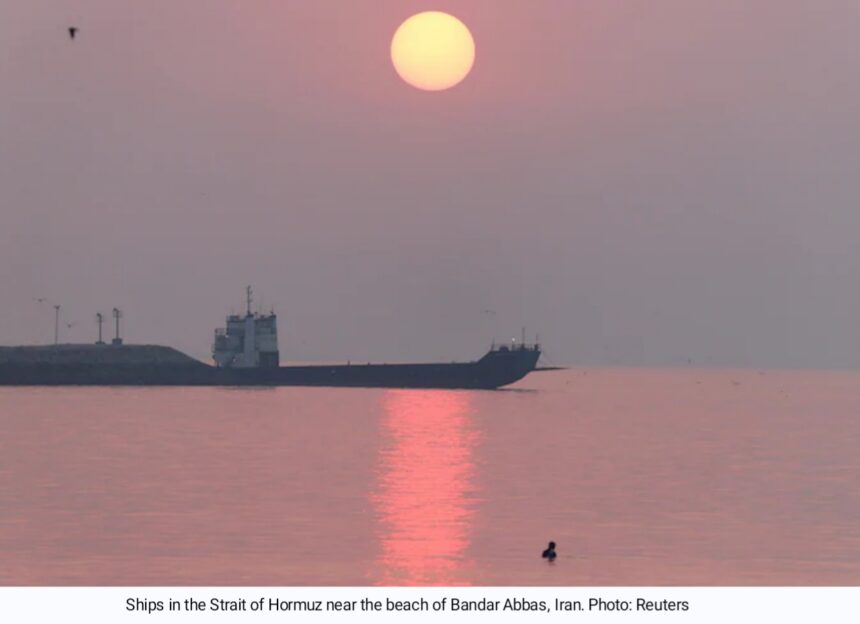
Tehran says it could reopen the vital waterway within seven days if Washington accepts its conditions, as indirect negotiations remain stalled and both sides warn against a return to military confrontation
DUBAI, October 4, 2026 — Iran has said the Strait of Hormuz will remain closed until the United States agrees to seven conditions linked to a previous interim understanding between the two countries, adding further pressure to stalled diplomatic efforts aimed at ending the conflict.
Iranian Parliament Speaker Mohammad Baqer Qalibaf said on Sunday that Tehran’s position was firm and that the strategic waterway would not be reopened until the conditions contained in a June interim agreement were fulfilled. His comments were reported by Iran’s state-linked Nournews, shortly after Tehran received Washington’s response to an Iranian diplomatic proposal.
The statement adds a new complication to negotiations that have been taking place indirectly through regional mediators. While Iranian officials continue to say that diplomacy remains possible, Tehran has made clear that reopening the Strait of Hormuz is tied directly to commitments that it expects Washington to make.
Qalibaf accused the United States of sending mixed messages through public statements while continuing to make proposals through intermediaries.
“The Americans, who say something different in the media, have recently put forward proposals through a mediator,” Qalibaf said, according to Nournews. He added that the period of delaying negotiations and imposing one-sided demands had ended.
He described Iran’s position as “completely clear and firm,” saying the Strait of Hormuz would not be opened until the seven conditions associated with the Islamabad Memorandum of Understanding were met.
The comments came as Iranian Foreign Minister Abbas Araqchi separately said that a proposal put forward by Tehran could allow the Strait of Hormuz to reopen within seven days if the United States accepted Iran’s conditions.
Speaking to foreign ambassadors and diplomats in Tehran, Araqchi said Iran had already communicated its conditions for reopening the waterway and that those conditions were connected to commitments that Washington would have to accept.
He also warned that Iran remained prepared for further military confrontation if the United States returned to military action.
“If they again move towards military solutions, we are more prepared than before and will take whatever action is necessary to defend ourselves,” Araqchi said, according to Reuters.
The contrasting elements of Tehran’s message are significant. Iran is presenting diplomacy as the preferred route while simultaneously warning that the military option remains open. At the same time, the government is linking one of the world’s most important maritime routes directly to the outcome of negotiations with Washington.
Hormuz becomes central to the negotiations
The Strait of Hormuz has become one of the most important pressure points in the US-Iran confrontation.
The narrow waterway connects the Persian Gulf with the Gulf of Oman and the wider Arabian Sea. It is a major route for energy shipments from Gulf producers to international markets. Any prolonged disruption therefore has implications far beyond Iran and the United States, affecting oil markets, shipping companies, energy-importing countries and consumers around the world.
For Iran, control over the waterway provides an important source of leverage. For Washington and its regional partners, ensuring freedom of navigation through the strait is a major strategic objective.
The dispute over the waterway has therefore become closely connected to wider disagreements involving sanctions, Iran’s nuclear programme, military activity and the future of US-Iran relations.
Earlier diplomatic efforts had attempted to separate these issues and establish a broader framework for ending hostilities. But disagreements over the sequence of concessions have continued to prevent a final settlement.
Recent reporting indicates that mediators have been working to bridge differences between Tehran and Washington, with proposals involving the reopening of the Strait of Hormuz alongside measures related to US sanctions and Iran’s nuclear activities.
The central disagreement is over what should happen first.
Iran wants commitments from Washington before fully reopening the waterway. The United States, meanwhile, has demanded assurances from Tehran on several issues before accepting an arrangement that would ease pressure on Iran.
That sequencing problem has repeatedly slowed negotiations.
Tehran says diplomacy is still possible
Despite the increasingly firm language from Iranian officials, Tehran has not closed the door to negotiations.
Araqchi’s latest comments suggest that Iran still sees a diplomatic agreement as the preferred way out of the confrontation. His warning about a possible military response was presented alongside a message that Washington could still choose diplomacy.
Iran has previously argued that sanctions relief, access to frozen assets and changes in the US military posture should form part of any agreement that includes reopening the waterway.
The Iranian position has also been that any settlement must provide reciprocal commitments rather than unilateral concessions from Tehran.
The latest developments suggest that this principle remains central to the Iranian negotiating position.
The diplomatic process has been complicated by the fact that Tehran and Washington have largely communicated through intermediaries rather than direct negotiations. Regional governments have played an important role in carrying messages between the two sides.
Qalibaf’s comments indicate that such back-channel communication remains active even though public negotiations appear to have reached an impasse.
The Iranian parliament speaker’s reference to proposals delivered through a mediator also suggests that Washington has not completely abandoned diplomacy.
At the same time, the lack of agreement over the terms means that neither side appears ready to make the concessions required for a comprehensive settlement.
Washington and Tehran remain far apart
The latest Iranian statements follow a period of disagreement over an Iranian proposal intended to provide a route toward ending the conflict.
Iranian officials have presented their plan as a framework that could produce a rapid reduction in tensions and allow commercial shipping through the Strait of Hormuz to resume.
US officials, however, have expressed dissatisfaction with the proposal and have sought wider commitments from Iran.
Earlier reports indicated that Washington wanted any agreement to address Iran’s nuclear programme and other security concerns, while Tehran has demanded sanctions relief and an end to measures that restrict its economic and maritime activity.
President Donald Trump has also publicly maintained pressure on Iran.
In late September, Trump said he expected further talks despite rejecting an earlier Iranian proposal. Iranian officials, meanwhile, said they were waiting for Washington’s definitive position before deciding their next step.
That diplomatic uncertainty remains at the centre of the current situation.
Tehran says it has now received Washington’s response to its latest proposal. But the full contents of the US response have not been publicly disclosed, making it difficult to determine whether the two sides have narrowed their differences.
What is clear is that Iran does not regard the reopening of Hormuz as a separate technical issue. Tehran is treating it as part of a broader political agreement.
The seven conditions
Iranian officials have referred repeatedly to seven conditions contained in the June interim understanding, but the full text and detailed implementation of all seven conditions have not been publicly set out in the latest statements from Qalibaf or Araqchi.
That distinction is important.
Rather than presenting a detailed list of the conditions in his Sunday remarks, Qalibaf referred to the seven conditions as a previously established framework under the Islamabad memorandum.
The lack of a publicly detailed list in the latest statement leaves significant uncertainty over exactly what Washington would have to accept before Iran considers the waterway ready to reopen.
Previous reports about the negotiations have pointed to several major areas of disagreement, including sanctions, the US naval blockade, Iranian oil exports, frozen Iranian assets and nuclear-related commitments.
But those issues should not automatically be treated as the precise wording of the seven conditions unless confirmed by the parties involved.
The broader direction of the negotiations, however, is clear. Tehran wants reciprocal steps, while Washington is seeking stronger guarantees on Iran’s nuclear and security policies.
The disagreement over these issues has prevented the two countries from converting the earlier interim arrangement into a lasting settlement.
Why the Strait matters to global energy markets
The Strait of Hormuz is important because of its role in the movement of oil and other energy products from the Gulf.
A prolonged disruption can force traders and governments to seek alternative routes, increase shipping risks and raise insurance costs. Even when physical supplies continue to move, uncertainty surrounding the waterway can have a major effect on global energy prices.
Recent developments have demonstrated that some shipments can still move through the area despite the broader confrontation.
Iraq’s state-owned Oil Tanker Company said on October 3 that it had transported 2 million barrels of Iraqi crude through the Strait of Hormuz aboard a very large crude carrier. The company described the operation as its first such movement through the waterway in decades.
That development highlights an important distinction between a formal political closure and the actual movement of vessels.
While Iranian officials have said the strait will not be reopened until their conditions are fulfilled, maritime traffic has not necessarily stopped completely. Some vessels and oil shipments have continued to move under specific circumstances.
This makes the situation more complicated for international markets.
The question is not simply whether ships can physically pass through Hormuz. It is also whether shipping companies, insurers, oil traders and governments consider the route sufficiently safe and predictable for normal commercial operations.
That uncertainty can itself have economic consequences.
Iran seeks leverage without abandoning diplomacy
For Tehran, the Strait of Hormuz is both a strategic asset and a negotiating tool.
By tying its reopening to the diplomatic process, Iran is increasing pressure on Washington and other countries that have an interest in restoring normal maritime trade.
At the same time, Tehran has an incentive to avoid an uncontrolled escalation that could damage its own economy and regional relationships.
This explains the combination of messages coming from Iranian officials.
Araqchi is emphasizing diplomacy, while warning of a stronger response to any new military action. Qalibaf is emphasizing that Iran will not reopen the strait without an agreement.
Together, the statements suggest that Tehran wants Washington to understand that reopening Hormuz will require a negotiated settlement rather than a unilateral Iranian concession.
Iran has also tried to make clear that it does not regard continued negotiations as a sign of weakness.
The government says it is prepared for military confrontation while maintaining that diplomacy offers the best path toward resolving the dispute.
The risk of renewed military confrontation
The biggest uncertainty surrounding the negotiations is whether diplomacy will continue long enough to produce a compromise.
Araqchi’s warning that Iran is more prepared than before for military action reflects Tehran’s assessment that the possibility of renewed hostilities remains real.
Washington has also maintained military pressure and has not ruled out further action.
That creates a dangerous environment in which diplomatic messages are being exchanged while military forces remain positioned in and around the region.
Any new confrontation could have consequences beyond the immediate US-Iran relationship.
The Gulf states are heavily dependent on secure maritime trade and energy exports. Asian economies rely heavily on Gulf energy supplies. European countries are also vulnerable to disruptions in oil and fuel markets.
A renewed military escalation around Hormuz could therefore affect international energy prices, shipping insurance and global trade.
The longer the diplomatic stalemate continues, the greater the uncertainty becomes.
A possible seven-day reopening
Araqchi’s statement that the Strait of Hormuz could reopen within seven days if Iran’s proposal is accepted is one of the clearest indications yet that Tehran sees a relatively rapid diplomatic pathway to restoring maritime traffic.
The seven-day timeline is significant because it suggests that Iran does not necessarily view reopening the waterway as a process that would require months of preparation.
Instead, Tehran appears to be linking the reopening to political decisions.
If Washington accepts the necessary commitments and Iran considers them satisfactory, the waterway could potentially return to broader commercial use within a short period.
But the proposal depends entirely on an agreement that has not yet been reached.
The seven-day timetable therefore represents an Iranian offer rather than a confirmed reopening schedule.
For shipping companies and energy markets, the difference is important. Until a formal agreement is reached and maritime authorities establish predictable conditions for navigation, commercial operators are likely to continue treating the region as a high-risk environment.
Pakistan’s diplomatic role
The reference to the Islamabad Memorandum of Understanding also highlights Pakistan’s role in the diplomatic process.
Pakistan has been involved in efforts to facilitate communication between Iran and the United States as regional governments seek to prevent a prolonged conflict.
The Islamabad framework became an important reference point for discussions over how the confrontation could be brought under control.
Iran’s continued reference to the memorandum suggests that Tehran views the earlier framework as a basis for future negotiations rather than something that has been completely discarded.
For mediators, this could provide a starting point for renewed discussions.
However, the two sides still have to agree on implementation, sequencing and verification.
An agreement that is politically acceptable to both governments would also have to be credible enough to survive changes in military and political conditions.
The wider nuclear dispute
The Strait of Hormuz issue cannot be separated from the wider dispute over Iran’s nuclear programme.
For Washington, nuclear restrictions and verification remain central to any long-term settlement.
For Tehran, the nuclear issue is closely connected to national sovereignty and the right to maintain peaceful nuclear activities. Iranian officials have repeatedly rejected demands that they view as unilateral or excessive.
The United States has sought stronger assurances and monitoring, while Iran has demanded reciprocal economic and political measures.
This creates a difficult negotiating equation.
A deal on Hormuz alone may not be sufficient to resolve the broader conflict. Conversely, waiting for a comprehensive settlement on every disputed issue could make it harder to achieve a quick reduction in tensions.
The challenge for mediators is therefore to find an interim arrangement that can reduce immediate risks while leaving room for negotiations on the more difficult long-term questions.
What happens next?
The immediate focus will be on the US response to Iran’s latest proposal and on whether mediators can narrow the remaining differences.
Iran’s leadership has made clear that it expects Washington to respond to its conditions before the Strait of Hormuz can be fully reopened.
Washington, meanwhile, faces a choice between continuing maximum pressure and pursuing a negotiated arrangement that could reduce the immediate risks surrounding the waterway.
The two sides have shown that they are still capable of communicating indirectly.
That means diplomacy has not completely failed.
But the language from Tehran also shows that the negotiating space remains narrow.
Qalibaf’s insistence that the period of unilateral demands is over reflects Iran’s desire for a reciprocal agreement. Araqchi’s warning of a stronger response to military action reflects the risks if diplomacy collapses.
For now, the Strait of Hormuz remains at the centre of the dispute.
Its reopening could become an early sign of a wider de-escalation, while continued restrictions would signal that the political confrontation remains unresolved.
The coming days are therefore likely to be important for both diplomacy and global energy markets.
If Washington and Tehran can agree on a sequence of reciprocal steps, the seven-day reopening proposal could provide a pathway toward restoring maritime traffic and reducing immediate tensions.
If they fail, the dispute over Hormuz could remain one of the most dangerous flashpoints in the wider Middle East conflict, with consequences extending well beyond the shores of Iran and the Gulf.
For Tehran, the message is clear: the Strait will not be reopened simply because Washington asks for it.
For Washington, the challenge is equally clear: any agreement must address the wider security concerns that have driven the confrontation.
Between those positions lies the difficult diplomatic task of finding a compromise that both governments can accept.
Until that happens, the Strait of Hormuz will remain both a vital international waterway and a powerful bargaining instrument in the increasingly complex US-Iran crisis.