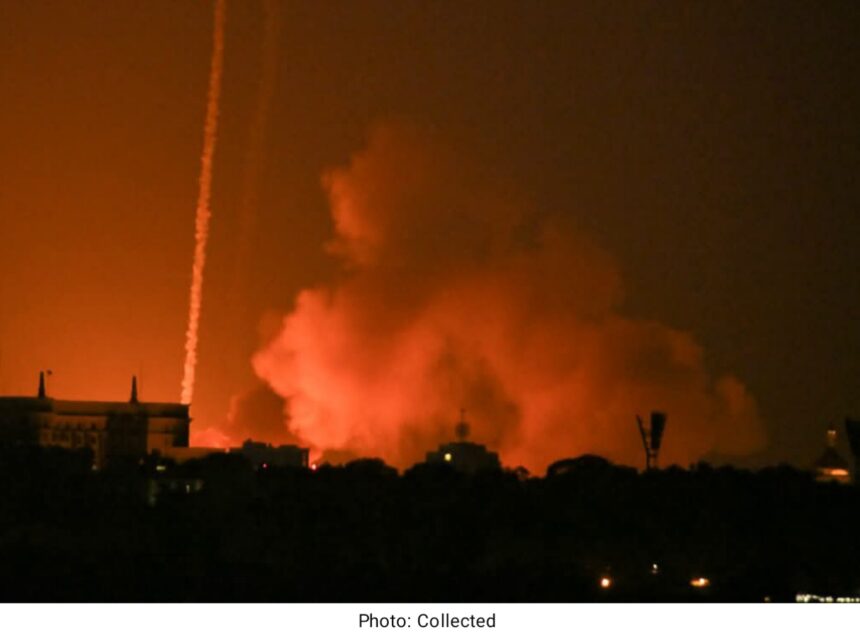
Kyiv/Moscow — Ukrainian officials say at least nine people were killed and 33 wounded in a massive Russian missile and drone assault on Kyiv and surrounding areas. Multiple explosions struck Kyiv’s Sviatoshynskyi, Solomianskyi and Shevchenkivskyi districts early Thursday, damaging residential buildings, a children’s hospital and other facilities. In Solomianskyi district, a nine-storey residential building collapsed and caught fire, with people reportedly trapped beneath the rubble. Ukraine’s emergency services launched rescue operations and said at least two people had been pulled alive from the debris. A separate attack in the Brovary district of the wider Kyiv region killed one person and wounded another. Ukraine’s air force had warned of Russian Kalibr cruise missiles heading towards the capital, while the scale of the attacks prompted heightened security measures in neighbouring NATO countries. Poland activated aircraft and air-defence systems to protect its airspace, while Romania said it detected aerial targets near the Ukrainian border and scrambled two Spanish NATO fighter jets and a Romanian military helicopter. Romania’s Defence Ministry also said a drone entered its airspace before crashing in an unpopulated area. Meanwhile, Russia’s Defence Ministry claimed that its forces had shot down 726 Ukrainian drones over Russian regions, the Black Sea and the Sea of Azov between Wednesday evening and Thursday morning, although battlefield claims from both sides remain difficult to independently verify. Alongside the intensifying military confrontation, Ukraine is also facing renewed political tensions. Former Defence Minister Mykhailo Fedorov has called for wartime elections, describing the country’s political situation as a “systemic governance crisis”. Ukrainian law currently prohibits elections while martial law remains in force, meaning national elections have been suspended since Russia’s full-scale invasion in 2022. President Volodymyr Zelenskyy’s term formally expired in May 2024, but the election has been postponed under the wartime legal framework. Fedorov’s call triggered demonstrations in Kyiv, with dozens of people demanding a renewal of the country’s leadership, although questions remain over whether free and secure elections could realistically be held while the war continues. Amid the political pressure, Ukraine’s parliament approved Yevhenii Khmara as the country’s new defence minister by a vote of 312-2, well above the required majority. Khmara, a career intelligence and security official, previously led a special operations unit within Ukraine’s security service and pledged to strengthen the country’s defence capabilities, reduce Russia’s war potential and work towards a just peace. His appointment comes as Zelenskyy’s government faces growing scrutiny over repeated changes in the military leadership and wider political tensions. The combination of intensified Russian strikes on Kyiv, a major reshuffle of Ukraine’s defence leadership and a growing debate over wartime elections is adding further complexity to the country’s political and security landscape. The latest developments underline that the Russia-Ukraine war is placing mounting pressure not only on the battlefield, but also on Ukraine’s domestic political stability and the broader European security architecture.
Russian airstrikes overnight in Kiev, 9 killed and 33 injured