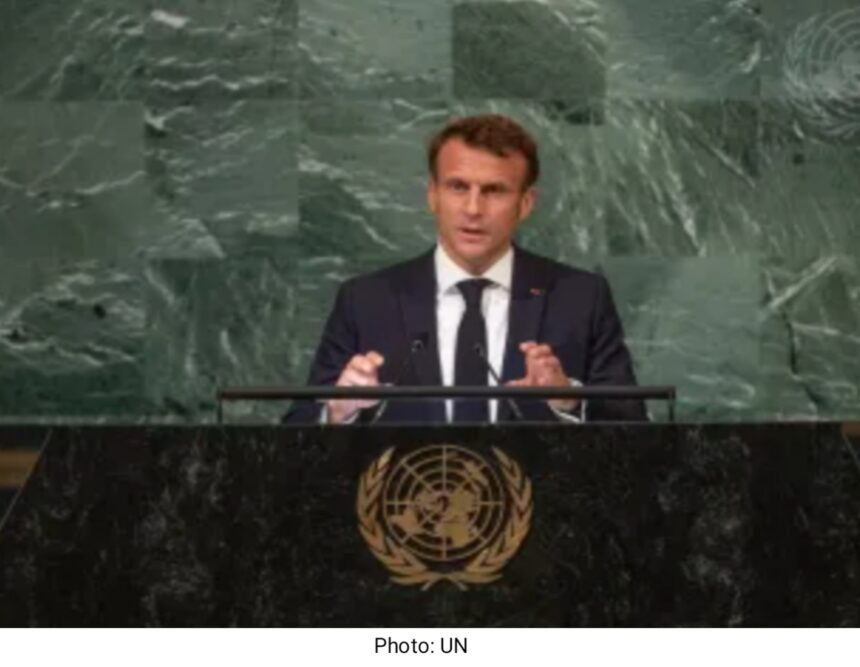
French President Emmanuel Macron has warned against what he described as a “survival of the fittest” approach to international relations, saying that the world faces a growing risk of allowing the interests and selfishness of a few powerful states to prevail over international law and collective action. Speaking at the United Nations General Assembly in New York, Macron used his address to mark the 80th anniversary of the United Nations and called for renewed efforts to preserve the international system built after the Second World War. Macron said that eight decades after the creation of the UN, the international community should take stock of its achievements and failures while protecting the ability of future generations to “dream.” He argued that the United Nations remains an important institution for addressing global conflicts and challenges and warned against a world in which power alone determines international relations. “That is the major risk of our time,” Macron said, referring to the danger of seeing the “survival of the fittest” become the guiding principle of world affairs. He also warned that the selfish interests of a small number of actors could prevail if countries abandon the principles of international cooperation and international law. Macron’s remarks came as world leaders gathered in New York for a UN General Assembly session dominated by the wars in Gaza and Ukraine, tensions in the Middle East, the future of the international system and growing disagreements over the role of major powers. The French president also addressed the conflict between Israel and the Palestinians during his diplomatic meetings in New York. In a bilateral meeting with US President Donald Trump, Macron said that Israel’s killing of Hamas leaders represented a “great achievement,” while stressing that military action alone could not resolve the Israeli-Palestinian conflict. Macron’s position reflected the French government’s stated emphasis on combining security measures with a political process aimed at addressing the broader conflict. His comments came as the question of Palestinian statehood remained a major issue at the UN, with several Western countries moving toward recognition of a Palestinian state and the United States taking a different position. Trump told the UN General Assembly that recognition of a Palestinian state amounted to a “reward for Hamas,” while other leaders argued that recognition could support a political path toward a two-state solution. The Gaza war also remained at the centre of international discussions, with humanitarian conditions in the Palestinian territory continuing to draw widespread concern. Qatar’s emir said that Israel’s attack on Doha had been an attempt to derail negotiations aimed at securing a ceasefire in Gaza, while Turkish President Recep Tayyip Erdogan told the UN that what he described as “genocide” was continuing in Gaza and condemned the humanitarian situation there. The Israeli government has rejected allegations of genocide and has repeatedly said that its military campaign is aimed at Hamas and that it seeks to protect Israeli citizens and secure the release of hostages taken during the October 7, 2023 attacks. The continuing disagreement over Gaza has highlighted the wider divide among governments over how the conflict should end and what political arrangements should follow. Macron’s UN speech therefore placed the Gaza crisis within a broader argument about the future of international relations, emphasizing the role of international institutions and rules at a time when major conflicts and geopolitical rivalries are putting pressure on the existing global order. His warning against a “survival of the fittest” world also reflected concerns over the weakening of multilateral cooperation and the growing use of military and economic power to pursue national interests. Macron called for the international community to preserve the principles on which the United Nations was founded while adapting them to current challenges. As leaders continued their meetings in New York, the debate over Gaza, Palestinian statehood, international law and the future role of the United Nations remained among the most closely watched issues of the General Assembly.
Macron warns UN amid Gaza war: Don’t let the rule of force be established in the world